


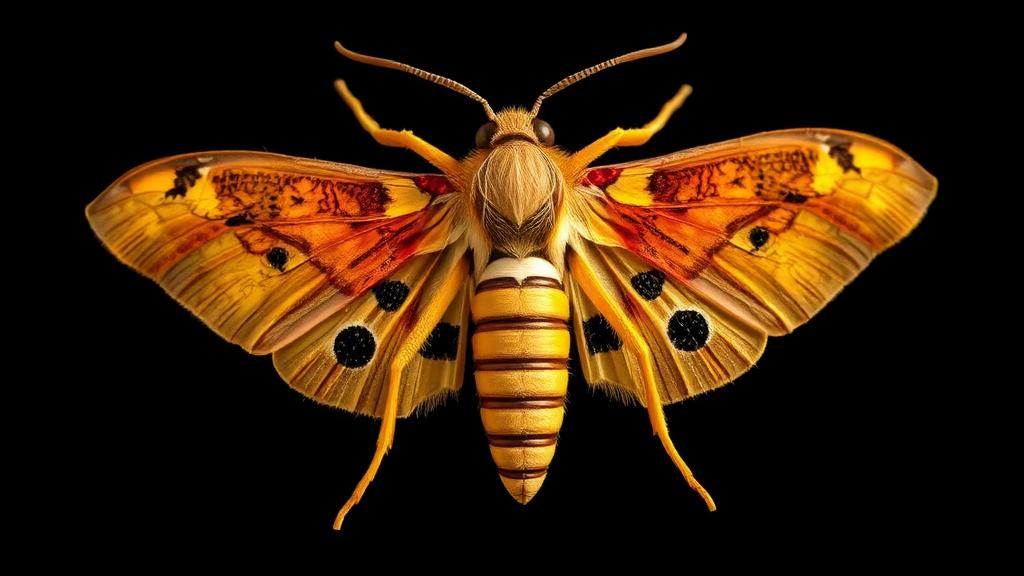
A tiny moth trapped in Eocene Baltic amber some 37 million years ago has just rewritten a chapter of butterfly and moth evolution. Researchers describing the specimen have named it Micropterix eocenica, a new species and the first confirmable record of the genus Micropterix in Baltic amber. The find matters far beyond its size: Micropterigidae, the family to which it belongs, are the most primitive lineage of all living Lepidoptera, still equipped with functional mandibles instead of the coiled proboscis that defines nearly every other moth and butterfly. A fossil of this archaic group is so rare that each new specimen is a scientific event, and this one carries a genus-level diagnosis that paleontologists have been waiting decades to confirm.
The jaw moths, as Micropterigidae are colloquially known, occupy a unique position at the base of the lepidopteran tree of life. Their adults use their mandibles to consume pollen, liverworts or, exceptionally, fern spores, a feeding strategy inherited from the earliest evolutionary experiments of the order. Fossils of the family have been described from both sediments and ambers, but finds older than the Cretaceous are restricted to sedimentary deposits. Because they are the most basal extant family, Micropterigidae are of special interest in elucidating the evolution of Lepidoptera as a whole. Every character preserved in a fossil jaw moth can illuminate how the order transitioned from mandibulate, pollen-chewing insects to the proboscis-bearing lineages that now dominate the planet.
The rarity of the new specimen cannot be overstated. In Baltic amber, Lepidoptera occur in roughly one out of 200 inclusions, and among those, Micropterigidae account for about one out of 50 lepidopteran inclusions. In the collection studied by the authors, there are 32 Micropterigidae among some 1,500 Lepidoptera. Yet among all those Micropterigidae, only this single specimen could be identified as belonging to the genus Micropterix. That combination of unique systematic position and extreme rarity underscores the relevance of reporting and identifying such finds, and explains why a forewing length of just 2.55 millimeters has generated such enthusiasm among lepidopterists and amber specialists alike.
The holotype, a male, was preserved in an irregular piece of Baltic amber measuring approximately 14 by 11.5 by 2 millimeters, recovered from the Jantarny amber mine in the Kaliningrad area of Russia. The specimen will be deposited in the Staatliche Naturwissenschaftliche Sammlungen Bayerns in Germany. The authors purchased their amber inclusions from trusted dealers known through long-term business relationships, so that authenticity is assured, and they also checked authenticity through material characteristics and the presence of typical trichomes. The inclusions were studied under incident and transmitted light with different types of microscopes and stereo magnifiers, and a stacking image was produced by the amber dealer and purchased with the specimen.
The description reveals a small, non-glossatan moth with homoneurous wing venation and jugate wing coupling, with spurs only on the hind legs in a 0-0-4 formula. The forewing length is 2.55 millimeters and the hindwing length 2.05 millimeters. The head bears erect, hair-like scales, and the semiglobular eyes are about 220 micrometers in diameter. The maxillary palpi are long, totaling about 0.88 millimeters across five segments, and the antennae reach about four-fifths of the forewing length, moniliform and unthickened, with 36 flagellomeres. The thorax and tegulae shine golden, a detail that hints at the metallic luster still seen in living members of the genus. The abdomen is partly covered by a wax-like emulsion and hidden by the right wings, a reminder of the taphonomic vagaries of amber preservation.
The wing venation, carefully reconstructed from a line drawing of the left wings, falls completely within the variability of the genus Micropterix. The preapical position of vein Rs4 in both forewing and hindwing is very indicative for Micropterix, and the presence of a jugum and humeral vein on the forewing further anchors the specimen in this archaic lineage. The hindwing shows Sc and R separate but close together, a closed cell, and Rs3 originating from one point with Rs4 from the cell. These venational details, traceable despite the distortions of amber entombment, provide the diagnostic framework that separates the fossil from related genera recently described from Bitterfeld amber.
Most significant of all, the male genitalia of a fossil Micropterix are figured for the first time in this study. The genital apparatus shows an uncus that is very short and rounded, a bulbous tegumen whose posterior margin carries six to seven moderately long, stout, unmodified setae known as accessory claspers, and valvae that are long and slender, continuously curved, apically somewhat broadened and medially slightly constricted, with a group of three to five stout and thickened setae at the distal end. These characters, the accessory claspers with a row of stout setae on the posterior margin of the tegumen and the long, slender valvae with stout, thickened apical setae, are recognized as apomorphies of Micropterix in the strict sense, as is the preapical position of Rs4 in both forewing and hindwing.
The new species is compared with Micropterix gertraudae, described from Baltic amber in 2010 but known until now only from a single female, whose placement in the genus has been doubted because it lacks clearly attributable apomorphies. Micropterix eocenica differs mainly in the presence of the crossvein Sc-R, the origin of Rs3 and Rs4 from one point in the forewing, the probable absence of crossvein M-Cu in the hindwing, and especially the preapical rather than apical position of Rs4 in both wings. The authors therefore question whether M. gertraudae belongs to Micropterix at all. Similar long and slender valvae appear in Saxomicropterix schumanni and Wichardius fossiliphilus from Bitterfeld amber, but both lack the accessory claspers and differ in uncus shape, confirming that the new male is the first true representative of Micropterix in the strict sense based on the given apomorphies.
Phylogenetically, the find provides a minimal geological age of 33.9 to 37.8 million years, the Priabonian stage of the Eocene, for the genus Micropterix. Based on ribosomal 16S RNA gene sequences, five lineages of Micropterigidae have been recognized, with basal nodes dating back into the Jurassic: Sabatinca in the strict sense, presently known from Oceania with fossils in Burmese amber; an Australian lineage assumed to be the basalmost of all; a poorly supported southern Sabatincoid Gondwana lineage; Northern Hemisphere genera occurring in North America and the eastern Palearctic, also present in Baltic amber with two species of Electrocrania; and the Micropterix lineage, the most species-rich, comprising nearly half of all described species and restricted mainly to the Mediterranean, stretching into Northern Europe and, with few species, the eastern Palearctic. The monophyly of Micropterix is strongly supported by molecular data and overall morphology, and fossils definitely belonging to the lineage were previously known only from the Priabonian of Baltic amber and from Bitterfeld amber.
It is counterintuitive that the name-giving genus of this primitive and old family would be phylogenetically young, but this can be understood given that early lepidopterology took place in Europe, which is the center of distribution of Micropterix in the strict sense. Of the nearly 80 described species of the genus, only two have reached Eastern Asia, and the majority are scattered around the Mediterranean basin. The discovery strongly supports the thesis that Micropterix is one of the youngest members of the Micropterigidae, developing not long before the Eocene in the amber forests of Europe. The climate of those forests was reconstructed as thermophilic or warm temperate, consisting of manifold conifers and Fagaceae, especially Quercus species, with a rich flora whose extant relatives live in Southeast Asia, Europe and North America. The presence of numerous heliophilous Lepidoptera, like Adelidae and Micropterigidae, indicates more or less open plant growth and somewhat constant soil humidity throughout the year, conditions known to be essential for the development of Micropterigidae larvae. No relative of the Micropterix lineage, neither extant nor fossil, is known from outside the Palearctic region, and the report from Eocene Baltic amber further confirms a European origin of the genus while providing another valuable calibration point for an extant genus within the family for which DNA analysis is possible.
Subject of Research: A fossil jaw moth from Eocene Baltic amber establishing the first confirmable record of the genus Micropterix
Article Title: Amber Lepidoptera : First confirmable record of Micropterix Hübner, 1825 from Eocene Baltic Amber ( Insecta , Micropterigidae )
Article References: Kurz, M. A., & Fischer, T. C. (2026). Amber Lepidoptera: First confirmable record of Micropterix Hübner, 1825 from Eocene Baltic Amber (Insecta, Micropterigidae). Zitteliana, 100, 163-169. https://doi.org/10.3897/zitteliana.100.187338
Image Credits: AI Generated
DOI: 10.3897/zitteliana.100.187338
Keywords: Baltic amber, Micropterix, Micropterigidae, jaw moths, Eocene, fossil Lepidoptera, paleontology, Priabonian, amber inclusions, moth evolution, Bitterfeld amber, phylogeny
Cite Scienmag News
Gavin Prescott. (October 15, 2026). Jaw Moth Sealed in Baltic Amber Reveals Ancient Origins of a Living Moth Genus. Scienmag. https://scienmag.com/jaw-moth-sealed-in-baltic-amber-reveals-ancient-origins-of-a-living-moth-genus/
Gavin Prescott. "Jaw Moth Sealed in Baltic Amber Reveals Ancient Origins of a Living Moth Genus." Scienmag, 15 October 2026, https://scienmag.com/jaw-moth-sealed-in-baltic-amber-reveals-ancient-origins-of-a-living-moth-genus/. Accessed 15 October 2026.
Gavin Prescott. "Jaw Moth Sealed in Baltic Amber Reveals Ancient Origins of a Living Moth Genus." Scienmag. October 15, 2026. https://scienmag.com/jaw-moth-sealed-in-baltic-amber-reveals-ancient-origins-of-a-living-moth-genus/


