


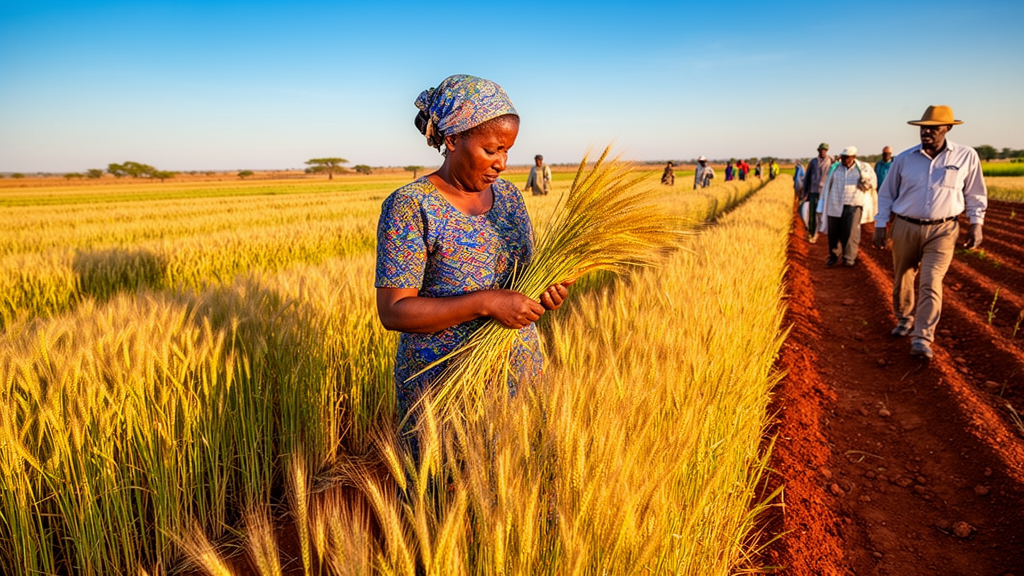
Tef, the tiny gluten-free grain that anchors Ethiopian agriculture, has become the focus of a new participatory demonstration study in the eastern Amhara region, where researchers tested an improved variety called Mena against local varieties under different management practices. The study, conducted across the Kobo, Habru, and Kalu districts of the North and South Wollo Zones, involved 18 farmers’ fields and five Farmer Training Centers. Researchers from Ethiopia’s agricultural research system worked directly with smallholder farmers to evaluate whether the improved Mena variety, paired with recommended production practices, could outperform the local varieties that farmers have relied on for generations. The findings, published in the journal Innovations in Agriculture, reveal a nuanced picture in which economic returns, farmer preferences, and site-specific conditions all shape the prospects for wider adoption of improved tef technologies.
Tef holds a singular position in Ethiopia’s agricultural economy. The self-pollinated warm-season cereal originated in Ethiopia and covers approximately 2.8 million hectares, the largest area among all cultivated crops in the country, contributing 17.57 percent to total grain production. Ethiopia produces over 95 percent of the world’s tef output, often reaching 4.8 million metric tons annually. The crop is valued for its exceptional nutritional profile, being gluten-free, rich in minerals and protein, and free from storage pests. Beyond the grain, tef straw is the most appreciated feed for cattle and is used to reinforce mud plaster for house walls and local grain storage facilities. The crop’s ecological resilience is equally remarkable, as it tolerates low moisture conditions and is often called a rescue crop because it can survive when earlier planted crops fail, making it a low-risk option for farmers facing erratic rainfall.
Despite this importance, tef productivity in the study areas remains very low due to several production constraints. Farmers face erratic distribution of rainfall, drought, diseases such as yellow rust, insect pests including shoot fly, and low adoption of improved tef production packages due to poor extension approaches. In Ethiopia, about 80 percent of the country’s 120 million population lives in rural areas where agriculture dominates the economy, providing 72.7 percent of employment opportunities and contributing 42 percent to the gross domestic product. Smallholder farmers account for 90 percent of the cultivated land, yet the sector is characterized by low productivity, traditional farming methods, and limited access to resources and markets. The Government of Ethiopia has established agricultural research institutes aimed at promoting demand-driven agricultural technologies to enhance production and alleviate food insecurity, and this demonstration initiative represents one such effort to bridge the gap between research and practice.
The study was conducted in the major tef-producing areas of eastern Amhara, with experimental sites purposively selected based on their high potential for tef production. Kobo District sits at approximately 1468 meters above sea level, Habru District at about 1825 meters, and Kalu District at 1492 meters. The areas experience a bimodal rainfall pattern with the main Kiremt season from June to September and the short Belg season from February to May. The researchers used the Farmer Research and Extension Group approach, a participatory research method in which researchers, extension workers, and groups of farmers collaboratively conduct research on selected topics based on farmers’ needs and interests directly in their fields. The experimental treatments included three management practices: the improved Mena tef variety with improved management, local tef varieties with improved management, and local tef varieties under traditional farmer management. Agronomic practices followed standard recommendations, with NPS fertilizer applied at 121 kilograms per hectare at planting and Urea at 100 kilograms per hectare in two splits.
Data collection was comprehensive, encompassing biological parameters such as grain yield, straw yield, plant height, and panicle length, economic data including market prices and input costs, and social data covering farmers’ perceptions and preferences. The researchers analyzed the data using analysis of variance through Gen Stat software, Duncan’s Multiple Range Test to compare means, partial budget analysis following CIMMYT guidelines to determine economic advantage, and pairwise ranking to analyze farmers’ preferences. Field days and field visits were organized at both the vegetative and maturity stages of the crop, during which host farmers and neighboring farmers participated in evaluating the performance of the tested technologies.
The analysis of variance results revealed no statistically significant differences in grain yield and biomass among treatments across all three districts, though numerical differences were noted. At Kobo, the Mena variety with improved management recorded the highest mean values for plant height at 119.0 centimeters, panicle length at 44.0 centimeters, biomass yield at 5.33 tons per hectare, and grain yield at 0.88 tons per hectare, with significant differences observed only for plant height. At Habru, the Mena variety showed significant differences in plant height and panicle length. At Kalu, Mena maintained its numerical advantage in grain yield at 1.36 tons per hectare and panicle length at 45.9 centimeters, although differences among treatments were not statistically significant. The coefficients of variation were relatively high in Kalu, particularly for grain yield at 38.8 percent, indicating notable variability among treatments and across locations due to pest or disease damage. These findings suggest that environmental conditions and pest or disease pressure play a crucial role in determining yield performance, even when improved varieties and management combinations can influence vegetative growth traits.
The partial budget analysis demonstrated clear economic differences among the tested treatments when evaluated using the marginal rate of return, an essential decision-making tool that measures the additional return obtained for each additional unit of cost incurred when shifting from a lower-cost to a higher-cost treatment. In Habru and Kalu districts, the improved Mena variety with recommended management produced positive marginal returns of 33.46 Birr and 1.34 Birr respectively, meaning each additional Birr invested in the improved package generated those amounts after covering additional input costs. According to CIMMYT guidelines, a marginal rate of return greater than 100 percent indicates strong economic feasibility, while below 50 percent suggests limited attractiveness. Therefore, the investment was profitable with a minimum rate of return in Habru and Kalu. However, in the Kobo district, the improved Mena variety with the full management package did not provide additional net benefit compared with the local Boset variety under farmers’ practice. This outcome may be attributed to the early maturity and high yield potential of the Boset variety under moisture-deficit conditions, which can reduce production risks and labor requirements while maintaining profitability.
Farmers’ preference analysis through pairwise ranking revealed strong and site-specific preferences for the improved Mena variety. In the Kobo district, 22 farmers participated in the selection process, and the improved Mena tef variety was the most preferred, based on panicle length, seed color, disease resistance, marketability, earliness, plant height, tiller number, and straw palatability for animal feed. The local Boset variety with improved management ranked second, while Boset under farmer practices ranked last. In the Kalu district, the final acceptability ranking showed that the Mena variety with improved management was the most preferred variety, followed by Bursa with improved management and Bursa with local management. The Mena variety’s top ranking reflects its superior performance in disease resistance, seed color, and grain size for market and consumption purposes, number of tillers, and panicle traits. However, in the Habru district, where 29 farmers participated, the local Magna variety with improved management ranked first, Mena with improved practices ranked second, and local Magna under farmer practices ranked last, suggesting that the local variety’s adaptation to specific agro-ecological conditions and cropping patterns continues to hold value in that location.
Farmers provided valuable feedback during field days, highlighting that the improved Mena tef variety possesses superior seed size and color suitable for both market and consumption, resistance to yellow rust disease, palatable straw for animal feed, and the ability to maintain green morphology even at the maturity stage. However, they expressed dissatisfaction with its loose panicle structure, which did not fully meet their preferences. In comparison, the local Magna variety in Habru, locally known as dalga tef, was appreciated for its semi-loose panicle, large seed size, high grain yield, shattering resistance, and green stalk retention. In Kalu, the local Bursa variety was praised for its white seed color, large seed size, tall plant height with compact panicles, and high productivity, though it was criticized for susceptibility to yellow rust, locally called mich, and non-palatable straw. In Kobo, the Boset variety was widely adopted due to its early maturity and high productivity, making it suitable for triple cropping systems during the Meher, irrigation, and Belg seasons, though farmers reported issues with grain shattering during unexpected rainfall at harvest.
Based on these findings, the researchers recommend scaling out the improved Mena variety with the recommended production package in Kobo and Kalu districts to create further demand, while in Habru, further adaptation trials and targeted extension support are recommended to optimize returns and align the variety with local farmer preferences. The study underscores the importance of integrating improved varieties with recommended production practices to achieve better agronomic and economic outcomes, and highlights that farmers’ preferences are strongly influenced by productivity, resilience, and market-related attributes. The superior ranking of the improved Mena variety in Kobo and Kalu demonstrates the combined advantage of genetically improved varieties and better crop management practices, while the continued value of local varieties in Habru emphasizes the need for location-specific recommendations. Continuous participatory evaluation and feedback integration should be maintained to ensure the promotion of varieties that meet both productivity and socio-economic needs of smallholder farmers in these risk-prone farming systems.
Subject of Research: Pre-extension demonstration of improved tef ( Eragrostis tef (Zucc.)) variety in mid and low land areas of eastern Amhara, Ethiopia
Article Title: Pre-extension demonstration of improved tef ( Eragrostis tef (Zucc.)) variety in mid and low land areas of eastern Amhara, Ethiopia
Article References: Haile, A., Siyum, N., Assefa, M., Mihret, T., & Bahta, M. (2026). Pre-extension demonstration of improved tef (Eragrostis tef (Zucc.)) variety in mid and low land areas of eastern Amhara, Ethiopia. Innovations in Agriculture, 9, Article e180602. https://doi.org/10.3897/ia.2026.180602
Image Credits: AI Generated
Keywords: tef, Ethiopia, agriculture, crop variety, participatory research, food security, Pre-extension, demonstration, improved, Eragrostis, Zucc, variety
Cite Scienmag News
Alan Morgan. (October 15, 2026). Improved Mena tef variety shows promise for Ethiopian farmers in field demonstrations. Scienmag. https://scienmag.com/improved-mena-tef-variety-shows-promise-for-ethiopian-farmers-in-field-demonstrations/
Alan Morgan. "Improved Mena tef variety shows promise for Ethiopian farmers in field demonstrations." Scienmag, 15 October 2026, https://scienmag.com/improved-mena-tef-variety-shows-promise-for-ethiopian-farmers-in-field-demonstrations/. Accessed 15 October 2026.
Alan Morgan. "Improved Mena tef variety shows promise for Ethiopian farmers in field demonstrations." Scienmag. October 15, 2026. https://scienmag.com/improved-mena-tef-variety-shows-promise-for-ethiopian-farmers-in-field-demonstrations/


