


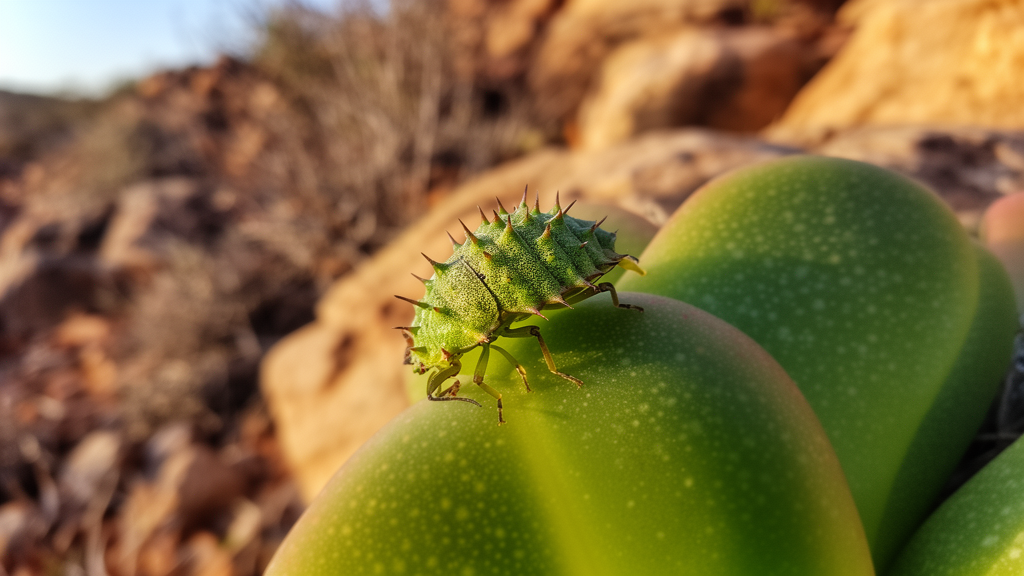
Deep in South Africa’s Western Cape, a team of entomologists collected a strange, spiny plant bug from a succulent called pig’s ear, only to suffer a flat tire on the way out. That mishap now lives on in science: the insect has been formally described as Fatumocoris flattirei, a new genus and species of plant bug associated with the succulent Cotyledon orbiculata. The name combines the Latin word for calamity or doom with the Greek word for bug, a tongue-in-cheek tribute to the field team’s doomed tire immediately after the specimens came aboard. The discovery, published in African Invertebrates, sheds light on one of the planet’s most plant-dense biodiversity hotspots and on the surprisingly rare phenomenon of plant bugs living on succulents.
The Cape Floristic Region is the most plant-dense Mediterranean-type ecosystem on Earth, with more than 9,000 plant species, roughly 70 percent of which are endemic. Yet the plant bug fauna of South Africa remains poorly documented: only about 200 species have been recorded for the entire country, and even fewer occur in the Cape region itself. Because most plant bugs with known host plants are specialists, the extraordinary floral diversity of the Cape suggests that many mirid species await description. Earlier fieldwork under the Plant Bug Planetary Biodiversity Inventory project generated around 50 drawers of specimens, but taxonomic attention focused on the subfamilies Orthotylinae and Phylinae, leaving the morphologically diverse subfamily Bryocorinae, with more than 1,000 species worldwide, largely outside the scope of those efforts.
Under a new project on the spatial phylogenomics and diet evolution of plant bugs, recent fieldwork in the Cape Floristic Region and the adjacent Succulent Karoo turned up a species that stood out immediately. Its prominent pronotal spines, wide posterior margin of the pronotum, relatively large size of 3.1 to 3.7 millimeters, and distinctive brown, white, and red coloration set it apart from all described Bryocorinae in South Africa. Notably, it is the first and only plant bug ever collected on Cotyledon orbiculata, and only the third South African plant bug genus recorded from succulents, after the genera Aloea and Eminoculus, which are associated with aloes and various Aizoaceae respectively.
Worldwide, only about 20 plant bug species are known to associate with succulent plants, making the new find genuinely unusual. Fatumocoris flattirei is only the third plant bug species with host records on Crassulaceae, the stonecrop family, joining Parthenicus sedumicola and Chlamydatus evanescens, both of which live on Sedum. The researchers classify Cotyledon orbiculata as a true host plant because nymphs were observed on it, indicating the bug uses the succulent for breeding and development rather than as a temporary perch.
Cotyledon species are toxic to mammals. They contain bufadienolides, neurotoxic compounds that cause cardiovascular and muscular problems after ingestion and may ultimately result in death. It is evident that Fatumocoris flattirei can feed on Cotyledon despite these compounds, although it remains unclear whether this tolerance is the product of coevolution or whether insects in general are unaffected by bufadienolides. Intriguingly, the stark coloration of the new bug, with its bold white circles and reddish tones, differs dramatically from its host plant, suggesting the species may be sequestering the toxins as warning colors, a hypothesis the authors flag for future testing.
The placement of the new genus was confirmed through a combination of morphological examination and molecular phylogenetics. DNA was extracted from a female specimen, the whole genome was sequenced at 20-fold coverage on an Illumina NovaSeq X Plus platform, and markers for 16S, 18S, and 28S rRNA were extracted from the filtered reads using the aTRAM pipeline. These sequences were incorporated into a recently published Sanger dataset for Miridae, producing a combined alignment of 3,192 base pairs and 203 taxa. Maximum likelihood reconstruction with IQ-TREE, supported by 10,000 ultrafast bootstrap iterations and 1,000 SH-aLRT iterations, placed the new species within one lineage of the paraphyletic tribe Dicyphini, in a fully supported clade alongside Usingerella, Cyrtopeltis miyamotoi, and Nesidiocoris tenuis.
Morphologically, Fatumocoris is diagnosed by a combination of features: its large size, a posterior pronotal margin much wider than the anterior one, a thickened first antennal segment roughly 2.75 times the width of the second, pronotal calli modified into two long spines reaching up to 0.69 millimeters in females, minimal microsculpture around the metathoracic spiracle and scent gland, and an asymmetrical pygophore whose tergal process bifurcates into prominent medial and ventral processes. Among other South African dicyphines it most closely resembles Pameridea, which lives on the carnivorous plant Roridula, but the new genus differs in size, coloration, spination, and host association. The presence of linear tarsi, fleshy pseudopulvilli, symmetrical setiform parempodia, and microsculpture around the thoracic pleura corroborates its dicyphine placement.
The description is backed by an unusually rich visual record: light microphotographs of the habitus, scanning electron micrographs of the pronotum, antennae, pretarsus, and pygophore, and detailed images of both male and female genitalia, including the L-shaped left paramere, the largely undifferentiated endosoma, and the female dorsal labiate plate with narrow sclerotized rings and serrate valvulae I. Measurements were taken from five males and five females, and genitalic dissections followed standard protocols with KOH clearing and glycerin preservation. Specimens are deposited at the Iziko South African Museum in Cape Town and the Entomology Research Museum in Riverside, California.
Community science played a starring role in mapping the new species. Beyond the 24 physical specimens collected in the field, 34 iNaturalist observations documented the bug on Cotyledon orbiculata in gardens across the Western Cape, from Cape Town and Montagu to Knysna and Pringle Bay, some dating back to 2019. Because Cotyledon orbiculata is a native species commonly planted in gardens and found across South Africa, the authors suggest Fatumocoris flattirei is likely distributed throughout the Western Cape. The iNaturalist records also provided the basis for describing the immature stages, which resemble adults but are smaller and more lightly colored, with light orange-red heads, dark brown wing buds, and rusty red abdomens, and with pronotal spines that lengthen with each instar.
The new bug was collected alongside Anoplolepis custodiens, the pugnacious ant, a crucial seed disperser in the fynbos ecosystem. The mirids and ants occupied different leaves of the same plant, and when confined together the ants attacked the mirids and removed their legs, confirming a hostile rather than cooperative relationship. Based on its color pattern and body shape, the authors judge the species unlikely to be myrmecomorphic, that is, an ant mimic. As for the aposematism question, testing whether the bug’s bold warning colors signal sequestered bufadienolides remains outside the scope of the current project, leaving a tempting mystery for the next round of Cape fieldwork, flat tires and all.
Subject of Research: Description of a new genus and species of succulent-associated plant bug from South Africa
Article Title: Fatumocoris flattirei , a new genus and species of Cotyledon -associated plant bugs from South Africa ( Hemiptera , Miridae , Bryocorinae )
Article References: Fox, M. C., Tyts, V., Schroeder, S., Hoey-Chamberlain, R., Mbanyana, N., Forthman, M., & Weirauch, C. (2026). Fatumocoris flattirei, a new genus and species of Cotyledon-associated plant bugs from South Africa (Hemiptera, Miridae, Bryocorinae). African Invertebrates, 67(2), 167-187. https://doi.org/10.3897/afrinvertebr.67.194158
Image Credits: AI Generated
DOI: 10.3897/AfrInvertebr.67.194158
Keywords: Fatumocoris flattirei, Miridae, Bryocorinae, Dicyphini, Cotyledon orbiculata, Cape Floristic Region, South Africa, succulent host plants, iNaturalist, molecular phylogenetics, Fatumocoris, flattirei
Cite Scienmag News
Gavin Prescott. (October 15, 2026). New plant bug with spiny armor discovered on toxic succulents in South Africa. Scienmag. https://scienmag.com/new-plant-bug-with-spiny-armor-discovered-on-toxic-succulents-in-south-africa/
Gavin Prescott. "New plant bug with spiny armor discovered on toxic succulents in South Africa." Scienmag, 15 October 2026, https://scienmag.com/new-plant-bug-with-spiny-armor-discovered-on-toxic-succulents-in-south-africa/. Accessed 15 October 2026.
Gavin Prescott. "New plant bug with spiny armor discovered on toxic succulents in South Africa." Scienmag. October 15, 2026. https://scienmag.com/new-plant-bug-with-spiny-armor-discovered-on-toxic-succulents-in-south-africa/


