


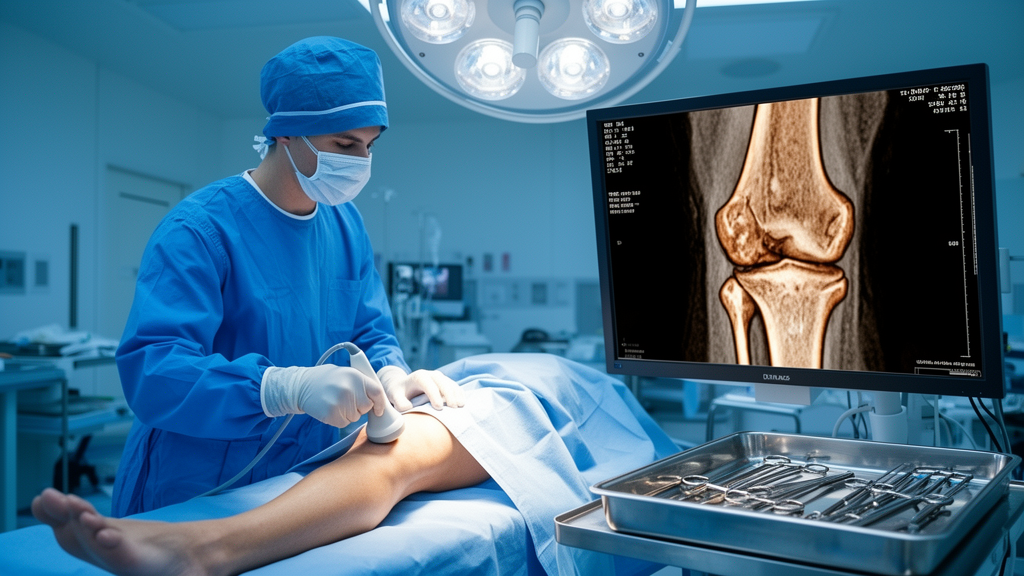
Every year, hundreds of thousands of patients undergo knee replacement or corrective knee surgery, and a growing number of those operations are guided by computer-assisted navigation systems that promise more precise implant placement and better long-term outcomes. A persistent technical headache in these procedures is the mismatch between the images surgeons plan with before the operation and the information they can gather while the patient is on the table. Preoperative computed tomography, or CT, offers a complete, high-resolution picture of the bone, but it is frozen in time. Intraoperative ultrasound, by contrast, can be swept across the exposed bone in real time, yet it delivers only partial, noisy glimpses of the bone surface. Stitching these two views together—a task known as rigid ultrasound-to-CT registration—is what allows a surgical navigation system to display the patient’s CT anatomy overlaid with live instrument positions. A new study published in BMC Medical Imaging reports a method that makes this stitching markedly more robust, at least in carefully controlled laboratory conditions.
The research, led by Shangqi Cui with colleagues Juying Huang and Zhi Yang at Capital Medical University in Beijing, introduces a framework the authors call Progressive Surface Representation and Refinement, or PSRR. The work was supported by the Beijing Natural Science Foundation, the National Natural Science Foundation of China, and the Beijing Municipal Health Commission. The core problem the team set out to solve is deceptively simple to state and notoriously hard to solve: when an ultrasound probe scans a bone during surgery, it does not see the whole surface. It sees fragments—patches of bone reflection that may be incomplete, contaminated by spurious echoes, or stretched into spatially extended echo bands that do not correspond cleanly to true anatomy. Any algorithm that tries to align those fragments with a complete CT-derived bone model must decide which ultrasound points to trust, which to discount, and how to keep the alignment from being dragged off course by bad data.
PSRR attacks this problem in stages, and its central idea is to attach a measure of confidence to every piece of ultrasound data before any alignment happens. Rather than treating each detected point on the ultrasound bone surface as equally reliable, the method builds confidence-weighted local representative points—summary locations that aggregate nearby observations according to how trustworthy they appear. Alongside each representative point, the algorithm computes an anisotropic covariance descriptor, a compact mathematical summary of how the surrounding surface points are spread out in different directions. Anisotropic means the spread is direction-dependent: a patch of bone surface that is well defined along one axis but fuzzy along another gets a covariance that reflects that asymmetry. These descriptors effectively give each ultrasound observation a fingerprint of its local geometry and its uncertainty, which the registration algorithm can exploit later when deciding how strongly each observation should pull the final alignment.
With these enriched representations in hand, the framework then estimates the rigid transformation—the six-degree-of-freedom rotation and translation that maps the ultrasound coordinate frame onto the CT coordinate frame. The word rigid is important: bone does not deform, so the registration only needs to find how one fixed shape is rotated and shifted relative to another, not how it bends. PSRR performs this estimation using progressively gated correspondences. In essence, the algorithm starts by accepting only the most confident matches between ultrasound points and the CT surface, computes an initial transformation, and then iteratively refines it. During each refinement step, the method uses surface normals computed from the CT model—the perpendicular directions that describe the local orientation of the CT bone surface—to dynamically update the target points and their covariance descriptors. This CT-normal-guided updating means that as the alignment improves, the algorithm continuously re-evaluates which CT locations the ultrasound observations should be matched to and how much uncertainty to assign to each match, rather than committing to a fixed set of correspondences from the outset.
To find out whether this staged, uncertainty-aware machinery actually delivers, the researchers put PSRR through a demanding battery of tests. They ran 120 controlled registration trials in a water-tank phantom setup—a laboratory rig in which a bone model is submerged in water to mimic the acoustic conditions of ultrasound imaging while eliminating the biological variability of real tissue. The 120 trials systematically varied two of the most punishing factors in registration: the effective overlap ratio, meaning how much of the CT bone surface the ultrasound scan actually covered, and the initial-pose perturbation level, meaning how far off the starting guess of the alignment was from the true answer. Low overlap and large initial errors are precisely the conditions that cause classical registration algorithms to fail, because with little shared surface and a poor starting point, the algorithms latch onto wrong correspondences and converge to incorrect answers. Evaluating across a grid of these conditions gives a much more honest picture of an algorithm’s reliability than a handful of easy cases.
The results were striking. Across all 120 trials, PSRR achieved the lowest overall mean average surface distance, a standard accuracy metric that measures how far the registered ultrasound surface sits from the CT surface on average. PSRR’s overall mean was 2.51 millimeters, with a standard deviation of 2.77 millimeters, and the method reached the clinically meaningful 5-millimeter accuracy threshold in 89.2 percent of trials—the highest attainment rate among all methods compared. To contextualize those numbers, the team benchmarked PSRR against five representative baseline algorithms, including the two workhorses of the point-cloud registration world: iterative closest point, universally known as ICP, and its probabilistic cousin, generalized ICP, or G-ICP. ICP, in its simplest form, repeatedly matches each point to its nearest neighbor on the other surface and re-estimates the transformation, an approach that is elegant but famously brittle when the point clouds are incomplete or contaminated with outliers. Against these baselines, PSRR reduced the all-case average surface distance by 48.6 percent relative to ICP and by 35.8 percent relative to G-ICP—substantial margins in a field where millimeters matter.
The advantages were most pronounced exactly where registration is hardest. Under low-overlap conditions, PSRR achieved a mean average surface distance of 2.57 millimeters, and under high initial-pose perturbations it recorded 4.18 millimeters, with a standard deviation of 4.21 millimeters—both the best figures among the compared methods. The team also evaluated performance using a landmark-based measure, the target registration error, or TRE, which quantifies how far specific anatomically meaningful points end up displaced after registration. PSRR yielded a mean TRE of 2.09 millimeters, again lower than ICP and G-ICP. Because surgical navigation systems ultimately care about the accuracy of the display at the location the surgeon is working on, TRE is often considered the metric most directly tied to clinical relevance, and a value just over two millimeters in a phantom setting is a promising figure for applications where implant alignment tolerances are tight.
Beyond the headline comparisons, the authors ran ablation analyses—experiments in which individual components of the method are removed one at a time to see how much each contributes. The results supported the importance of all three pillars of the framework: the confidence-weighted construction of local representative points, the CT-normal-guided refinement of target points during iteration, and the dynamic updating of covariance descriptors. In other words, the performance gains did not come from a single clever trick but from the coordinated combination of uncertainty-aware data representation and progressive, self-correcting matching. That kind of component-level validation matters, because it tells other researchers which design elements are genuinely load-bearing and worth carrying forward into future systems.
The authors are careful, appropriately, about the limits of what they have shown. The experiments were conducted in water-tank phantoms, which provide idealized acoustic conditions and eliminate the soft-tissue artifacts, shadowing, and anatomical variability that complicate real surgical ultrasound. The study’s conclusions explicitly state that further evaluation in tissue-mimicking phantoms, cadaveric specimens, or clinical settings is required before the method’s intraoperative applicability can be established. Real operating rooms introduce challenges no water tank can fully reproduce: blood and irrigation fluid on the bone surface, probe positioning constraints imposed by the surgical incision, time pressure, and the sheer heterogeneity of patient anatomy. Still, the phantom study is the right first step, because it isolates the algorithmic question—can a registration method survive incomplete data and bad initial guesses?—from the confounding factors of the clinical environment, and PSRR answered that question convincingly across 120 systematically varied trials.
If the method carries its phantom performance into more realistic settings, the implications for computer-assisted knee surgery could be meaningful. Reliable ultrasound-to-CT registration would let surgeons plan on detailed CT images and then navigate with radiation-free, real-time ultrasound updates, potentially reducing the need for intraoperative imaging and improving the precision of bone cuts and implant positioning. More broadly, the framework’s strategy of representing uncertain, partial observations with confidence weights and anisotropic covariance descriptors, and then refining correspondences progressively under the guidance of a complete reference model, is a recipe that could transfer to other registration problems in surgery—anywhere a noisy intraoperative sensor must be aligned with a rich preoperative image. The Beijing team’s work, published open access so that any lab can build on it, adds a carefully validated piece to the puzzle of making surgical navigation both more accurate and more forgiving of the imperfect data that real operations inevitably supply.
Subject of Research: Rigid ultrasound-to-CT registration for computer-assisted knee surgery
Article Title: Progressive surface representation and refinement for rigid ultrasound-CT registration: a phantom study
Article References: Cui, S., Huang, J., & Yang, Z. (2026). Progressive surface representation and refinement for rigid ultrasound-CT registration: a phantom study. BMC Medical Imaging. https://doi.org/10.1186/s12880-026-02745-x
Image Credits: AI Generated
DOI: 10.1186/s12880-026-02745-x
Keywords: ultrasound-CT registration, computer-assisted surgery, knee surgery, point cloud registration, iterative closest point, medical imaging, phantom study, surgical navigation, covariance descriptors, target registration error, BMC Medical Imaging, biomedical engineering
Cite Scienmag News
Ophelia Keating. (October 15, 2026). Smarter Ultrasound-to-CT Matching Could Sharpen Computer-Assisted Knee Surgery. Scienmag. https://scienmag.com/smarter-ultrasound-to-ct-matching-could-sharpen-computer-assisted-knee-surgery/
Ophelia Keating. "Smarter Ultrasound-to-CT Matching Could Sharpen Computer-Assisted Knee Surgery." Scienmag, 15 October 2026, https://scienmag.com/smarter-ultrasound-to-ct-matching-could-sharpen-computer-assisted-knee-surgery/. Accessed 15 October 2026.
Ophelia Keating. "Smarter Ultrasound-to-CT Matching Could Sharpen Computer-Assisted Knee Surgery." Scienmag. October 15, 2026. https://scienmag.com/smarter-ultrasound-to-ct-matching-could-sharpen-computer-assisted-knee-surgery/


