


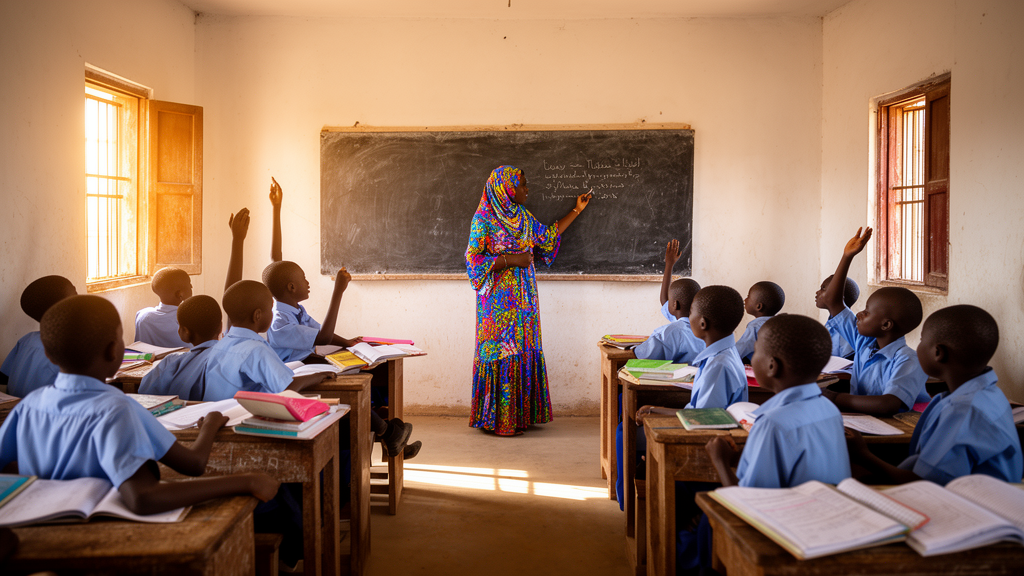
In a city rebuilding itself from three decades of conflict, researchers have now put numbers on what makes a school work. A new study of secondary education in Mogadishu, Somalia, has found that four factors—curriculum relevance, favorable student–teacher conditions, parental involvement, and teacher competence—are all significantly associated with the quality of education that students receive. The research, published in the journal Discover Sustainability, offers one of the first statistically rigorous portraits of educational quality in the Somali capital, and its findings carry weight far beyond the classroom walls, touching on global commitments to sustainable development in fragile states.
The study was led by Omar Abdi Mohamud and Mohamed Jama Mohamed of the Graduate School at SIMAD University in Mogadishu, together with Leila Mohamed Warsame and Abdirahman Ibrahim Abdi of the university’s Faculty of Education. Their work addresses a persistent gap in the literature: while access to secondary education has expanded substantially in Somalia in recent years, empirical evidence about what actually drives quality in Somali classrooms has remained scarce. Education quality, the authors note, remains a critical challenge in developing and post-conflict countries, and Somalia is a particularly striking case, having spent decades reconstructing institutions that were shattered by civil war.
To untangle the relationships between potential determinants and educational outcomes, the team employed a quantitative cross-sectional survey design. They gathered data from 239 respondents drawn from four distinct groups: students, teachers, parents, and school administrators. Participants were selected through simple random sampling within the participating schools, a technique that gives every member of each group an equal chance of inclusion and helps reduce selection bias in a setting where official records can be incomplete. The survey instrument captured perceptions and assessments across the four hypothesized determinants of quality—teacher competence, favorable student–teacher conditions, curriculum relevance, and parental involvement—alongside measures of overall education quality.
The analytical engine of the study was Partial Least Squares Structural Equation Modeling, or PLS-SEM, conducted with the software SmartPLS 4. Structural equation modeling is a family of statistical techniques that allows researchers to test networks of relationships among observed measurements and theoretical constructs simultaneously, rather than examining each variable in isolation. PLS-SEM, in particular, is favored in social science research when the goal is to explain variance in a target outcome and when constructs are measured through multiple indicators. Before testing their hypotheses, the researchers verified that the measurement model demonstrated satisfactory reliability and validity, meaning the survey items consistently and accurately captured the concepts they were intended to represent.
The results of the structural model were clear and, in one respect, surprising. Curriculum relevance emerged as the strongest predictor, with a path coefficient of β = 0.303 and a p-value below 0.001, indicating a highly significant positive association with education quality. Favorable student–teacher conditions followed closely at β = 0.273, also with p < 0.001. Parental involvement showed a significant association at β = 0.213 with p = 0.015, and teacher competence, while still significant, was the weakest of the four at β = 0.122 with p = 0.038. Together, these four hypotheses—labeled H1 through H4 in the study—were all supported by the data.
Perhaps the most striking finding for anyone who assumes that teachers are the whole story is the relative ranking. Teacher competence mattered, but it was the smallest contributor in the model. What mattered more was whether the curriculum felt relevant to students’ lives and futures, and whether the conditions surrounding the student–teacher relationship—classroom climate, mutual respect, and the day-to-day dynamics of learning—were favorable. This pattern suggests that in Mogadishu’s secondary schools, the surrounding architecture of education, from syllabus design to classroom atmosphere to family engagement, may matter as much as the individual skill of the person at the front of the room.
The model as a whole explained 58.5 percent of the variance in education quality, a statistic the researchers describe as indicating moderate explanatory power. In practical terms, this means that more than half of the differences in perceived education quality across the surveyed schools could be accounted for by the combination of these four factors, while the remainder reflects other influences not captured in the model—potentially including infrastructure, resources, leadership practices, and community conditions. For a single study in a complex, post-conflict environment, an R² of 0.585 represents a substantial and meaningful share of explained variation.
The authors situate their findings within two established theoretical frameworks: Education Production Function Theory and Systems Theory. Education Production Function Theory treats schooling as a process in which inputs—teachers, curricula, family resources—are transformed into educational outputs, allowing researchers to estimate which inputs yield the greatest returns. Systems Theory, meanwhile, emphasizes that the components of an organization are interconnected, so that a change in one part reverberates through the whole. The Mogadishu data support both views: education quality was associated with interconnected instructional, classroom, curricular, and family-related conditions rather than with any single lever pulled in isolation.
The implications reach into international development policy. The study explicitly connects its findings to Sustainable Development Goal 4, the United Nations commitment to inclusive and equitable quality education and lifelong learning opportunities for all. For countries emerging from conflict, SDG 4 has often been pursued primarily through enrollment drives—getting children through the school door. This research suggests that the harder question, what happens once students are inside, depends on strengthening curriculum implementation, investing in teacher professional development, cultivating favorable student–teacher conditions, and building genuine school–parent partnerships. The authors argue that these steps can support Somalia’s progress toward a more resilient and sustainable education system.
The research also carries a methodological significance. Conducting rigorous survey research in Mogadishu requires navigating security concerns, institutional fragility, and the practical difficulties of sampling in a rapidly changing urban environment. The study received ethical approval from the SIMAD University Centre for Research and Development Institutional Research Ethics Committee, was conducted in accordance with the Declaration of Helsinki, and obtained written informed consent from all participants, who took part voluntarily and could withdraw at any time. The work was supported by the Center for Research and Development at SIMAD University, a homegrown institution producing context-specific evidence from within Somalia rather than about it. As the country continues its long reconstruction, studies like this one provide the statistical footing on which education policy can finally stand—evidence that in the classrooms of Mogadishu, relevance, relationships, families, and teachers together shape whether quality education takes root.
Subject of Research: Determinants of secondary education quality in Mogadishu, Somalia, analyzed with partial least squares structural equation modeling
Article Title: Determinants of education quality in secondary schools in Mogadishu Somalia using partial least squares structural equation modeling
Article References: Mohamud, O. A., Warsame, L. M., Mohamed, M. J., & Abdi, A. I. (2026). Determinants of education quality in secondary schools in Mogadishu Somalia using partial least squares structural equation modeling. Discover Sustainability. https://doi.org/10.1007/s43621-026-04740-2
Image Credits: AI Generated
DOI: 10.1007/s43621-026-04740-2
Keywords: education quality, secondary education, Somalia, Mogadishu, PLS-SEM, teacher competence, curriculum relevance, parental involvement, student–teacher conditions, SDG 4, post-conflict education, Discover Sustainability
Cite Scienmag News
Violet Maxwell. (October 15, 2026). Curriculum and Classrooms Drive School Quality in Post-Conflict Mogadishu, Study Finds. Scienmag. https://scienmag.com/curriculum-and-classrooms-drive-school-quality-in-post-conflict-mogadishu-study-finds/
Violet Maxwell. "Curriculum and Classrooms Drive School Quality in Post-Conflict Mogadishu, Study Finds." Scienmag, 15 October 2026, https://scienmag.com/curriculum-and-classrooms-drive-school-quality-in-post-conflict-mogadishu-study-finds/. Accessed 15 October 2026.
Violet Maxwell. "Curriculum and Classrooms Drive School Quality in Post-Conflict Mogadishu, Study Finds." Scienmag. October 15, 2026. https://scienmag.com/curriculum-and-classrooms-drive-school-quality-in-post-conflict-mogadishu-study-finds/


