


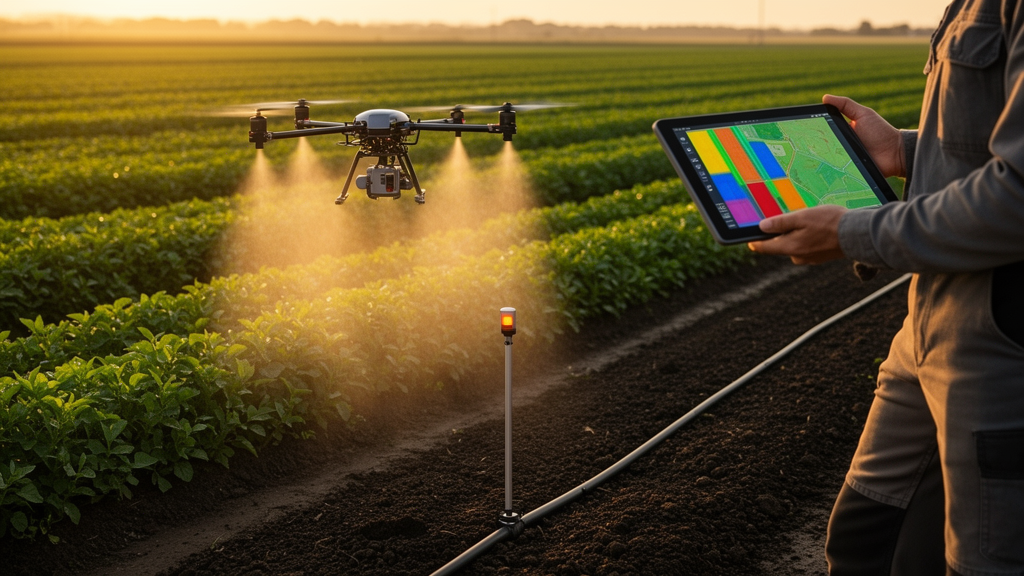
Agriculture is the thirstiest industry on Earth, drawing roughly 70 to 80 percent of all freshwater extracted worldwide, and much of that water never reaches a crop. Gravity-fed systems such as basin, border and furrow flooding can lose nearly 60 percent of applied water to runoff, evaporation and deep percolation, while farmers who irrigate by fixed calendars or a glance at wilting leaves routinely drown or starve their fields. The consequences are measurable: groundwater tables are dropping 4 centimeters per year in Punjab, India, 1.5 meters per year in California’s Central Valley and 6 centimeters per year in the North China Plain, and models project that 52 percent of global cropland will face extreme water stress by 2070. A sweeping review published in Frontiers in Water argues that the fix is no longer a single gadget but a converged stack of sensors, imaging, artificial intelligence, variable-rate irrigation and field robotics that senses, predicts and acts in a closed loop.
The core problem the review identifies is that crop water demand is wildly variable in space and time. It shifts with species, growth stage, soil texture, weather and plant water status; maize needs about 4,800 cubic meters per hectare per season against roughly 4,000 for wheat, and reference evapotranspiration rising from 4.5 to 6.2 millimeters per day can inflate irrigation needs by 31 percent. Uniform application and single-parameter scheduling ignore this heterogeneity, producing over-irrigation that causes waterlogging, salinization and nutrient leaching, or under-irrigation that suppresses photosynthesis and yield. Even the standard FAO-56 crop-coefficient method can overestimate water needs by more than 25 percent during tillering in certain regional conditions, which is precisely the kind of error that data-driven systems are built to correct.
At the foundation sit the soil sensors. Capacitive and frequency-domain reflectometry probes estimate volumetric water content from the dielectric permittivity of soil, exploiting the enormous contrast between water (about 80), dry soil (3 to 5) and air (1), while time-domain reflectometry times an electromagnetic pulse to reach roughly plus-or-minus 2 percent accuracy. Tensiometers track matric potential at up to 85 kilopascals, neutron probes profile moisture down to 3 or 4 meters, and multi-depth networks at 15, 35 and 50 centimeters can define the active root zone and prevent deep percolation. In one semi-arid sweet corn trial, capacitive sensors triggering irrigation at specific soil-moisture thresholds raised grain and stalk yields by about 12 and 15 percent respectively while saving up to 24.5 percent of water compared with conventional evapotranspiration-based scheduling.
Plant-based sensors go further by listening to the crop itself. Infrared thermometry detects the canopy temperature rise that follows stomatal closure, sap-flow probes measure xylem water movement, dendrometers log stem and fruit swelling, and leaf patch clamp pressure sensors track turgor. Electrophysiological sensors are the most striking: they pick up rapid plant electrical responses to moisture changes within 1 to 5 minutes, and when a convolutional neural network classified those signals into irrigation levels it achieved 83 percent accuracy with 10 to 20 percent lower water use, all without damaging tissue. Because such indicators can flag stress 3 to 7 days before visible wilting, they shift irrigation from a rescue operation to a preventive one; in vineyards, pairing thermal-dissipation sap-flow probes with internet-of-things systems cut water use by 20 to 30 percent, and continuous stem water potential monitoring in olive and almond improved water-use efficiency by 25 to 35 percent without yield loss.
Above the field, imaging scales the picture. Satellites such as Sentinel-1 and Sentinel-2, Landsat-8/9, MODIS and ECOSTRESS deliver vegetation indices, land surface temperature and evapotranspiration estimates across entire basins, with synthetic aperture radar penetrating clouds to sense shallow soil moisture. Below the clouds, unmanned aerial vehicles fly 1 to 10 centimeter resolution surveys using RGB, multispectral, hyperspectral, thermal and LiDAR payloads, building canopy maps, digital surface models and water-stress hotspot zones. Hyperspectral imaging, capturing hundreds of narrow bands from 400 to 2,500 nanometers, can detect drought up to 10 days before symptoms appear; in pearl millet it identified the 670 to 780 nanometer range as most sensitive to water stress, and support vector machines reached 95.38 percent classification accuracy, still 80.76 percent at the earliest stress stage. Even a drone-mounted ground-penetrating radar platform has mapped soil moisture non-invasively to two depths using a 1D convolutional neural network.
The AI layer turns this data flood into decisions. Long short-term memory networks forecast soil salinity and moisture with R-squared values of 0.97 and 0.92 in rice and maize; a hybrid CNN-LSTM-attention model for rice alternate wetting and drying scheduling delivered R-squared of 0.988 and water savings of 16.5 to 37 percent; and Random Forest evapotranspiration models for sugarcane hit R-squared of 0.99. Reinforcement learning, including soft actor-critic algorithms, adapts irrigation under constrained water allocations, while model predictive control optimizes irrigation depths under shifting weather. Random Forest demand prediction achieved R-squared of 0.93 for maize and 0.91 for wheat with 30 and 27 percent water savings respectively, and a fuzzy controller fusing canopy temperature-based water stress index with root-zone soil moisture slashed water use by 59.61 percent, energy use by 67.35 percent and still raised lettuce yield by 22.58 percent.
Execution falls to precision irrigation hardware and robots. Variable-rate technology uses electrical-conductivity-based management zones, GIS prescription maps and GPS-guided center-pivot or nozzle control; a GIS-zoned system increased crop yield 13.4 percent while cutting fertilizer by 16 percent and water intake by 12.5 percent, and a retrofittable variable-rate applicator controller achieved about 96 percent discharge accuracy. Digital twins close the loop: the DT-SIS twin delivered 38 percent water savings with 16 percent higher yield than manual scheduling, and the Irri_DesK decision-support system cut irrigation water use 26 percent and monitoring labor 80 percent. On the ground, platforms such as VineScout map grapevine water status at 2.3 points per square meter, an optical soil-image irrigation robot achieved 58.57 percent water savings over flood irrigation and 86.97 percent over conventional drip, and wearables plus a Niryo robot arm reduced water use 10 to 20 percent by reading electrophysiology directly.
The integration, not any single technology, is the real scientific insight. Sensors quantify the water status, imaging extends it spatially, IoT and edge-cloud platforms move the data with ESP32-class controllers making local decisions even when connectivity drops, machine learning predicts demand and stress, digital twins rehearse scenarios, variable-rate systems apply water only where needed, and UAVs and ground robots fill the gaps with mobile sensing and intervention. Wireless sensor networks combined with closed-loop automated irrigation consistently report water savings of 15 to more than 30 percent, soil-moisture-based drip reduced paddy rice water use by 41.5 percent versus flooding, and a Raspberry Pi CatBoost controller raised yield 16.85 percent while improving irrigation water-use efficiency 8.77 percent in cherry tomato.
The honest caveats are substantial. Point soil sensors misrepresent field heterogeneity and drift over time; UAVs remain limited by battery life, payload and weather; satellites struggle with clouds and mixed pixels; low-power IoT devices carry weak cryptography, with more than 8 percent of sensor observations lost to communication dropouts in some rural deployments; and AI models rarely transfer across crops, soils or regions without retraining. Deficit irrigation without drainage planning can accelerate salinization, and alternate wetting and drying in rice, while cutting methane, can raise nitrous oxide emissions. High upfront costs and fragmented, proprietary data formats still block many farmers, particularly smallholders, from participating. The authors argue the path forward runs through biodegradable sensors, TinyML edge intelligence, standardized open datasets, federated learning for privacy-preserving model training, explainable AI for farmer trust, and policy tools such as subsidies, low-interest loans and cooperative digital infrastructure. If those pieces mature, the review concludes, irrigation can finally become what it has always pretended to be: exactly the right water, in exactly the right place, at exactly the right time.
Subject of Research: Integration of sensors, imaging, artificial intelligence and robotics for precision irrigation in agriculture
Article Title: Smart water management in agriculture: convergence of sensors, imaging, AI, precision irrigation, and robotics systems
Article References: Smart water management in agriculture: convergence of sensors, imaging, AI, precision irrigation, and robotics systems. (n.d.). https://doi.org/10.3389/frwa.2026.1973897
Image Credits: AI Generated
DOI: 10.3389/frwa.2026.1973897
Keywords: precision irrigation, artificial intelligence, soil moisture sensors, remote sensing, drones, digital twins, agricultural robotics, Internet of Things, crop water stress, water-use efficiency, machine learning, variable-rate irrigation
Cite Scienmag News
Alan Morgan. (October 15, 2026). AI, Drones and Sensors Are Rewriting How Farms Drink. Scienmag. https://scienmag.com/ai-drones-and-sensors-are-rewriting-how-farms-drink/
Alan Morgan. "AI, Drones and Sensors Are Rewriting How Farms Drink." Scienmag, 15 October 2026, https://scienmag.com/ai-drones-and-sensors-are-rewriting-how-farms-drink/. Accessed 15 October 2026.
Alan Morgan. "AI, Drones and Sensors Are Rewriting How Farms Drink." Scienmag. October 15, 2026. https://scienmag.com/ai-drones-and-sensors-are-rewriting-how-farms-drink/


