


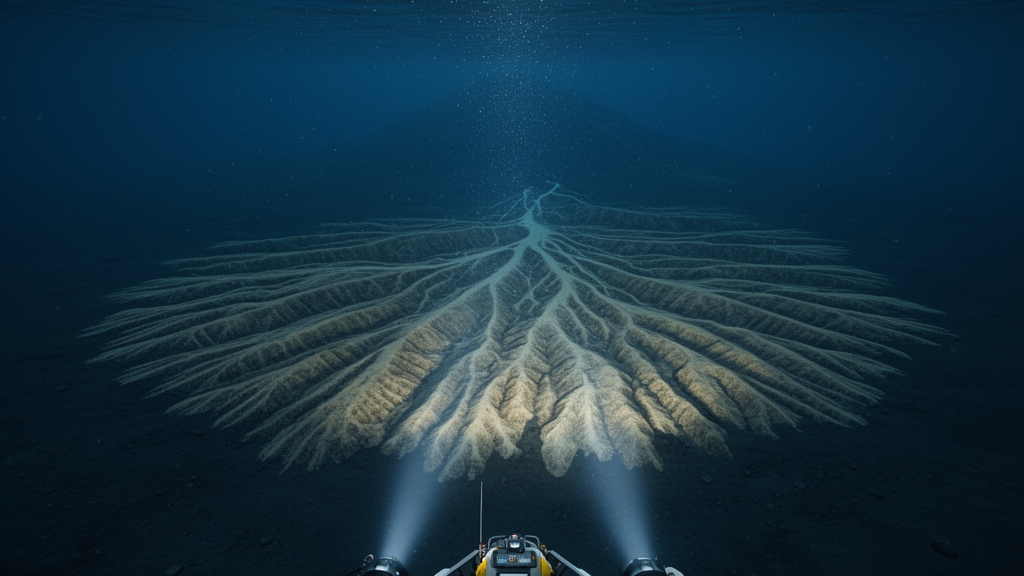
Deep in the Bay of Bengal, at water depths of nearly three kilometers, an international research team has discovered the true endpoint of Earth’s largest submarine fan. The Bengal Fan, a colossal deposit of Himalayan sediment covering three million square kilometers with a maximum thickness of 16.5 kilometers, has long been assumed to carry its active sediment channel all the way to the lower fan. New findings from the SO304 expedition aboard the research vessel SONNE, published in Communications Earth & Environment, overturn that assumption. The team, led by Pauline H. Cornard of MARUM–Center for Marine Environmental Sciences at the University of Bremen, identified an avulsion of the active channel in the middle fan that shifted the terminal sediment sink roughly 1,800 kilometers landward, forming a modern terminal lobe complex located only about 1,280 kilometers south of the Ganges–Brahmaputra–Meghna river mouths.
The discovery matters because the Bengal Fan is one of the very few giant submarine fans on Earth that is still active today. It is fed by the Ganges and Brahmaputra rivers, which drain the Himalaya, together with the Lower Meghna River, delivering one of the largest sediment discharges on the planet at roughly 1.1 gigatonnes per year. Under current highstand conditions, only about 30 percent of that enormous sediment mass reaches the Swatch of No Ground, the shelf-incised canyon that funnels material into the fan’s channel-levee system, while the majority is trapped in the floodplain and delta. For decades, scientists used the fan and its apparently active channel as a modern laboratory to study channel-levee growth, Himalayan erosion and the regional carbon cycle, all premised on the idea that sediments traveled to the distal reaches of the system.
The newly mapped lobe complex consists of two lobes, named the Northeastern and Southern lobes, separated by a 30-meter-high slope break related to the topography of an old meandering channel-levee system. The Northeastern Lobe covers an area of 1,352 square kilometers with a maximum thickness of 15 meters, plus or minus 2 meters, and a total volume of 5.43 cubic kilometers. It is incised by the currently active channel and overlain by levee deposits, indicating that it developed during an earlier stage of the complex. The Southern Lobe, which lies at the end of the channelized system and shows the lowest backscatter intensities, covers 877 square kilometers with a maximum thickness of 20 meters and a volume of 2.65 cubic kilometers. Both lobes are relatively thin, less than 20 meters, but cover remarkably large areas, up to 1,350 square kilometers, rivaling the scale of lobes in other giant submarine systems such as the Amazon, Congo and Rhône fans.
The Southern Lobe is divided by a topographic high, formed by the banks of an ancient channel, into a confined and an unconfined sub-lobe. The confined sub-lobe, constrained by abandoned channel banks, exhibits an elongated shape with an aggradational stacking pattern, meaning deposits pile vertically on top of one another to greater thicknesses. The unconfined sub-lobe, in contrast, shows a radial shape spanning a larger area with a compensational stacking pattern, in which each new lobe element fills the low spots left by previous flows. Both exhibit stacked, meter-thick, lens-shaped lobe elements interpreted as the products of sediment-gravity flows. A network of surficial distributary channels, only 5 to 6 meters deep and 20 to 30 meters wide, feeds the unconfined sub-lobe and is highlighted by lower backscatter intensities that indicate recent deposition.
Sediment cores recovered from both lobes confirm that the complex is genuinely modern. The presence of excess lead-210 within the surficial fine-grained part of the turbidites indicates that the sediment has been deposited within the past 150 years. The turbidites show a characteristic bipartite facies: a sandy base with abundant plant debris, separated by a sharp grain-size shift from an overlying silty interval 10 to 20 centimeters thick. These deposits likely originated from high-density turbidity currents whose dense basal layers overspilled the levees of the active channel, which reaches heights of about 18 meters near the core sites. Radiocarbon dating of a gravity core through the Southern Lobe indicates that the three most recent flow events occurred within the last roughly 400 years, while dating of the hemipelagic sediments beneath the lobe shows it must be younger than about 12.25 thousand calibrated years before present.
Optically stimulated luminescence dating of quartz grains within the first turbidite deposited in the Southern Lobe yielded an age of about 10.80 thousand years before present, constraining the onset of the lobe to the Early Holocene. That timing coincides with a major constructional phase of the upstream channel-levee system, between 14.5 and 9.2 thousand calibrated years before present, which has been linked to a strengthening of the southwest monsoon and increased erosion rates in the Himalaya during a period of rapid global sea-level rise. The rapid sea-level rise following the last deglaciation likely progressively disconnected the river system from the canyon head, reducing sediment supply to the deep sea after about 9.2 thousand years before present. This suggests that sediment delivery to the lobes may be considerably lower today than it was during the Early Holocene, even though the Bengal Fan has remained continuously active independently of sea-level cycles since the Middle Pleistocene.
While monsoon strength and sea level regulate how much sediment reaches the fan, the morphology and evolution of the lobe complex probably results from the interaction of these external forcings with internal drivers such as autogenic processes and inherited topography. Enhanced sediment discharge during the Early Holocene likely increased the frequency and magnitude of sediment-gravity flows, accelerating the decrease in accommodation space and local slope gradient of the Northeastern Lobe, causing flows to divert toward steeper-gradient areas. Ancient channel banks promoted channel incision and progradation into the Northeastern Lobe deposits and directed the downstream evolution of the Southern Lobe, producing a progradational, forward-stepping stratigraphic pattern with no lobe overlap. Although such stacking patterns had been documented in mud-rich systems like the Congo Fan, this study shows that comparable patterns also occur in a more sand-rich system.
Perhaps the most striking implication concerns where the sediment actually goes. The Southern Lobe constitutes only a minor volume of about 2.65 cubic kilometers, compared with the upstream channel-levee system, which accumulated a minimum of roughly 1,083 cubic kilometers of sediment over the last 11 thousand years. Under present-day highstand conditions, the lobe complex does not represent the main depocenter of the Bengal Fan, as sediments predominantly accumulated on the upstream levees. This pattern is especially evident between the avulsion point at 16 degrees north and the lobe complex onset, where the channel shallows from about 60 meters to about 20 meters, facilitating overspill and impeding efficient sediment delivery to the lobe environment. The initiation of the Southern Lobe also coincides with a decline in sediment accumulation rates on the lower fan, from about 60 to 20 centimeters per thousand years on distal levees, which had previously been attributed to late deglacial sea-level rise. The new findings instead suggest that an upstream avulsion disrupted the supply pathway to the lower fan.
The comparison with the Congo Fan, the only other currently active giant fan worldwide, reveals how hinterland characteristics shape lobe morphology. Although the Congo’s modern lobe complex is younger, at about 4 thousand calibrated years before present, it resembles the Bengal complex in source-to-lobe distance, channel slope gradient and progradational stacking pattern. Two key differences stand out. Sands dominate the Bengal lobe bodies, whereas in the Congo lobes they are restricted to channels, and the Bengal lobes show a high occurrence of distributary channels. Sand is likely transported efficiently from the relatively steep Himalayan hinterland to the Bengal Bay, whereas much of the Congo’s sand becomes trapped in lakes within its relatively flat hinterland, resulting in more mud-rich flows. Mud-rich flows tend to build and maintain shallow channels, allowing flows to travel farther and produce more elongated depositional geometries, while sand-rich flows induce frequent channel avulsion, resulting in more widely spread deposits. This explains why the Bengal lobes, with a length-to-width ratio of about 2, cover a larger area than the Congo lobes but have relatively small volumes of less than 5 cubic kilometers, likely reflecting episodic flows, the disconnection between feeding rivers and canyon head, and the trapping of at least a third of the river sediments on the continental shelf.
Identifying the modern sediment sink of the Bengal Fan establishes the closure point of the largest source-to-sink system on Earth, with direct implications for future investigations of sediment dynamics, sediment budgets, and marine litter and carbon fluxes along the complete onshore-offshore transect. Such integrated perspectives are essential for hazard assessments in one of the world’s most densely populated and environmentally sensitive coastal regions, where subsidence, ongoing sea-level rise, monsoonal changes and anthropogenic activities strongly influence sedimentary and biogeochemical dynamics. The discovery also opens critical opportunities for studying deep-sea processes in real time, offering insights into submarine fan dynamics worldwide, from how catastrophic slope failures in the steep upper canyon flush material seaward to how the dense cores of turbidity currents overspill channel levees and build sandy lobes nearly three kilometers beneath the ocean surface.
Subject of Research: The active Bengal lobe complex as the modern terminal sink of Earth’s largest submarine fan
Article Title: The active Bengal lobe complex as the modern terminal sink of Earth’s largest submarine fan
Article References: Cornard, P. H., Schwenk, T., Feddersen, G., France-Lanord, C., McHugh, C., Hanebuth, T. J. J., Kudrass, H. R., Römer-Stange, N., Wei, B., Geibert, W., Zander, A., Spieß, V., & Miramontes, E. (2026). The active Bengal lobe complex as the modern terminal sink of Earth’s largest submarine fan. Communications Earth & Environment, 7(1), Article 745. https://doi.org/10.1038/s43247-026-04037-2
Image Credits: AI Generated
DOI: 10.1038/s43247-026-04037-2
Keywords: active, Bengal, lobe, complex, modern, terminal, sink, Earth, largest, submarine, scientific research
Cite Scienmag News
Violet Maxwell. (October 15, 2026). Earth’s Largest Submarine Fan Ends 1,800 Kilometers Early, New Lobes Reveal. Scienmag. https://scienmag.com/earths-largest-submarine-fan-ends-1800-kilometers-early-new-lobes-reveal/
Violet Maxwell. "Earth’s Largest Submarine Fan Ends 1,800 Kilometers Early, New Lobes Reveal." Scienmag, 15 October 2026, https://scienmag.com/earths-largest-submarine-fan-ends-1800-kilometers-early-new-lobes-reveal/. Accessed 15 October 2026.
Violet Maxwell. "Earth’s Largest Submarine Fan Ends 1,800 Kilometers Early, New Lobes Reveal." Scienmag. October 15, 2026. https://scienmag.com/earths-largest-submarine-fan-ends-1800-kilometers-early-new-lobes-reveal/


