


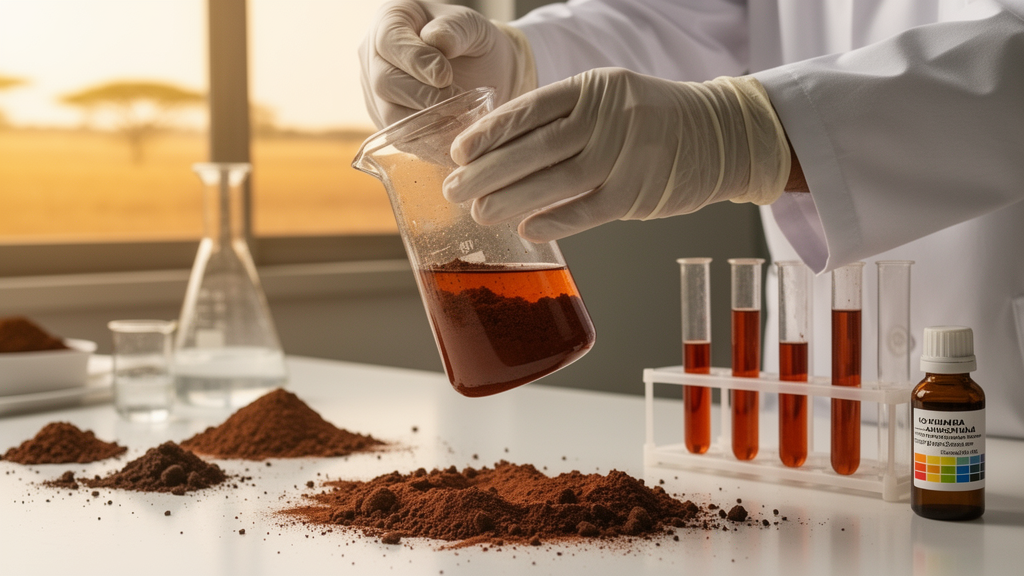
Phosphorus is the quiet gatekeeper of agriculture in the Nigerian savanna. It fuels energy transfer, root development and biomass accumulation in every crop, yet in the highly weathered soils that dominate northern Nigeria it is locked away by iron and aluminum oxides with an almost mineral grip. A new open-access study led by A. A. Mustapha and colleagues at Bayero University Kano, published in Discover Soil, has now systematically compared how well the standard soil tests used across Nigeria actually release that hidden phosphorus, and the results challenge some long-standing assumptions about what a soil phosphorus number really means.
The research team sampled soils across four agroecological zones of the Nigerian savanna, from the Derived Savanna in the south to the Sudan Savanna in the far north. Ten samples were collected at each of eight representative sites, spanning Alfisols, Ultisols, Vertisols and Inceptisols, at a depth of 0 to 30 centimeters. The soils were air-dried, gently crushed and sieved to two millimeters before analysis. Physicochemical characterization revealed predominantly sandy loam textures, with sand content ranging from 33.12 to 84.88 percent, and pH values between 4.31 and 6.98 in water, confirming the acidic to moderately acidic conditions that strongly favor phosphorus fixation through interactions with iron and aluminum oxides.
Three conventional extractants were evaluated head to head: Bray I, a dilute acid-fluoride solution designed to release phosphorus bound to aluminum and iron; Bray II, which uses a stronger acid concentration to access additional fractions including calcium-associated phosphorus; and Mehlich-3, a multi-nutrient extractant combining acetic acid, ammonium nitrate, ammonium fluoride, nitric acid and EDTA that can dissolve phosphorus associated with aluminum, iron and calcium across a broad range of soil conditions. For each extraction, one gram of soil was mixed with ten milliliters of extractant, shaken for one minute and centrifuged at 2000 rpm for fifteen minutes before phosphorus was measured colorimetrically using the molybdenum-blue method.
The innovation came from a set of procedural modifications the researchers denoted with the suffix -S. Shaking time was extended from one to five minutes to enhance soil-solution interaction and promote desorption of phosphorus from reactive surfaces, while centrifugation time was cut from fifteen to five minutes to minimize clay flocculation and reduce the chance that released phosphate would be re-adsorbed onto mineral particles. The team also developed modified acid-based extractants, including combinations of acetic acid with hydrochloric acid and with nitric acid, and ammonium fluoride with acetic acid, specifically to improve phosphorus dissolution in soils where iron and aluminum oxides dominate retention.
The effect of these simple operational changes was dramatic. Bray II-S recorded a mean extractable phosphorus value of 31.80 milligrams per kilogram, compared with just 7.57 milligrams per kilogram for the standard Bray II method, a more than fourfold increase. The acetic acid plus hydrochloric acid extractant rose from 5.30 to 16.76 milligrams per kilogram under the modified protocol, while the version including nitric acid climbed from 7.21 to 20.93 milligrams per kilogram. In contrast, Mehlich-3 produced a relatively high 20.78 milligrams per kilogram under standard conditions but a lower 8.56 milligrams per kilogram when modified, suggesting that its multi-component chemistry already extracts efficiently without procedural enhancement.
Regional patterns added further nuance. In the Derived Savanna, the modified nitric acid extractant recovered 14.84 milligrams per kilogram and Mehlich-3 11.08, both significantly higher than Bray II at 4.38, which falls below the commonly reported critical range of 7 to 20 milligrams per kilogram for savanna soils and likely underestimates phosphorus status. In the Northern Guinea Savanna, Mehlich-3 yielded 14.42 and the modified acetic-hydrochloric extractant 9.00, while Bray II managed only 2.73. In the Southern Guinea Savanna, Mehlich-3 extracted 12.08 against Bray II’s 1.18, though even the higher value remained below the expected critical level, confirming strong fixation in these highly weathered soils. Only in the Sudan Savanna did Bray II-S reach 22.00 milligrams per kilogram, within the expected sufficiency range, hinting at comparatively greater phosphorus availability there.
Across soil orders the selectivity of extractants became even clearer. In Alfisols of the Derived Savanna, Bray II recovered only 2.54 milligrams per kilogram while Bray I extracted 10.07. In Vertisols, the modified acetic-hydrochloric extractant produced the highest value at 27.94. In the Northern Guinea Savanna, Bray II managed just 1.45 in Alfisols and 4.01 in Inceptisols, whereas Mehlich-3 reached 22.78 in Alfisols and the modified acetic-hydrochloric extractant 17.01 in Inceptisols. Most strikingly, in the Inceptisols of the Sudan Savanna, Bray II-S extracted as much as 222.01 milligrams per kilogram, far exceeding any plausible plant-available threshold, while the modified acetic-hydrochloric extractant yielded 28.07. The authors interpret such elevated values as evidence that intensified extraction conditions dissolve non-labile phosphorus pools rather than strictly plant-available fractions.
The study also tested Near Infrared Spectroscopy as a rapid, non-destructive alternative. Spectra were collected in diffuse reflectance from 400 to 2500 nanometers on a Metrohm NIRS DS2500 analyzer, preprocessed with Savitzky-Golay smoothing, standard normal variate and first-derivative transformations, and calibrated against laboratory-measured phosphorus using partial least squares regression with a 70:30 calibration-validation split. Despite this rigorous pipeline, NIR consistently produced low values, averaging just 2.62 milligrams per kilogram, and showed a weak relationship with chemical extraction results, with a coefficient of determination of only 0.189. The authors attribute this to phosphorus’s weak direct spectral response and NIR’s reliance on indirect correlations, particularly in soils with low organic matter content.
To anchor the chemical results in agronomic reality, the team grew maize in twenty-liter pots without phosphorus fertilizer, so that plant uptake reflected inherent soil phosphorus availability. At physiological maturity, plants were harvested, dried at 50 degrees Celsius, ground and digested with nitric acid and hydrogen peroxide, and tissue phosphorus was determined by the vanadomolybdate method. Correlating uptake with extracted phosphorus revealed moderate coefficients ranging from 0.35 to 0.67 for conventional and moderately aggressive extractants, indicating a reasonable though imperfect representation of plant-available phosphorus. Weaker relationships emerged for the nitric-acid-containing modified extractant at 0.14 and for NIR at negative 0.11, confirming that strong acid-based extractants solubilize stable, non-labile pools with reduced predictive relevance for crop response.
The broader message is that no single extractant performed consistently across all soil types, and that extraction efficiency alone is not a sufficient criterion for judging method performance. Bray I showed relatively better suitability in Alfisols of the Derived Savanna, while Mehlich-3 was more consistent across Alfisols and Ultisols of the Northern and Southern Guinea Savanna. Regression analysis revealed strong linear relationships among most chemical extractants, with coefficients of determination between 0.646 and 0.926, suggesting overlapping phosphorus pools, though extractant aggressiveness and soil mineralogy still modulate what each method accesses. Extractable phosphorus also correlated positively with soil pH and clay content, reflecting how acidic conditions promote fixation while rising pH reduces sorption intensity. The authors conclude that soil-specific calibration is essential, and that careful interpretation of extraction data, rather than uniform soil testing approaches, will underpin more reliable phosphorus assessment and more effective fertilizer recommendations for sustainable nutrient management across savanna agroecosystems.
Subject of Research: Phosphorus extraction method performance and optimization in Nigerian savanna soils
Article Title: Comparative evaluation and optimization of phosphorus extraction methods for Nigerian Savannah soils
Article References: Mustapha, A. A., Shaibu, A. S., Abdulrahman, B. L., Abubakar, A. U., & Ibrahim, M. (2026). Comparative evaluation and optimization of phosphorus extraction methods for Nigerian Savannah soils. Discover Soil, 3(1), Article 97. https://doi.org/10.1007/s44378-026-00258-1
Image Credits: AI Generated
DOI: 10.1007/s44378-026-00258-1
Keywords: Comparative, evaluation, optimization, phosphorus, extraction, methods, Nigerian, Savannah, soils, scientific research
Cite Scienmag News
Alan Morgan. (October 15, 2026). Simple Shaking Change Rewrites Phosphorus Readings in Nigerian Savanna Soils. Scienmag. https://scienmag.com/simple-shaking-change-rewrites-phosphorus-readings-in-nigerian-savanna-soils/
Alan Morgan. "Simple Shaking Change Rewrites Phosphorus Readings in Nigerian Savanna Soils." Scienmag, 15 October 2026, https://scienmag.com/simple-shaking-change-rewrites-phosphorus-readings-in-nigerian-savanna-soils/. Accessed 15 October 2026.
Alan Morgan. "Simple Shaking Change Rewrites Phosphorus Readings in Nigerian Savanna Soils." Scienmag. October 15, 2026. https://scienmag.com/simple-shaking-change-rewrites-phosphorus-readings-in-nigerian-savanna-soils/


