


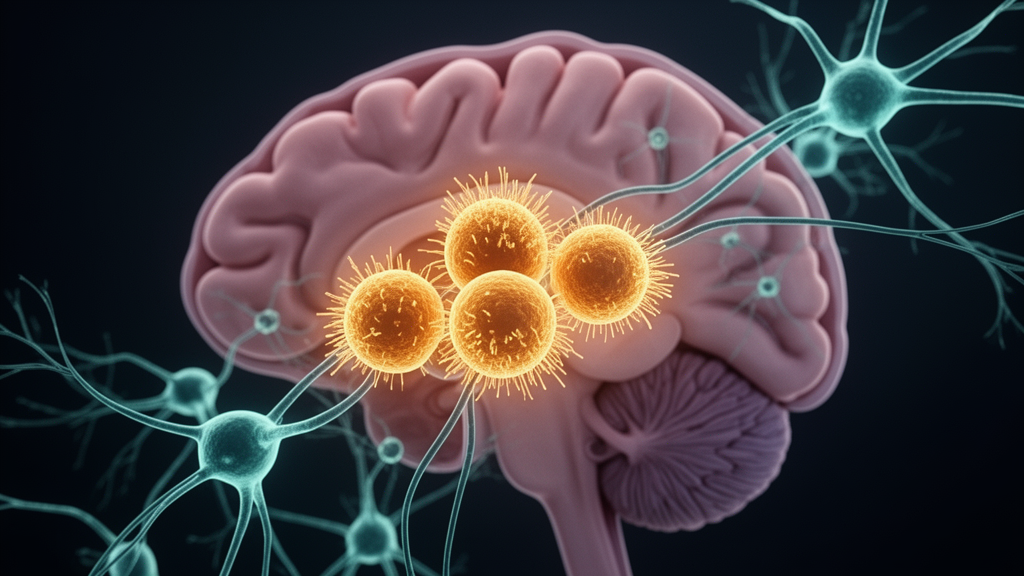
Deep inside the cerebellum, the brain region long celebrated for coordinating movement, sits a tiny and long-overlooked nerve cell that is now drawing attention for a far more ambitious role. The unipolar brush cell, or UBC, is a rare interneuron whose brush-like tuft of dendrites receives an unusually powerful synaptic input, and a new scoping review published in Translational Psychiatry argues that this small cell may be a key player in the cerebellum’s emerging portfolio of sophisticated signal transformations, temporal processing, and even higher cognitive functions. Written by Tonya Clark-Taylor of Eastern Health in Melbourne, Australia, the review synthesizes the last five years of UBC research, spanning 31 articles drawn from PubMed and Embase, and closes with a provocative question: could these whispering cells of time be relevant to schizophrenia?
The UBC was originally dismissed as a curiosity. It is vastly outnumbered by the granule cells that crowd the cerebellar granular layer, and in rodents it is largely restricted to the flocculonodular complex, a vestibular processing hub at the base of the cerebellum. Yet the review highlights a striking evolutionary pattern: UBCs undergo considerable enrichment through higher species, reaching their greatest abundance in the primate brain. That evolutionary expansion matters because the cerebellum itself has recently been implicated in cognitive, affective, and social functions far beyond its classical motor duties. How a cell type that expands alongside primate evolution contributes to those recently described higher functions remains largely unknown, and Clark-Taylor positions the UBC as one of the most promising candidates for closing that gap.
To organize the sprawling literature, the review grouped the 31 included articles into eight themes: plasticity, sensory processing, neurotransmission, a continuum of firing patterns, neurocircuitry, experimental models, neurodevelopment, and tumourigenesis. Two of the papers were review articles, while the majority of original research involved rodents and eleven studies involved humans. This thematic architecture reveals a field in rapid maturation, moving from descriptive anatomy toward mechanistic studies of how UBCs transform signals in the cerebellar microcircuit, and toward developmental and clinical questions that connect the cell to human disease.
Among the most notable findings the review describes is the characterization of a continuum of UBC firing patterns. Rather than falling into rigid categories, UBCs display a spectrum of intrinsic physiological behaviors, and this continuum underpins a powerful array of signal transformations within the cerebellar microcircuit. In practical terms, a population of UBCs can take incoming pulses and reshape them in time, prolonging, delaying, or filtering signals depending on where each cell sits along the firing continuum. Neuroscientists have long sought the cellular substrates of temporal processing in the brain, and the suggestion that a single, genetically identifiable interneuron class can implement such a versatile repertoire of timing operations makes the UBC a compelling candidate for effecting the precise temporal computations the cerebellum is thought to perform.
Sensory processing emerges as another major thread. The review points to potential UBC roles in timing, auditory processing, sensory prediction, and self-cancellation, the mechanism by which the brain distinguishes sensations generated by its own actions from those imposed by the external world. Self-cancellation is a fundamental operation: when you speak, your brain predicts the auditory consequences of your voice and dampens the response, which is why you cannot tickle yourself. Disruptions of this predictive dampening have been repeatedly proposed in schizophrenia, where patients may experience their own thoughts and actions as alien because the brain’s self-cancellation machinery falters. If UBCs participate in generating or refining these sensory predictions within cerebellar circuits, their dysfunction becomes directly relevant to theories of the disorder.
The connection to schizophrenia is framed carefully rather than triumphantly. The review provides a brief discussion of the research findings on the UBC and their implications for the illness, resting on two converging facts. First, the cerebellum has a demonstrable role in higher cognitive functions, and cerebellar abnormalities have been described in schizophrenia research. Second, UBCs are most enriched in the primate brain, precisely the species in which the cerebellum’s cognitive, affective, and social functions are most elaborate. Considering the cell’s potential roles in timing, auditory processing, sensory prediction, and self-cancellation, Clark-Taylor argues that advances in UBC research may provide novel insights for schizophrenia research, even though no direct causal link between UBC pathology and the disorder has yet been established in the reviewed literature.
Not every theme points toward psychiatry. One of the review’s most consequential findings is entirely oncological: the identification of the origins of group 4 medulloblastoma, the most common malignant brain tumor of childhood. Medulloblastomas arise in the cerebellum, and tracing the developmental lineage of this molecular subgroup to UBC-related lineages offers a concrete example of how basic research into a rare interneuron can illuminate clinical disease. The neurodevelopment theme likewise connects UBC biology to the broader question of how cerebellar circuits are built, a process whose perturbation is increasingly studied in neurodevelopmental disorders.
Methodologically, the review reflects both the strengths and the constraints of a young field. Most original research involved rodents, whose UBCs are concentrated in vestibular regions that differ from the primate distribution, and eleven studies involved humans, indicating that human evidence is growing but still limited. Experimental models form one of the eight themes, underscoring how much of the mechanistic knowledge depends on animal preparations. The field also spans neurotransmission and neurocircuitry studies that map the UBC’s unusual synaptic arrangement, in which a single mossy fiber terminal engulfs the cell’s brush of dendrites, creating one of the largest and most powerful excitatory synapses in the brain. Plasticity studies add another dimension, showing that UBC circuits are not fixed hardware but adaptable elements whose properties can change with experience.
What makes the review compelling for a general audience is the sheer audacity of the scale mismatch it describes. The cerebellum contains roughly four times as many neurons as the rest of the brain combined, yet a single rare interneuron type, dwarfed by the abundance of granule cells, is now proposed as a substrate for some of the brain’s most refined temporal computations. The metaphor in the article’s title, little whispers in time, captures the idea precisely: UBCs may operate as quiet timing elements whose individual contributions are small but whose collective signal transformations shape how cerebellar circuits represent the world across milliseconds.
The review, which was received in December 2025, revised in August 2026, and published open access on 30 September 2026, is explicitly a starting point rather than a conclusion. It charts where the last five years of research have taken the UBC and implicitly sets the agenda for the next five: determining how the continuum of firing patterns is generated and regulated, establishing whether UBCs contribute to auditory processing and self-cancellation in primates, and testing whether cerebellar timing abnormalities documented in schizophrenia trace back to this rare cell type. For now, the unipolar brush cell stands as a reminder that neuroscience’s biggest questions about time, prediction, and the self can hide inside its smallest, most easily overlooked cells.
Subject of Research: Neuroscience
Article Title: Little whispers in time: Review of the cerebellar unipolar brush cell, with insights for schizophrenia
Article References: Clark-Taylor, T. (2026). Little whispers in time: Review of the cerebellar unipolar brush cell, with insights for schizophrenia. Translational Psychiatry. https://doi.org/10.1038/s41398-026-04461-0
Image Credits: AI Generated
DOI: 10.1038/s41398-026-04461-0
Keywords: cerebellum, unipolar brush cell, schizophrenia, temporal processing, medulloblastoma, Translational Psychiatry, Little, whispers, time, Review, cerebellar, unipolar
Cite Scienmag News
Glenn Wilkins. (October 15, 2026). Cerebellum’s Whispering Brush Cells May Hold Timing Clues for Schizophrenia. Scienmag. https://scienmag.com/cerebellums-whispering-brush-cells-may-hold-timing-clues-for-schizophrenia/
Glenn Wilkins. "Cerebellum’s Whispering Brush Cells May Hold Timing Clues for Schizophrenia." Scienmag, 15 October 2026, https://scienmag.com/cerebellums-whispering-brush-cells-may-hold-timing-clues-for-schizophrenia/. Accessed 15 October 2026.
Glenn Wilkins. "Cerebellum’s Whispering Brush Cells May Hold Timing Clues for Schizophrenia." Scienmag. October 15, 2026. https://scienmag.com/cerebellums-whispering-brush-cells-may-hold-timing-clues-for-schizophrenia/


