


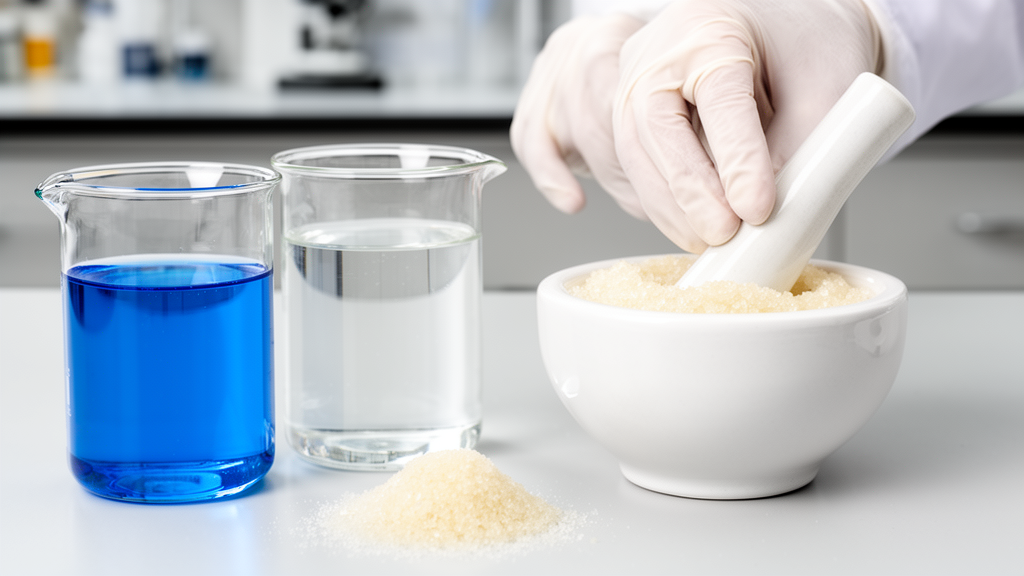
A zinc-based metal–organic framework ground together with nothing more exotic than an agate mortar and pestle has removed 99.35 percent of methylene blue dye from water in a new study, offering one of the greenest routes yet to a high-performance water-purification material. Researchers at Federal University Dutsin-Ma and Bayero University in Nigeria report in Discover Chemistry that the solvent-free mechanochemical synthesis of a 4,4′-biphenyldicarboxylic acid (BPDC) zinc framework not only matched the performance of conventionally prepared adsorbents but did so with a 73.45 percent yield, no organic solvent during framework formation, and a fraction of the energy normally demanded by solvothermal chemistry.
The significance of the work lies in how the material was made. Conventional MOF synthesis typically relies on solvothermal or hydrothermal methods that require large volumes of organic solvents, elevated temperatures, and reaction times stretching over hours or days. Mechanochemistry, by contrast, drives chemical reactions through mechanical force. The team combined 25 mmol of the BPDC ligand with 50 mmol of zinc chloride in a 2:1 metal-to-ligand ratio and simply ground the powders for twenty minutes. The slight excess of metal salt, the authors note, ensures full coordination to both carboxylate groups without the need for ball milling, promoting framework formation while leaving minimal unreacted linker behind.
After grinding, the crude powder was washed in ethanol for two hours to strip away unreacted precursors, salts, and unbound ligand, then activated by drying at 50 degrees Celsius for 24 hours. From roughly 12.88 grams of starting materials, the researchers recovered 9.46 grams of product. Because mechanochemical synthesis uses little or no solvent, solvent molecules are far less likely to occupy the pore structure of the final material, preserving the active adsorption sites that make MOFs so effective at capturing dissolved pollutants.
A battery of characterization techniques confirmed that the grinding had indeed produced a genuine crystalline framework rather than a simple physical mixture. Fourier-transform infrared spectroscopy revealed new bands absent from the free ligand, including a broad absorption near 3369 cm⁻¹ attributed to coordinated or adsorbed solvent molecules at zinc centers, alongside shifts in carboxylate vibrations that verify coordination between BPDC ligands and Zn²⁺ ions. X-ray diffraction showed the disappearance of several ligand peaks and slight shifts in the remaining reflections, evidence of structural rearrangement upon framework formation rather than a loss of crystallinity. Energy-dispersive X-ray fluorescence confirmed zinc as the only significant metal in the material, with strong Zn Kα and Kβ emission lines at 8.6 and 9.6 keV.
The porosity measurements were equally encouraging. Nitrogen adsorption–desorption analysis using the BET method yielded a specific surface area of 221.022 m²/g, while Barrett–Joyner–Halenda analysis gave a pore volume of 0.134 cm³/g and an average pore diameter of 2.118 nm, placing the material squarely in the IUPAC mesopore range. Thermogravimetric analysis showed the framework remains stable up to about 310 degrees Celsius, with the organic ligand decomposing between 311 and 512 degrees and the structure collapsing beyond 520 degrees to leave zinc oxide residue. The point of zero charge was measured at pH 6, meaning the surface carries a net negative charge above that value and will electrostatically attract cationic species such as methylene blue.
To move beyond one-factor-at-a-time experimentation, the team employed response surface methodology with a Box–Behnken design, running 29 batch experiments across four variables at three levels each: adsorbent dosage from 0.1 to 0.5 grams, ionic strength from 0 to 0.17 mol/L, contact time from 30 to 120 minutes, and pH from 2 to 12. The resulting quadratic model achieved an R² of 0.9934, meaning 99.34 percent of the variation in dye removal could be attributed to the independent factors, with an adjusted R² of 0.9869 and a non-significant lack-of-fit test. Analysis of variance identified adsorbent dosage, contact time, pH, and their quadratic and interaction terms as statistically significant, while ionic strength played a comparatively minor role.
The desirability function pinpointed optimal conditions of 0.422 grams of adsorbent, an ionic strength of 0.0347 mol/L, a contact time of 61.78 minutes, and pH 11.2, predicting 99.51 percent removal. The experimentally verified value of 99.35 percent at a dye concentration of 30 mg/L fell remarkably close to the prediction, validating the statistical model. The strong pH dependence follows directly from the point of zero charge: above pH 6 the negatively charged surface draws the positively charged dye molecules, and at the highest tested pH of 12 removal peaked, whereas at pH 2 the protonated surface repelled the cationic dye and removal dropped to as low as 29.15 percent.
Isotherm analysis added mechanistic nuance. The Langmuir model, which assumes ideal monolayer adsorption on a homogeneous surface, fit poorly with an R² of just 0.3733. The Freundlich model performed moderately at 0.7089, with an exponent below unity signaling strong surface heterogeneity. The Temkin isotherm gave the closest fit at R² 0.8828, indicating that adsorbate–adsorbent interactions significantly influence the process and that the heat of adsorption decreases linearly with increasing surface coverage, a hallmark of heterogeneous MOF surfaces. The π-electron-rich aromatic rings of the BPDC linker are thought to engage in π–π interactions with the aromatic structure of methylene blue, complementing the electrostatic attraction.
Kinetic performance may be the study’s most striking result. Equilibrium was reached within approximately ten minutes, an abrupt drop in dye concentration occurring in the first ten minutes for all concentrations tested. That is markedly faster than many comparable adsorbents: HKUST-1 required about 60 minutes, Zn/Co-ZIF@CNT composites about 120 minutes, and ZnO-based adsorbents between 15 and 45 minutes. The adsorption followed a pseudo-second-order model with correlation coefficients exceeding 0.9999 across all concentrations, and equilibrium capacity rose from 8.29 to 41.49 mg/g as the initial dye concentration increased from 20 to 100 mg/L, while the rate constant declined under greater site competition.
Thermodynamics completed the picture. Across 298 to 338 K, the Gibbs free energy ranged from −12.465 to −17.396 kJ/mol, confirming a spontaneous process that becomes more favorable at higher temperatures. The positive enthalpy change of 20.026 kJ/mol marks the uptake as endothermic and sits at the boundary of the physisorption range of 2.1 to 20.9 kJ/mol, while the positive entropy change of +112.638 J/mol·K reflects increased randomness at the solid–liquid interface as dye–solvent interactions give way to dye–framework interactions. The authors caution that regeneration, reusability, column studies, real wastewater trials, and competitive adsorption remain outside the current scope, and future work will target improving the relatively low adsorption capacity and probing long-term stability. Still, the demonstration that a mortar and pestle can deliver a statistically optimized, near-complete dye scavenger underscores how green chemistry principles are reshaping the design of water-treatment materials.
Subject of Research: Mechanochemical synthesis of a zinc-based metal–organic framework for optimized adsorptive removal of methylene blue dye from water
Article Title: Response surface methodology optimization of methylene blue dye removal using a mechanochemically synthesized zinc-based metal organic framework with its isotherm, kinetic and thermodynamic insights
Article References: Response surface methodology optimization of methylene blue dye removal using a mechanochemically synthesized zinc-based metal organic framework with its isotherm, kinetic and thermodynamic insights. (n.d.). https://doi.org/10.1007/s44371-026-00889-x
Image Credits: AI Generated
DOI: 10.1007/s44371-026-00889-x
Keywords: metal-organic frameworks, methylene blue, mechanochemical synthesis, adsorption, response surface methodology, wastewater treatment, zinc-based MOF, isotherm models, adsorption kinetics, thermodynamics, green chemistry, BPDC linker
Cite Scienmag News
Bethany Barker. (October 15, 2026). Mortar-and-Pestle MOF Strips Nearly All Methylene Blue From Water in Minutes. Scienmag. https://scienmag.com/mortar-and-pestle-mof-strips-nearly-all-methylene-blue-from-water-in-minutes/
Bethany Barker. "Mortar-and-Pestle MOF Strips Nearly All Methylene Blue From Water in Minutes." Scienmag, 15 October 2026, https://scienmag.com/mortar-and-pestle-mof-strips-nearly-all-methylene-blue-from-water-in-minutes/. Accessed 15 October 2026.
Bethany Barker. "Mortar-and-Pestle MOF Strips Nearly All Methylene Blue From Water in Minutes." Scienmag. October 15, 2026. https://scienmag.com/mortar-and-pestle-mof-strips-nearly-all-methylene-blue-from-water-in-minutes/


