


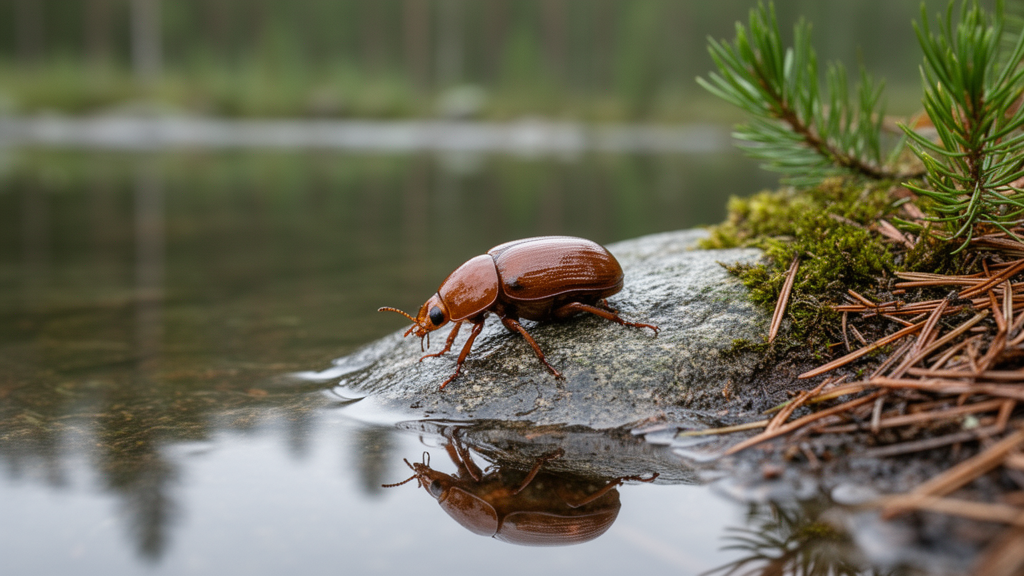
In the flooded ruts of a field track west of Ski, just south of Oslo, a common European water beetle is quietly rewriting what scientists know about one of the strangest reproductive strategies in nature. New cytogenetic work published in Comparative Cytogenetics reports the first triploid parthenogenetic females of the little water beetle Helophorus brevipalpis from Norway, and their chromosomes show a pattern unlike any recorded in the species before. The finding means that parthenogenesis and triploidy in this beetle have now arisen on three separate occasions in Europe, a rare demonstration that a complex chromosomal innovation can evolve repeatedly and independently.
Helophorus brevipalpis is a very common beetle across much of Europe, familiar to entomologists for its conspicuous mid- to late summer swarming, when it may land in great numbers on shiny surfaces such as car bodies and windows. The first hint that the species could reproduce without males came decades ago, from the discovery of a females-only population in Logan Canyon, Utah, USA, described in 1971. Because that site represents the only genuine North American record of the species, it suggested the beetles there were an introduction, carried across the Atlantic with all-female reproduction already in place.
The first confirmed parthenogenetic triploids in Europe were identified from the Provincia de León in Spain, where they occurred alongside bisexual diploid populations. Records from the Po valley in Italy followed, and in 2025 triploid material was reported from the Camargue in southern France. The Spanish and French beetles share the same chromosomal arrangement, while the Italian population shows minor differences, hinting that more than one origin might be involved. The new Norwegian material settles the question decisively.
The trail to Norway began in July 2025, when Czesław Greń of Bytom, Poland, emailed the study’s author to report that he had sampled 126 specimens of H. brevipalpis near Ski, of which only 12 were males. Such a strong female bias is exactly what parthenogenetic populations produce, since triploid females need no fertilization and males become scarce. Acting on this information, the author visited the area in the first week of July 2026, accompanied by his daughter Helen Hosier, and collected living beetles from a flooded field track west of Ski in Akershus, at coordinates 59.93988°N, 10.93933°E.
Fieldwork took place on two days, 2 and 6 July 2026, the first to locate a suitable site and take an initial sample, the second to collect beetles that would spend as little time as possible in transit. The author estimated that more than 100 beetles were collected in total, although the retained sample amounted to 69 specimens. Back in England, the living material faced an unexpected obstacle: a southeast England heatwave with temperatures above 30 °C. To prevent mortality during the journey, the beetles were placed in the salad drawer of a refrigerator, which certainly avoided deaths but also halted cell division in the midguts, the tissue from which chromosome preparations are made.
Transferring the beetles to an aquarium in a garden shed restored cell division, and specimens were processed for chromosome slides on 8, 9 and 10 July and again on 17 July, ten specimens per day on the first three dates and nine on the last. The preparations on 8 and 9 July failed, but 10 July yielded four preparations indicating triploid females, with a further four on 17 July. On 30 July the remaining livestock in the aquarium were rounded up, 28 specimens in all, including one diploid male from which chromosomes were obtained. The 27 females were killed by immersion in boiling water and mounted. Chromosome preparations were photographed under oil immersion at the Natural History Museum in London using an Olympus BX63 microscope with an Olympus DP73 camera, capturing single optical sections under brightfield illumination with cellSens Dimension software version 4.2.1.
Countable triploid nuclei were obtained from eight of the 38 females processed. Because the first 20 attempted preparations failed, the success rate once successful preparations were achieved was eight out of 19, a respectable yield for this kind of cytogenetic work. The karyotypes from the Norwegian beetles show a chromosomal arrangement identical to that of English diploid material: chromosomes 1 to 3 are metacentric, chromosomes 4 and 5 are acrocentric, and chromosome 6 is submetacentric, while the smaller chromosomes 7 to 10 range from submetacentric to acrocentric. In a less condensed preparation, the acrocentric chromosome 4 appears almost telocentric, with its centromere pushed to the very end of the chromosome.
That arrangement is clearly different from the published Spanish and French material, in which chromosome 2 is acrocentric, and from the Italian population, in which chromosome 5 is metacentric. For the C-banding analysis of the French beetles, the author re-examined his original photographic negatives, which clarified the shapes of several chromosomes and revealed that during the C-banding treatment some had acquired extraneous heavily staining particles. An incomplete C-banded preparation showed the acrocentric chromosome 2 very clearly, with the short arm extended in one replicate, and chromosome 4 also acrocentric with a relatively shorter short arm. The Italian material, by contrast, shows the longest acrocentric in position 4. It is thus clear that the known development of parthenogenesis and triploidy has occurred on three separate occasions.
The Norwegian beetles are also distinctive in appearance, noticeably dark with heavily mottled elytra and a main pronotal area that is black apart from yellowish anterior and lateral margins, sometimes shining but without greenish or maroon bronze reflections. This colouration matches a male collected in Finland at Parikkala, Karelia australis, in 1970. The aedeagi of the two Norwegian males are similar in size to English material and to Bedel’s French lectotype: the Norwegian aedeagi measure 0.4 and 0.37 mm long, the lectotype 0.45 mm, and the slightly larger aedeagus of the Shetland Islands form H. brevipalpis var. bulbipalpis measures 0.52 mm. The Norwegian triploid females therefore appear to belong to the same northern dark form as the Finnish male, rather than to any of the southern parthenogenetic lineages.
For a species that swarms over shiny surfaces every summer and lands on cars across Europe, H. brevipalpis has proved remarkably good at keeping cytogenetic secrets. The Ski population adds a northern chapter to a story that began in Utah, unfolded through Spain, Italy and France, and now shows that the same triploid parthenogenetic solution has been reached independently three times. Each origin involves a different chromosomal arrangement, meaning the underlying triploid karyotypes were assembled from scratch in each lineage rather than inherited from a common ancestor. As chromosome staining and banding techniques continue to refine comparisons between populations, the little water beetles of a Norwegian field track may stand as a textbook example of convergent evolution at the level of the genome.
Subject of Research: Independent evolution of triploid parthenogenesis in the water beetle Helophorus brevipalpis
Article Title: Triploid parthenogenetic female Helophorus brevipalpis Bedel, 1881 ( Coleoptera , Helophoridae ) near Oslo, Norway
Article References: Angus, R. B. (2026). Triploid parthenogenetic female Helophorus brevipalpis Bedel, 1881 (Coleoptera, Helophoridae) near Oslo, Norway. Comparative Cytogenetics, 20, 229-234. https://doi.org/10.3897/compcytogen.20.213474
Image Credits: AI Generated
DOI: 10.3897/compcytogen.20.213474
Keywords: parthenogenesis, triploidy, karyotype, Helophorus brevipalpis, cytogenetics, Norway, water beetles, chromosomes, Triploid, parthenogenetic, female, Helophorus
Cite Scienmag News
Gavin Prescott. (October 15, 2026). Triploid female water beetles near Oslo reveal a third independent origin of parthenogenesis. Scienmag. https://scienmag.com/triploid-female-water-beetles-near-oslo-reveal-a-third-independent-origin-of-parthenogenesis/
Gavin Prescott. "Triploid female water beetles near Oslo reveal a third independent origin of parthenogenesis." Scienmag, 15 October 2026, https://scienmag.com/triploid-female-water-beetles-near-oslo-reveal-a-third-independent-origin-of-parthenogenesis/. Accessed 15 October 2026.
Gavin Prescott. "Triploid female water beetles near Oslo reveal a third independent origin of parthenogenesis." Scienmag. October 15, 2026. https://scienmag.com/triploid-female-water-beetles-near-oslo-reveal-a-third-independent-origin-of-parthenogenesis/


