


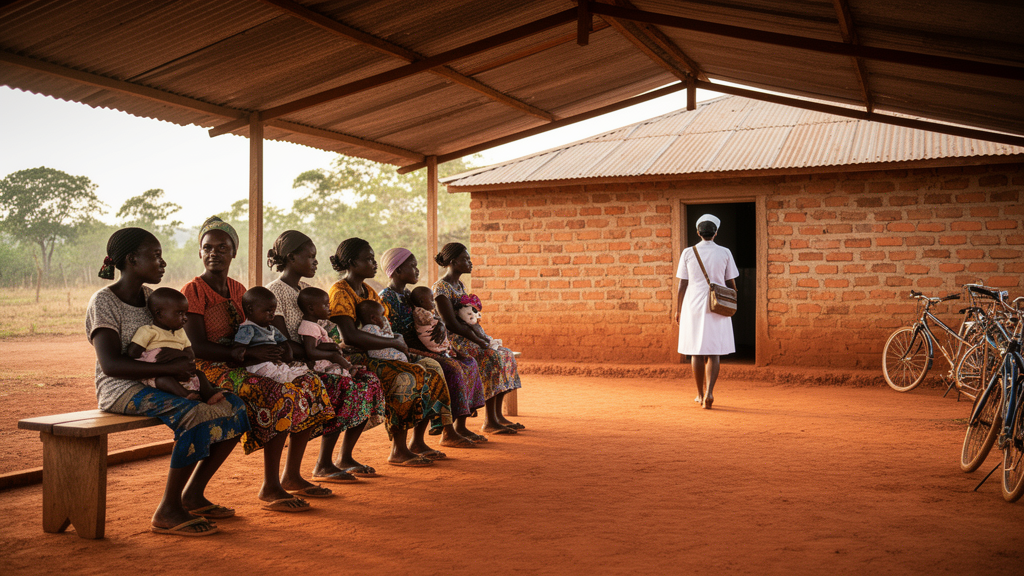
In a finding that offers both reassurance and warning for global reproductive health advocates, a comprehensive new survey of Uganda’s family planning services has revealed that while the vast majority of health facilities consistently provide modern contraceptive methods, the experience of waiting for those services varies dramatically depending on who you are, where you live, and how much education you have received. The study, published in the International Journal for Equity in Health, provides one of the most detailed portraits yet of how equitable family planning delivery really is at the point where patients actually encounter the health system.
Researchers from Makerere University School of Public Health, working alongside the United Nations Population Fund, analyzed data from a 2023 cross-sectional survey that visited 614 health facilities providing family planning services across Uganda and interviewed 2,378 clients as they exited those service delivery points. Rather than simply measuring whether people use contraception—a metric that has dominated family planning research for decades—the team focused on process indicators drawn from the Availability, Accessibility, Acceptability and Quality framework, which capture the remediable, day-to-day realities that shape whether services actually reach the people who need them.
The headline availability figure is genuinely encouraging. On average, 89.7 percent of all surveyed service delivery points consistently provided a minimum of three modern contraceptive methods as part of their regular services. That threshold matters because offering a choice of at least three methods is widely regarded as a baseline for genuine contraceptive autonomy, allowing clients to select options that fit their bodies, relationships, and life circumstances rather than accepting whatever happens to be in stock.
But dig into the stratified results and a more complicated picture emerges. The facilities performing best were not the small rural outposts that serve the majority of Uganda’s population. Health Centre IV facilities—the highest tier of health centre in the country’s tiered system—reported the highest proportion of regular provision of at least three modern methods at 98.3 percent. Government-run facilities reached 93.1 percent, and rural facilities 91.3 percent, figures that outperformed their counterparts at lower levels and in other ownership categories. The pattern suggests that while the public sector has built impressive commodity availability at higher-level facilities, the lower-tier posts and clinics that rural women and adolescents are most likely to visit first may still be the weakest links in the supply chain.
Waiting time data tell an equally revealing story about who bears the cost of system strain. Clients aged 15 to 19—the very adolescents that family planning programs most struggle to reach—spent an average of 72 minutes waiting for services, the longest of any age group surveyed. Those aged 20 to 29 waited an average of 66 minutes, while clients aged 30 to 39 waited 69 minutes. The numbers indicate that the youngest clients, who often face the greatest social barriers to seeking contraception in the first place, are also asked to endure the longest physical waits once they arrive, a combination that discourages return visits and fuels discontinuation.
Gender and education both carved additional fault lines through the data. Female clients waited an average of 66 minutes for family planning services, while male clients waited just 43 minutes—a 23-minute gap that likely reflects both the greater complexity of services women receive and differences in how facilities triage and schedule clients. Education gradients were equally stark: clients with no education waited an average of 68.4 minutes and those with primary education 69.5 minutes, while clients with post-primary education waited just 55.8 minutes. In a health system where time is money and long absences from work or family responsibilities carry real costs, these waiting time disparities function as a regressive tax on the least privileged users.
Quality perceptions added a further dimension of concern. Only 53.3 percent of the 1,267 clients who were asked believed that service providers adhered to all best practices in family planning service delivery across all levels of service delivery points. In other words, nearly half of the clients leaving Ugandan family planning clinics had reservations about whether the care they received met accepted standards. Since acceptability and perceived quality are known drivers of contraceptive continuation, this finding suggests that even where commodities are physically present, the interpersonal and technical dimensions of care may be undermining trust and uptake.
The study’s methodology deserves attention because it illustrates how process indicators can illuminate problems that utilization statistics obscure. Data were collected between September 13 and October 3, 2023, through face-to-face interviews with facility managers and exit interviews with clients, and the analysis was performed using STATA version 15. Descriptive statistics—frequencies, percentages, and means—were generated across service delivery point and client characteristics to identify differences in outcomes across facility levels and population sub-groups. By disaggregating results by facility tier, ownership, location, age, sex, and education, the researchers transformed what could have been a single national average into a diagnostic map of exactly where the system is failing whom.
The authors argue that the path forward requires strengthening community-based distribution through outreach programs, community health workers, drug shops, and pharmacies, particularly to reach underprivileged groups such as adolescents and rural women who face the longest waits and the thinnest method choice. At the same time, they call for empowering and equipping lower-level service delivery points by skilling personnel, ensuring commodities and supplies are available, and improving service delivery processes so that even the smallest facilities can competently provide a full range of modern contraceptive methods. These are not glamorous interventions, but the evidence suggests they target precisely the bottlenecks the survey identified.
The broader significance of the work extends well beyond Uganda’s borders. As international funders and governments pour resources into expanding contraceptive access, the study demonstrates that availability metrics alone can mask profound inequities in how services are actually experienced. A country can report high method availability while adolescents wait more than an hour for care and half of all clients doubt the quality of what they receive. Measuring availability, accessibility, acceptability, and quality together—and disaggregating by the characteristics that determine who is left behind—offers a template for other low-resource settings seeking to convert nominal coverage into genuine, equitable access to reproductive health care for everyone in need.
Subject of Research: Equity assessment of family planning service delivery points in Uganda using UNFPA 2023 survey data
Article Title: Equity of family planning at service delivery points in Uganda
Article References: Equity of family planning at service delivery points in Uganda. (n.d.). https://doi.org/10.1186/s12939-026-03072-x
Image Credits: AI Generated
DOI: 10.1186/s12939-026-03072-x
Keywords: family planning, Uganda, health equity, contraception, service delivery, waiting times, adolescent health, UNFPA, reproductive health, health facilities, rural health, access to care
Cite Scienmag News
Courtney Benton. (October 15, 2026). Uganda’s Family Planning Services Reach Most Facilities, But Waiting Times Reveal Deep Inequities. Scienmag. https://scienmag.com/ugandas-family-planning-services-reach-most-facilities-but-waiting-times-reveal-deep-inequities/
Courtney Benton. "Uganda’s Family Planning Services Reach Most Facilities, But Waiting Times Reveal Deep Inequities." Scienmag, 15 October 2026, https://scienmag.com/ugandas-family-planning-services-reach-most-facilities-but-waiting-times-reveal-deep-inequities/. Accessed 15 October 2026.
Courtney Benton. "Uganda’s Family Planning Services Reach Most Facilities, But Waiting Times Reveal Deep Inequities." Scienmag. October 15, 2026. https://scienmag.com/ugandas-family-planning-services-reach-most-facilities-but-waiting-times-reveal-deep-inequities/


