


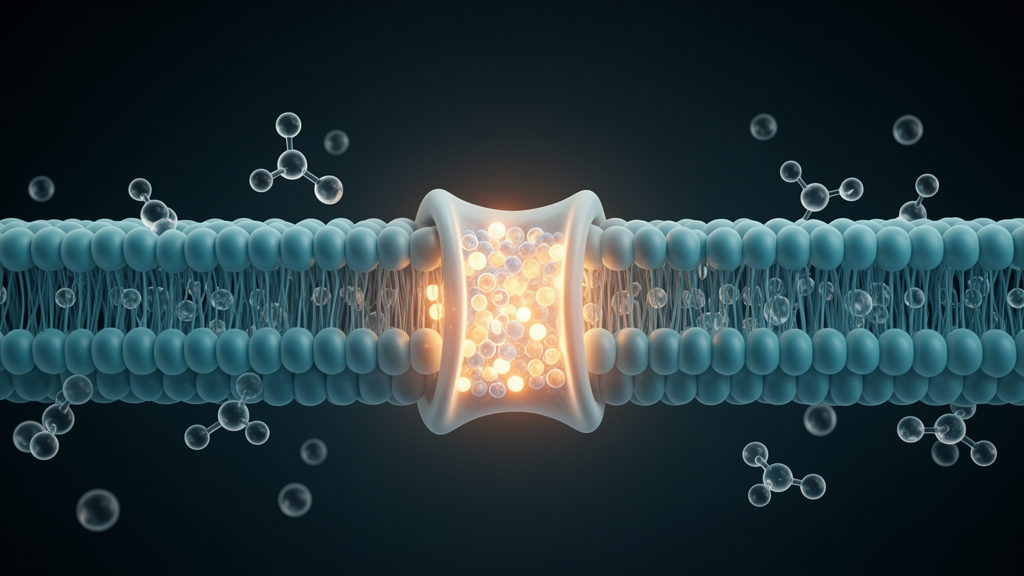
Every living cell is wrapped in a fatty membrane that is both a shield and a checkpoint. Nothing meaningful gets in or out—glucose, amino acids, ions, drugs, toxins—without the help of a vast family of molecular gatekeepers known as membrane transporters. These proteins sit embedded in the lipid bilayer, recognizing specific small molecules on one side of the membrane and ferrying them to the other. Yet for all their importance, the vast majority of transporters remain functional mysteries: biologists know the sequence of amino acids that builds them, but not which cargo they carry. A new computational framework called TraSPIN, published in Genome Biology, promises to change that by teaching an artificial intelligence to read the language of transporter specificity.
The challenge of experimentally characterizing transporters is formidable. Membrane proteins are notoriously unstable once removed from their native lipid environment, which complicates purification, crystallization, and nearly every classical biochemical assay used to establish what a protein binds. As a result, curated databases of experimentally verified transporter–substrate relationships cover only a small fraction of known transporters, and many solute carrier proteins—the largest transporter family in humans—remain so-called orphans with no assigned substrate. Computational tools could in principle fill this gap, but existing methods have tended to focus on narrow classes of substrates or have struggled to generalize to transporters that are evolutionarily distant from those in their training data.
TraSPIN, developed by Tong Pan, Fuyi Li, Jiangning Song, and colleagues at institutions including the South Australian immunoGENomics Cancer Institute, Monash University, and the University of Melbourne, takes a fundamentally different approach. The framework is built on geometric deep learning, a branch of machine learning designed to operate on graph-structured data, and it jointly models both sides of the recognition problem: the transporter protein and the small-molecule substrate. By representing transporters and substrates in a shared learning framework, the model can learn the relational patterns that connect a protein’s sequence and structure to the chemical features of the molecules it accepts.
A central innovation is the use of protein language models as the foundation for transporter representations. These models, analogous to the large language models behind modern chatbots, are trained on enormous databases of protein sequences and learn to encode the statistical grammar of amino acid chains. In doing so, they capture subtle information about which positions in a sequence are functionally constrained, which residues are likely to form binding pockets, and how mutations are tolerated. TraSPIN leverages these learned embeddings to build rich, transferable representations of transporters, which are then combined with graph-based learning over protein–substrate interaction networks. The graph structure allows the model to propagate information across related transporters and related substrates, so that knowledge about one interaction informs predictions about others.
This architecture matters because specificity prediction is, at its core, a link-prediction problem on a sparse and biased network. The known interaction map is dense only for a handful of well-studied transporter families and substrate classes, such as sugar transporters or neurotransmitter carriers. A model that simply memorizes these dense regions performs poorly when asked about a transporter from an unexplored family. TraSPIN’s language-model-guided design is explicitly aimed at this generalization problem. In benchmark comparisons reported in the paper, the framework outperformed existing computational methods, and critically, it retained predictive accuracy on substrates it had never seen during training and on transporters whose sequences are dissimilar to anything in the training set—precisely the scenarios where earlier tools broke down.
Beyond raw prediction accuracy, the authors show that TraSPIN is interpretable in biologically meaningful ways. The model’s internal representations can be interrogated to reveal structural determinants of transporter–substrate recognition and sequence motifs associated with binding particular classes of molecules. In other words, the network does not behave as an inscrutable black box; it appears to have learned features that map onto real biochemical principles of molecular recognition. This kind of mechanistic insight is valuable in its own right, because it can guide experimentalists toward specific residues or structural regions to mutate and test, turning a purely computational prediction into a testable hypothesis.
The practical demonstrations in the study highlight two applications with immediate relevance to biology and medicine. The first is cross-species inference: using knowledge accumulated about transporters in well-characterized organisms to predict substrate specificities in species where little experimental data exists. This matters for microbiology, parasitology, and biotechnology, where transporter function in non-model organisms often underpins nutrient uptake, drug resistance, and metabolic engineering. The second application is de-orphanization—the assignment of substrates to uncharacterized solute carrier proteins. Human solute carriers regulate drug absorption, metabolism, and disposition, and orphan carriers are increasingly recognized as potential therapeutic targets and as mediators of unexplained drug–drug interactions. A reliable computational tool that can propose substrates for these orphans could dramatically accelerate functional annotation efforts that would otherwise require years of laboratory work.
The broader context is a rapidly growing intersection between artificial intelligence and structural biology. Protein language models have already transformed fields from structure prediction to protein design, and geometric deep learning has proven adept at tasks where the geometry of molecules—whether the three-dimensional fold of a protein or the two-dimensional scaffold of a small molecule—carries the essential signal. TraSPIN sits squarely at this confluence, treating transporter specificity not as an isolated classification task but as a relational inference problem across a heterogeneous graph of proteins and chemicals. The authors’ results suggest that this joint modeling strategy, rather than modeling proteins and substrates separately, is key to the framework’s generalization ability.
There are, of course, the usual caveats that accompany any machine learning advance in biology. Predictions of transporter–substrate interactions are hypotheses, not measurements, and the sparsity of ground-truth data means that performance estimates on rare substrate classes carry uncertainty. The authors acknowledge that experimental validation remains essential, and the model’s greatest value may lie in prioritizing which of thousands of untested transporter–substrate pairs should be examined first in the laboratory. Used this way—as an intelligent filter rather than an oracle—computational frameworks like TraSPIN can multiply the productivity of experimental programs focused on membrane proteins, where each assay is technically demanding and expensive.
Nevertheless, the arrival of TraSPIN marks a significant step toward solving one of the most persistent annotation problems in molecular biology. The genomes of humans and of every model organism encode hundreds of transporters whose substrates have never been determined, and each uncharacterized carrier is a potential link in a metabolic pathway, a drug target, or a determinant of drug response. By combining the sequence-reading power of protein language models with the relational reasoning of graph learning, TraSPIN offers a scalable route from sequence to function for this protein universe. If its predictions continue to hold up under experimental scrutiny, the era in which transporter specificity is inferred by computer before it is confirmed at the bench may arrive sooner than anyone expected.
Subject of Research: Computational prediction of membrane transporter substrate specificity using protein language models and geometric deep learning
Article Title: TraSPIN: inferring transporter specificity through language model-guided graph learning
Article References: TraSPIN: inferring transporter specificity through language model-guided graph learning. (n.d.). https://doi.org/10.1186/s13059-026-04309-2
Image Credits: AI Generated
DOI: 10.1186/s13059-026-04309-2
Keywords: membrane transporters, substrate specificity, TraSPIN, protein language models, geometric deep learning, graph learning, solute carriers, de-orphanization, protein-substrate interactions, functional annotation, Genome Biology, machine learning
Cite Scienmag News
Blake Davidson. (October 15, 2026). AI Model Decodes Which Molecules Transporters Carry Across Cell Membranes. Scienmag. https://scienmag.com/ai-model-decodes-which-molecules-transporters-carry-across-cell-membranes/
Blake Davidson. "AI Model Decodes Which Molecules Transporters Carry Across Cell Membranes." Scienmag, 15 October 2026, https://scienmag.com/ai-model-decodes-which-molecules-transporters-carry-across-cell-membranes/. Accessed 15 October 2026.
Blake Davidson. "AI Model Decodes Which Molecules Transporters Carry Across Cell Membranes." Scienmag. October 15, 2026. https://scienmag.com/ai-model-decodes-which-molecules-transporters-carry-across-cell-membranes/


