


The skin is the body’s most visible organ and one of its busiest construction sites. Its outer layer, the epidermis, is replaced continuously throughout life, as stem cells nested at the base of the tissue divide and push their specialized descendants upward toward the surface, where they are eventually shed. For decades, biologists have argued about precisely how this assembly line is organized, and whether a strict hierarchy of stem and progenitor cells governs the flow. A new study led by researchers at the Université libre de Bruxelles (ULB), in collaboration with the University of Cambridge, has now delivered an answer with an unexpected twist: the rules of skin renewal depend on the sex of the animal. In female mice, epidermal stem cells work in a strikingly coordinated fashion; in males, each cell marches to its own beat. The difference is orchestrated by sex hormones, and it comes with a measurable consequence — female mice heal wounds faster.
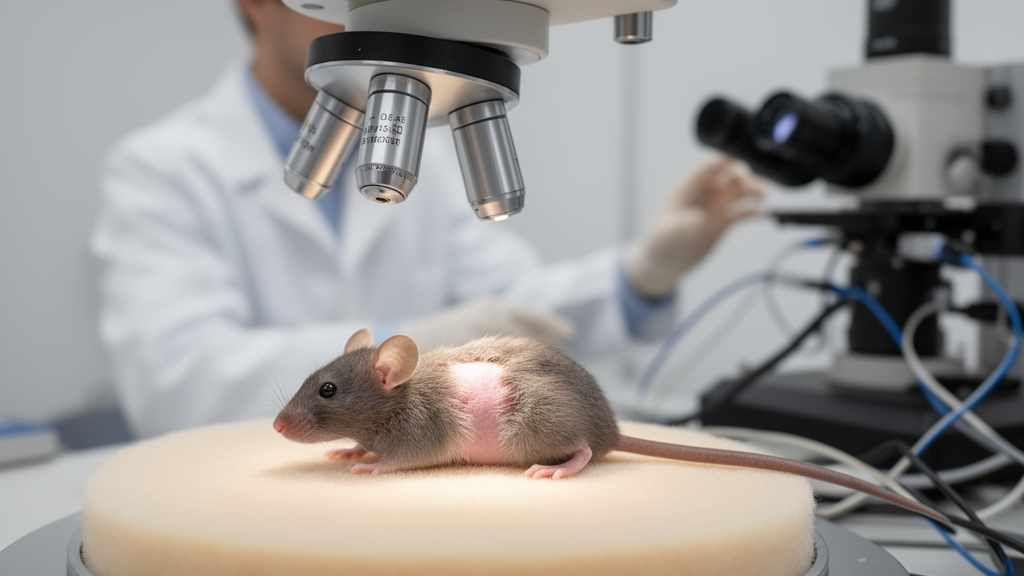
The study, published in the journal Nature, was led by Professor Cédric Blanpain, MD/PhD, investigator at the WEL Research Institute, director of the Laboratory of Stem Cells and Cancer and professor at the Université libre de Bruxelles, working with the team of Professor Benjamin Simons at the University of Cambridge and partner institutions in Italy, the United States and Belgium. The technical achievement at the heart of the work is as remarkable as the biological finding. Using a microscopy technique that allows cells to be filmed through the skin of a living mouse, the researchers followed the same stem cells and their progeny for five months — an unprecedented tracking period for this kind of experiment. Rather than inferring stem cell behavior from snapshots of fixed tissue, the team could watch individual lineages unfold in real time, in the animal’s own environment.
To appreciate why this matters, it helps to recall how the epidermis maintains itself. At the very bottom of the tissue lie the stem cells, which multiply throughout life. When a stem cell divides, some of its daughter cells remain stem cells, preserving the reservoir, while others commit to differentiation: they become specialized skin cells that can no longer divide, take on the barrier function that keeps the body sealed against the outside world, migrate toward the surface, and are eventually sloughed off. How the balance between self-renewal and differentiation is regulated — and whether stem cells convert directly into mature cells or pass through intermediate stages — has been debated for decades. The five-month films provided a direct answer to the second question. Stem cells, the team showed, do not turn directly into fully mature skin cells. They first enter an intermediate stage during which they can divide only a limited number of times before becoming completely specialized, adding a previously unresolved tier to the epidermal hierarchy.
The surprise came when the researchers compared the films from female and male mice. In females, two so-called sister cells — the pair of daughters born from the division of a single stem cell — tend to make the same choice at the same time: either to divide again or to specialize. Like two rowers synchronizing their strokes, they move in step, producing a high degree of coordination across the tissue. In males, by contrast, each cell follows its own rhythm to a much greater extent, and the renewal of the skin proceeds in a less synchronized manner. The discovery emerged from an experiment designed for a different purpose, as the first author of the study, Doctor Dan Engelman, explained. “We initially set out to understand how the skin renews itself, and whether there is a hierarchy with stem cells at the top. We were surprised to discover strong differences in the way stem cells renew the skin in females and males,” he said.
Once the dimorphism was established, the obvious suspect was hormonal. Sex hormones are best known for their roles in reproduction, but they act on many tissues, and the skin is richly responsive to them. To test whether they were responsible for the difference in stem cell behavior, the researchers performed a series of elegant perturbation experiments. Castration of male mice, which removes the main source of the male hormone testosterone, changed the tempo of the epidermis: after castration, male skin behaved more like female skin, with the rate at which cells differentiate and leave the stem cell layer shifting accordingly. When castrated animals were treated with dihydrotestosterone, or DHT, an active form of testosterone, the characteristic male behavior was restored. The hormone, in other words, was sufficient to impose the male pattern on the tissue.
The mirror experiment in females told a complementary story. Removal of the ovaries — ovariectomy — reduced stem cell proliferation in the epidermis and almost abolished the signature of coordination between sister cells. Both effects could be reversed by treatment with oestradiol, the principal female hormone. Taken together, the results assign distinct roles to the two hormonal systems. Testosterone, which circulates at higher levels in males, controls the rate at which skin cells mature and exit the stem cell compartment. Oestrogens, which are more abundant in females, drive stem cell proliferation and contribute to the remarkable synchrony observed between sister cells. The tempo and the choreography of skin renewal, the study shows, are set by chemistry that differs between the sexes.
Crucially, the findings are not confined to mice. In human skin reconstructed in the laboratory, testosterone also accelerated stem cell differentiation, suggesting that the mechanism uncovered in the mouse epidermis may also operate in humans. That observation transforms the study from a curiosity of mouse biology into a plausible explanation for clinical observations that doctors and researchers have accumulated for years. Wound healing, the severity of certain inflammatory skin diseases and the frequency of certain skin cancers are all known to differ between men and women, but the biological reasons behind these differences have remained obscure. By identifying the cellular and hormonal machinery at work in the skin, the study lifts part of the veil on this long-standing puzzle.
One of the most tangible consequences the team documented concerns injury. A wound on the skin of the back closed markedly faster in female mice than in males, particularly during the first few days after the injury was inflicted. This head start is partly explained by an earlier activation of stem cells in females, which also operate in a more coordinated way, allowing the tissue to mount a faster collective response. The gap between the sexes then narrows as the wound closes, but the early advantage could be clinically meaningful, since the first days after injury are often critical for preventing infection and scarring. The finding links the microscopic choreography of stem cells directly to a macroscopic, medically relevant outcome.
The implications extend well beyond wound healing. In the long run, the researchers suggest, the work could pave the way for treatments that take the patient’s sex into account — for example in the management of burns, recovery after surgery, or chronic wounds in people with diabetes, a complication that affects millions of people worldwide. It could also inspire new strategies to prevent skin cancers, which are among the most common malignancies. Sex, the authors argue, is a parameter too often overlooked in biology and medicine, and the epidermis now offers a concrete model for how ignoring it can leave important biology unexplained. The results also settle, or at least substantially clarify, a long-standing debate among specialists about how the skin renews itself, by revealing both an intermediate progenitor stage and a sex-dependent mode of coordination that earlier static analyses could not detect.
Professor Blanpain, who led the study, framed the discovery as both a technical and conceptual milestone. “This study is a technological tour de force, and the discovery of differences between male and female skin stem cells is fascinating and entirely unexpected. It sheds light on a series of clinical observations that previously lacked a biological explanation. It opens up a wide range of new questions, spanning from fundamental stem cell biology to clinical issues such as wound healing, cancer development, and autoimmune diseases. Sex is a parameter too often overlooked in biology and medicine. We will now investigate the differences between males and females during the formation and progression of skin cancers, as well as the molecular mechanisms responsible for these differences,” he said. The work was a collaboration between the Blanpain team at ULB and the Simons team at Cambridge, together with the teams of Michele De Luca at the University of Modena and Reggio Emilia in Italy, Yulia Shwartz at the Broad CIRM Center of the University of Southern California in Los Angeles, and Esther Hoste at VIB-Ghent University in Belgium. It was supported by the FNRS, including FRIA fellowships, TELEVIE, the WEL Research Institute, the Fondation contre le Cancer, the Fondation ULB, the Fonds Erasme, the Fondation Julie et Françoise Drion, the Fonds Yvonne Boël, the joint FNRS/FWO EOS programme and the European Research Council. What began as an effort to film the ordinary mechanics of skin renewal has ended by revealing that even the body’s outermost wrapper carries a sexual signature — one written in hormones, visible in the synchronized strokes of sister cells, and legible in the speed at which a wound closes.
Subject of Research: Sexual dimorphism in epidermal stem cell dynamics and its hormonal control in skin renewal and wound healing
Article Title: Skin has a sex: females and males do not renew their skin in the same way
Article References: Skin has a sex: females and males do not renew their skin in the same way. (n.d.). Original publication
Image Credits: AI Generated
DOI: Not provided
Keywords: skin stem cells, epidermis, sexual dimorphism, sex hormones, testosterone, oestradiol, wound healing, skin renewal, differentiation, live imaging, Nature study, regenerative medicine
Cite Scienmag News
Drew Townsend. (October 15, 2026). Filmed for Five Months, Mouse Skin Reveals That Males and Females Renew It Differently. Scienmag. https://scienmag.com/filmed-for-five-months-mouse-skin-reveals-that-males-and-females-renew-it-differently/
Drew Townsend. "Filmed for Five Months, Mouse Skin Reveals That Males and Females Renew It Differently." Scienmag, 15 October 2026, https://scienmag.com/filmed-for-five-months-mouse-skin-reveals-that-males-and-females-renew-it-differently/. Accessed 15 October 2026.
Drew Townsend. "Filmed for Five Months, Mouse Skin Reveals That Males and Females Renew It Differently." Scienmag. October 15, 2026. https://scienmag.com/filmed-for-five-months-mouse-skin-reveals-that-males-and-females-renew-it-differently/


