


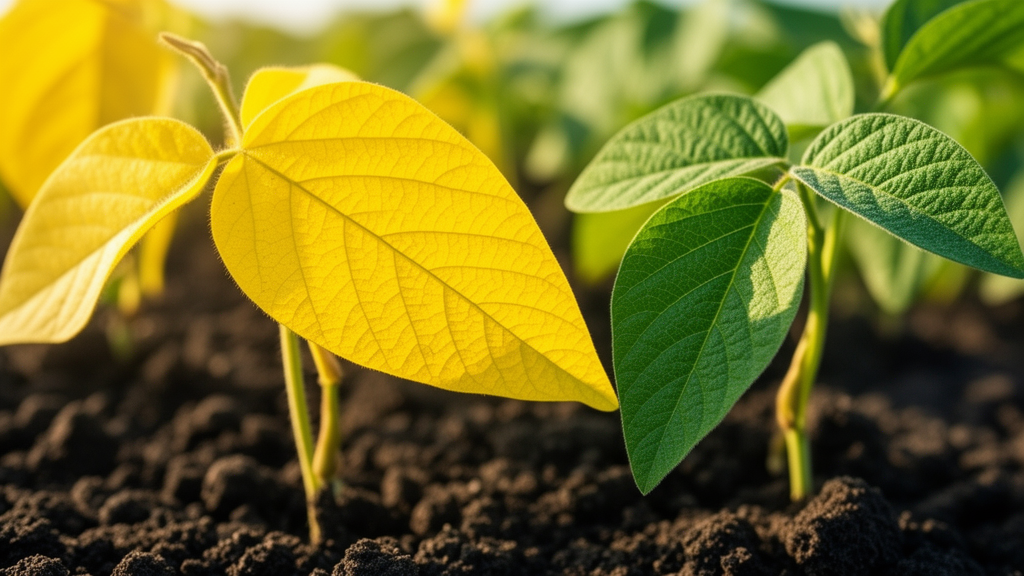
A soybean seedling that turns yellow and dies before it can ever produce a crop is more than an agricultural curiosity. For plant geneticists, such dramatic mutants are windows into the machinery of photosynthesis, and a new study has now zeroed in on what may be going wrong inside one of them. In research published in BMC Plant Biology, a team led by Lei Chen and Jing Zhao of Yantai University, working with colleagues at the Hebei Academy of Agricultural and Forestry Sciences and the Henan Academy of Agricultural Sciences, reports the fine mapping of a recessive mutation called yll, short for yellow-leaf lethal, and the identification of a striking candidate gene whose transcript appears to be misassembled in the mutant plants.
The story begins with the mutant phenotype itself. Seedlings carrying the yll mutation in the homozygous state show a dramatic reduction in chlorophyll content, the green pigment complexes that harvest light in the chloroplast. Their photosystem II, the protein complex at the heart of the light reactions of photosynthesis, performs poorly, and the plants do not survive past the seedling stage. Because the trait is recessive, plants inheriting only one copy of the mutation look perfectly normal, which is exactly the pattern that makes such mutants so useful for genetic analysis. Chlorophyll-deficient mutants have long served as entry points for dissecting chloroplast biology in crops, and soybean, one of the world’s most important oilseed and protein crops, has relatively few such well-characterized loci.
To find the gene responsible, the researchers turned to classical genetic mapping, but at high resolution. By following the inheritance of molecular markers across segregating populations, they narrowed the yll locus to a remarkably small stretch of DNA: a 165-kilobase interval on chromosome 10. In the reference soybean genome annotation known as Wm82.a6.v1, that interval contains just two genes. This is the kind of genetic compression that mapping projects dream of, because it converts a genome-wide search of tens of thousands of genes into a two-horse race.
Of the two genes in the interval, one emerged as the clear frontrunner. Glyma.10G090700, which the authors designate GmPAO7, encodes a protein annotated as a polyamine oxidase, an enzyme of the PAO1-like family. Several independent lines of evidence converged on it. First, the gene is expressed in leaves, the tissue where the phenotype manifests. Second, its transcript abundance is reduced in yll seedlings compared with their normal siblings. Third, and most strikingly, the mutant plants carry a reproducible splicing defect: a 110-base-pair intron between the first and second exons of the gene is retained in the mature messenger RNA instead of being excised.
The consequences of that retained intron are severe. In molecular terms, the extra sequence introduces a premature termination codon, a stop signal that halts protein synthesis far earlier than it should. Computational prediction suggests that instead of the annotated 500-amino-acid PAO1-like protein, the mutant would produce a truncated peptide of only 32 amino acids. That fragment would lack both of the domains that define the enzyme’s function: the flavin amine oxidase domain and the NAD(P)-binding domain. In other words, if the prediction holds, the mutant plants would be effectively devoid of a functional GmPAO7 protein.
The splicing evidence was verified the old-fashioned way, by direct sequencing. The researchers amplified the relevant region of the gene’s complementary DNA by RT-PCR and read the sequence of the products. Wild-type plants showed the normally spliced transcript, with the intron cleanly removed and the first exon joined directly to the second. Homozygous mutant plants showed the intron-retained sequence. Heterozygous plants, carrying one normal and one mutant copy, displayed overlapping splice forms, with sequencing chromatograms showing mixed signals downstream of the splice junction, consistent with both transcript types being present. The authors are careful to note that this qualitative assay demonstrates the presence of the aberrant transcript but does not establish the relative proportions of the splice forms in any genotype.
To understand what the mutation does to the plant more broadly, the team performed RNA sequencing on mutant and wild-type sibling seedlings at the same developmental stage. The comparison revealed widespread expression differences, with significant enrichment of genes involved in photosynthesis, chloroplast function, and redox metabolism. A protein-protein interaction network built from the differentially expressed genes, using the STRING database with a confidence threshold of 0.700, retained a connected core of 304 nodes and 3,278 predicted interactions, organized into modules covering photosynthesis and chloroplast function, ribosome and translation, RNA processing, redox metabolism, and protein folding. Supplementary heatmaps also documented changes in transcription factor families including MYB, NAC, WRKY, bHLH, ERF/AP2, and bZIP, as well as in genes associated with the major plant hormones: auxin, gibberellin, cytokinin, abscisic acid, and ethylene.
Here the authors exercise an important caution. Because yll seedlings are severely chlorotic and developmentally compromised, the transcriptomic differences they observe cannot be taken as a clean readout of the gene’s primary function. A dying, yellow seedling is a very different biological system from a healthy green one, and many of the expression changes may simply reflect the downstream consequences of a failing chloroplast rather than direct regulatory effects of the candidate gene. The profiles are best interpreted, the authors write, as the transcriptomic state associated with the phenotype. This distinction matters, and it is the kind of nuance that separates careful candidate-gene studies from overreach.
Complementary evidence came from the electron microscope. Transmission electron microscopy of mutant leaves revealed chloroplast ultrastructural abnormalities: grana, the stacked membrane structures where photosystem II concentrates, were poorly developed, and the thylakoid membranes were disorganized. These defects are entirely consistent with the reduced chlorophyll content and impaired photosystem II performance measured physiologically. But as the authors point out, ultrastructural observations, while suggestive, do not by themselves functionally validate the candidate gene. They describe the cellular wreckage without proving which genetic wrench caused it.
That proof remains the outstanding task. Glyma.10G091000, the second gene in the 165-kilobase interval, has not been excluded, and the authors are explicit that functional complementation, introducing a normal copy of GmPAO7 into the mutant to see whether it rescues the phenotype, or the identification of an independent allele of the same gene, will be required to establish causality. They also flag a tempting but untested hypothesis: a connection between polyamine oxidase activity, polyamine metabolism, and reactive oxygen species. Polyamine oxidases are known to participate in redox reactions that can generate hydrogen peroxide, and such a pathway could plausibly tie a defective oxidase to chloroplast damage and cell death. But the authors did not measure PAO enzyme activity, polyamine concentrations, or reactive oxygen species levels in this study, so that link remains a hypothesis to be tested, not a finding.
Even with those caveats, the study is a textbook example of how modern crop genetics proceeds. A lethal phenotype is captured, mapped to a small genomic interval, and a candidate is prioritized by triangulating expression data, transcript abundance, and a concrete molecular lesion, in this case an intron-retention event that would demolish the encoded protein. If GmPAO7 is confirmed, it would add a new entry to the short list of genes whose disruption produces chlorophyll-deficient, seedling-lethal phenotypes in soybean, and it would spotlight alternative splicing, a process often overlooked in crop mutation screens, as a source of catastrophic developmental defects. It would also raise broader questions about what polyamine oxidation contributes to chloroplast maintenance in one of the world’s staple legumes. For now, the strongest candidate stands accused, the evidence is circumstantial but coherent, and the decisive experiment, complementation, is the next act in a story that began with a handful of yellow seedlings that never made it out of the seedling tray.
Subject of Research: Fine mapping and candidate gene analysis of a soybean yellow-leaf lethal mutant implicating aberrantly spliced polyamine oxidase gene GmPAO7
Article Title: Fine mapping of yll prioritizes aberrantly spliced Glyma.10G090700 (GmPAO7) as the strongest candidate in a soybean yellow-leaf lethal mutant
Article References: Chen, L., Feng, J., Ning, J., Shi, X., Wu, X., Che, X., Li, Z., Yu, Z., Wang, X., Chen, Q., Sun, H., Guo, Y., Liu, L., Ma, Z., Li, H., Lin, J., & Zhao, J. (2026). Fine mapping of yll prioritizes aberrantly spliced Glyma.10G090700 (GmPAO7) as the strongest candidate in a soybean yellow-leaf lethal mutant. BMC Plant Biology. https://doi.org/10.1186/s12870-026-10015-9
Image Credits: AI Generated
DOI: 10.1186/s12870-026-10015-9
Keywords: soybean, yellow-leaf lethal mutant, GmPAO7, polyamine oxidase, intron retention, alternative splicing, chloroplast, chlorophyll deficiency, fine mapping, candidate gene, RNA-seq, photosystem II
Cite Scienmag News
Juliet Wilcox. (October 15, 2026). A Single Botched Splice May Explain a Deadly Yellow-Leaf Soybean Mutant. Scienmag. https://scienmag.com/a-single-botched-splice-may-explain-a-deadly-yellow-leaf-soybean-mutant/
Juliet Wilcox. "A Single Botched Splice May Explain a Deadly Yellow-Leaf Soybean Mutant." Scienmag, 15 October 2026, https://scienmag.com/a-single-botched-splice-may-explain-a-deadly-yellow-leaf-soybean-mutant/. Accessed 15 October 2026.
Juliet Wilcox. "A Single Botched Splice May Explain a Deadly Yellow-Leaf Soybean Mutant." Scienmag. October 15, 2026. https://scienmag.com/a-single-botched-splice-may-explain-a-deadly-yellow-leaf-soybean-mutant/


