


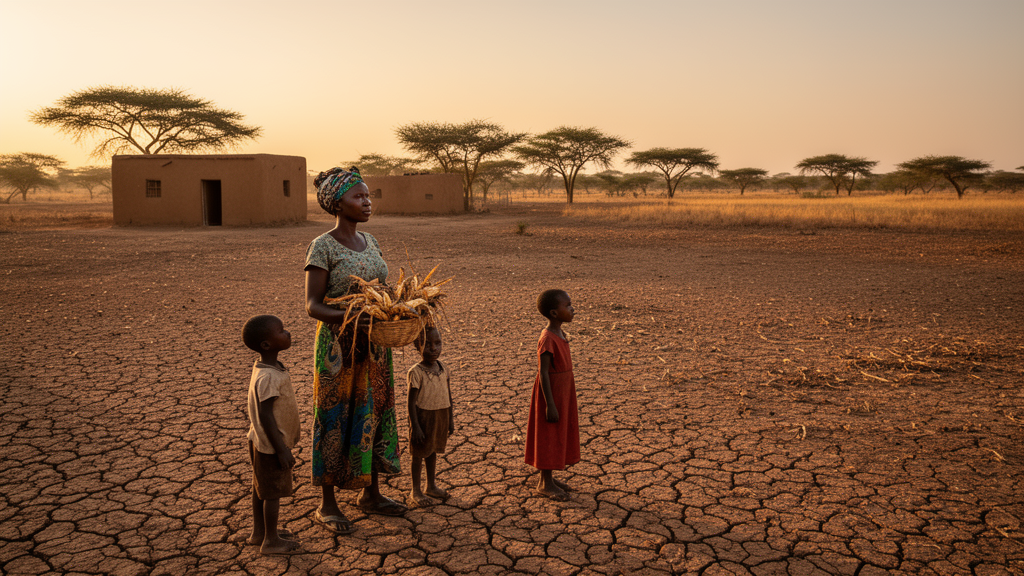
Climate change is often described as a threat that hits the poorest hardest, but a new study suggests the story of who loses what is far stranger than that simple narrative implies. In research published in the journal Discover Sustainability, Pieter Opperman of Stellenbosch Business School and A. F. Tita of the University of the Western Cape examined how a country’s exposure to climate hazards, and its capacity to respond to them, relate to the concentration of income at the very top of the distribution across 42 sub-Saharan African countries. Their central finding is counterintuitive: greater climate vulnerability is associated with smaller income shares for the richest 10 percent and richest 1 percent of the population, while climate readiness shows no consistent relationship with top incomes at all.
The study matters because it connects two global goals that are usually pursued on separate tracks. Sustainable Development Goal 13 calls for urgent climate action, and Sustainable Development Goal 10 calls for reduced inequality within countries. Policymakers frequently assume these agendas reinforce one another, since climate disasters demonstrably devastate low-income households. But the authors caution that a falling measured inequality statistic is not the same thing as improved welfare for the poor. If climate shocks compress measured inequality by destroying wealth and income at the top, or by pushing previously middle-class households down the ladder, the statistical signature looks identical to a genuine redistribution, even though nobody is actually better off.
To disentangle these possibilities, the researchers assembled an annual panel dataset covering the years 1995 to 2021, a period spanning nearly three decades of economic transformation, commodity booms, and intensifying climate stress across the continent. Their dependent variables were the top 10 percent and top 1 percent income shares, measures drawn from distributional data that capture how much of a nation’s total income flows to its wealthiest residents. The climate side of the analysis relied on indices of vulnerability and readiness, concepts popularized by the Notre Dame Global Adaptation Initiative, which score countries on exposure to climate hazards, sensitivity to their impacts, and the capacity to adapt.
Methodologically, the paper’s most distinctive feature is its use of a method-of-moments quantile regression estimator, abbreviated MM-QR, applied to panel data with country fixed effects. Ordinary regression techniques estimate how a explanatory variable shifts the average of an outcome, which in this context would mean the average level of inequality across countries and years. Quantile regression instead asks how the association changes across the conditional distribution of the outcome itself. This distinction is crucial for inequality research, because the forces that shape inequality in a relatively egalitarian country may operate very differently in a country where income is already extremely concentrated at the top. A single average effect could easily mask opposing dynamics at the two ends of the distribution.
The results reveal exactly that kind of heterogeneity. Climate vulnerability is negatively associated with both top income measures, but the association is generally stronger and more consistently statistically significant at lower levels of income concentration. In other words, in countries where the top decile already commands a modest share of national income, additional vulnerability is linked to further compression of top incomes, while in the most unequal countries the relationship weakens. The authors also report robustness checks using a logarithmic Gini coefficient as the dependent variable, and the pattern holds: vulnerability coefficients are negative across the distribution, ranging from strongly significant at the lowest quantiles to weaker and less precisely estimated at the highest.
Perhaps the most sobering result concerns climate readiness, the composite of economic capacity, governance quality, and social preparedness that adaptation advocates often treat as the key lever for building resilience. Across the quantiles of the top income share distributions, readiness shows no systematic association with either measure of income concentration. The sensitivity analyses reinforce this picture: when the authors re-estimate their models on restricted country samples, the negative vulnerability association largely survives, though the top 10 percent relationship proves more sensitive to which countries are included. Readiness, by contrast, never settles into a stable sign or significance pattern. Aggregate national preparedness, it appears, does not automatically translate into more inclusive distributional outcomes.
Why would vulnerability shrink top income shares? The authors are careful not to overclaim a causal mechanism, but several interpretations are consistent with the evidence. Climate hazards in sub-Saharan Africa frequently strike agriculture, the sector that employs the majority of the workforce, and repeated droughts and floods can depress aggregate output, compress returns to capital, and erode the asset base of wealthier households alongside poorer ones. Alternatively, vulnerability may correlate with structural economic features, such as dependence on climate-sensitive exports, that simultaneously constrain top-end income growth. There is also a measurement dimension: top incomes in the region are often captured imperfectly in household surveys, and shocks that push households between income brackets can alter measured shares without altering underlying welfare in the way the statistics imply.
The study’s implications for policy are deliberately double-edged. On one hand, the findings warn against a tempting misreading of the data: a government that sees its top income share falling during a period of intensifying climate stress should not congratulate itself on progress toward SDG 10. The compression may reflect destruction rather than redistribution, and the appropriate response is adaptation investment, not complacency. On the other hand, the null result for readiness delivers an equally important message to the adaptation community. Building readiness, through stronger institutions, better infrastructure, and improved adaptive capacity, is valuable in its own right, but the evidence here suggests it cannot be assumed to deliver distributional benefits automatically. If climate policy is to serve both agendas simultaneously, distributional outcomes must be monitored and targeted explicitly rather than treated as a byproduct of resilience.
The research also showcases the value of quantile-based methods for development economics more broadly. The authors’ finding that associations vary across the conditional distribution of inequality would have been invisible to a standard mean-based analysis, and the scale parameters reported in their robustness appendix indicate that vulnerability and readiness also relate to the dispersion of inequality across countries, not just its central tendency. For a region where income concentration ranges from moderate to extreme, and where climate exposure varies from the Sahel’s drought belt to the cyclone-prone southeastern coast, that heterogeneity is not a statistical curiosity but the substantive story. Averages flatten precisely the variation that policymakers need to see.
As climate stress intensifies across sub-Saharan Africa, the study offers a reminder that the distributional consequences of a warming world cannot be read off a single statistic. Falling top income shares in vulnerable countries may signal resilience, or they may signal erosion, and only distribution-sensitive methods combined with careful welfare analysis can tell the difference. Meanwhile, the absence of a readiness-inequality link suggests that the region’s adaptation investments will be judged on many dimensions, and that inclusive outcomes will require deliberate design rather than hopeful assumption. The joint pursuit of climate action and reduced inequality, the authors conclude, demands that economists and policymakers look beyond averages and ask, quantile by quantile, who is actually gaining and who is actually losing.
Subject of Research: The relationship between climate vulnerability, climate readiness, and top income shares in sub-Saharan African countries
Article Title: Distributional effects of climate vulnerability and readiness on top income shares in sub-Saharan Africa
Article References: Distributional effects of climate vulnerability and readiness on top income shares in sub-Saharan Africa. (n.d.). https://doi.org/10.1007/s43621-026-05014-7
Image Credits: AI Generated
DOI: 10.1007/s43621-026-05014-7
Keywords: climate vulnerability, climate readiness, income inequality, sub-Saharan Africa, top income shares, panel quantile regression, SDG 13, SDG 10, development economics, Discover Sustainability, Gini coefficient, climate adaptation
Cite Scienmag News
Sloane Callahan. (October 15, 2026). Climate Vulnerability Reshapes the Income Ladder in Sub-Saharan Africa, Study Finds. Scienmag. https://scienmag.com/climate-vulnerability-reshapes-the-income-ladder-in-sub-saharan-africa-study-finds/
Sloane Callahan. "Climate Vulnerability Reshapes the Income Ladder in Sub-Saharan Africa, Study Finds." Scienmag, 15 October 2026, https://scienmag.com/climate-vulnerability-reshapes-the-income-ladder-in-sub-saharan-africa-study-finds/. Accessed 15 October 2026.
Sloane Callahan. "Climate Vulnerability Reshapes the Income Ladder in Sub-Saharan Africa, Study Finds." Scienmag. October 15, 2026. https://scienmag.com/climate-vulnerability-reshapes-the-income-ladder-in-sub-saharan-africa-study-finds/


