


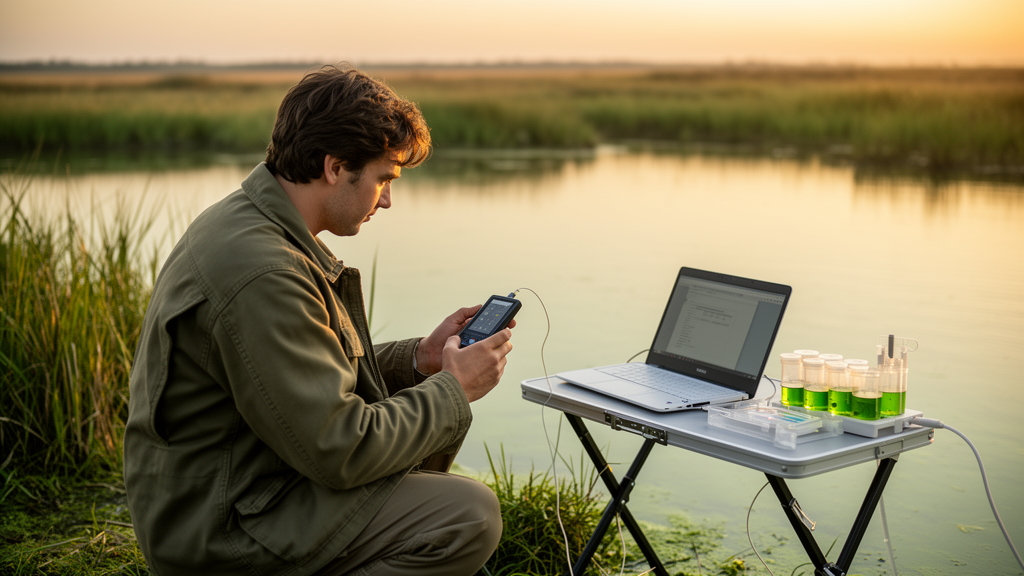
Along Florida’s Atlantic coast stretches one of the most biologically diverse estuaries in North America, a 251-kilometer ribbon of brackish water known as the Indian River Lagoon. In recent decades, this fragile ecosystem has been repeatedly battered by harmful algal blooms, explosive growths of microscopic organisms that can poison fish, shellfish, and even the people who depend on them. Now, a team of researchers has demonstrated that a handheld DNA sequencer, small enough to fit in a backpack, can detect the microbial culprits behind these blooms with unprecedented speed and detail, potentially transforming how coastal managers respond to emerging threats.
The study, published in PLOS Water, was led by Justin Gibbons, Heidi Pagán, Tatiana Ferrer, Rays H. Y. Jiang, and Greg O’Corry-Crowe. Rather than relying on traditional microscopy or conventional short-read genetic sequencing, the team turned to Oxford Nanopore Technologies’ MinION platform, a device that reads long strands of DNA by threading them through tiny protein pores and measuring the electrical signals produced as each base passes through. This long-read approach allowed the researchers to target the 18S rRNA gene, a genetic marker specific to eukaryotic organisms, the branch of life that includes algae, dinoflagellates, and other complex single-celled organisms responsible for many of the world’s most damaging blooms.
The choice of target matters enormously. Most environmental DNA surveys of aquatic microbial communities have historically focused on the 16S rRNA gene, which preferentially captures bacteria and archaea, the prokaryotic members of the microbial world. While these surveys are valuable for tracking bacterial communities, they largely miss the eukaryotic species that form harmful algal blooms. By designing their survey around the 18S marker and pairing it with long-read sequencing, the researchers were able to generate community profiles that resolved eukaryotic diversity at a level of detail that shorter reads and prokaryote-focused assays simply cannot match.
Sampling was ambitious in scope. The team collected water from 20 sites spread across the lagoon, capturing both wet and dry seasons and covering the estuary’s full latitudinal range, which spans both subtropical and temperate subregions. This design allowed them to ask not just which harmful species are present, but where and when they flourish, and how their distributions track the environmental conditions of the lagoon. The Indian River Lagoon is a notoriously complex system, with restricted ocean inlets, variable salinity gradients, and nutrient inputs from a heavily developed watershed, all of which shape the microbial communities living in its waters.
The sequencing results were striking. Across the samples, the team detected more than 200 unique eukaryotic species, and the community composition differed clearly by season, by region, and along environmental gradients including salinity, temperature, and nutrient ratios. These patterns offer a window into the ecological forces that govern which microbes dominate at any given place and time. In an estuary where conditions can shift rapidly with rainfall, runoff, and temperature, understanding these relationships is essential for predicting when conditions become favorable for a bloom to ignite.
Most importantly from a public health and ecological standpoint, the survey detected eleven harmful algal bloom taxa, including some of the most notorious offenders in Florida waters. Among them were Aureoumbra lagunensis, the golden alga responsible for the devastating brown tide events that have clouded lagoon waters and collapsed seagrass meadows; Karlodinium veneficum, a dinoflagellate that produces ichthyotoxins capable of killing fish; and Pyrodinium bahamense, which produces saxitoxins that accumulate in shellfish and can cause paralytic shellfish poisoning in humans. In some sampling sites, Aureoumbra lagunensis accounted for more than 50 percent of the relative abundance of the eukaryotic microbial community, a dominance that signals the kind of near-monoculture conditions characteristic of an active or incipient brown tide.
The ability to detect such dominance with genetic tools rather than microscopy carries practical advantages. Traditional bloom monitoring depends heavily on expert taxonomists identifying organisms under a microscope, a process that is labor-intensive, slow, and dependent on the availability of specialized skills. Morphological identification can also be ambiguous, since closely related species may look nearly identical while differing sharply in toxicity. Genetic barcoding of the 18S region sidesteps many of these problems, offering a molecular fingerprint that can distinguish species even when their physical forms cannot be told apart.
What sets the nanopore approach apart from earlier genetic methods is its potential for near real-time, field-deployable analysis. The MinION sequencer is compact and can be run outside a conventional laboratory, meaning that water samples collected from the lagoon could in principle be processed on-site or nearby, with results available in hours rather than days or weeks. For resource managers charged with protecting public health, closing shellfish beds, or warning recreational users, that speed could make the difference between a timely intervention and a costly after-the-fact response. The authors present the approach as a promising tool for rapid detection of harmful algal bloom species in complex estuarine systems like the Indian River Lagoon.
The findings also carry broader scientific significance. By documenting how eukaryotic microbial communities shift across seasons, regions, and environmental gradients, the study improves understanding of the ecological drivers that shape bloom risk. Salinity, temperature, and the ratios of nutrients such as nitrogen and phosphorus are known to influence which species can thrive, and the lagoon’s north-to-south span across climatic zones makes it a natural laboratory for studying how these factors interact. As climate change alters rainfall patterns, warms coastal waters, and intensifies nutrient runoff in estuaries worldwide, tools that can track microbial communities at fine spatial and temporal resolution will become increasingly valuable for anticipating, rather than merely reacting to, bloom events.
The Indian River Lagoon itself has become a symbol of both ecological vulnerability and scientific urgency. Its waters support dolphins, manatees, sea turtles, and thousands of other species, and its seagrass beds, already stressed by decades of blooms and nutrient loading, form the foundation of the estuary’s food web. Monitoring programs that can rapidly identify which harmful species are present, and in what abundance, give scientists and managers a fighting chance to protect these resources. This study demonstrates that long-read sequencing of the 18S rRNA gene can capture the full breadth of eukaryotic diversity in estuarine waters while resolving the potentially harmful taxa that matter most, offering a template that other coastal systems, from Chesapeake Bay to the Gulf of Mexico, could readily adopt as harmful algal blooms continue to intensify around the world.
Subject of Research: Near real-time long-read eDNA sequencing of 18S rRNA to monitor harmful algal bloom species in the Indian River Lagoon estuary
Article Title: Near real-time long-read eDNA sequencing reveals harmful algal bloom dynamics in the Indian River Lagoon
Article References: Gibbons, J., Pagán, H., Ferrer, T., Jiang, R. H. Y., & O’Corry-Crowe, G. (2026). Near real-time long-read eDNA sequencing reveals harmful algal bloom dynamics in the Indian River Lagoon. PLOS Water, 5(10), e0000557. https://doi.org/10.1371/journal.pwat.0000557
Image Credits: AI Generated
DOI: 10.1371/journal.pwat.0000557
Keywords: harmful algal blooms, environmental DNA, nanopore sequencing, Indian River Lagoon, 18S rRNA, Aureoumbra lagunensis, Karlodinium veneficum, Pyrodinium bahamense, estuarine ecology, brown tide, water quality monitoring, Oxford Nanopore MinION
Cite Scienmag News
Juliet Wilcox. (October 15, 2026). Pocket-Sized DNA Sequencer Tracks Toxic Algal Blooms in Real Time. Scienmag. https://scienmag.com/pocket-sized-dna-sequencer-tracks-toxic-algal-blooms-in-real-time/
Juliet Wilcox. "Pocket-Sized DNA Sequencer Tracks Toxic Algal Blooms in Real Time." Scienmag, 15 October 2026, https://scienmag.com/pocket-sized-dna-sequencer-tracks-toxic-algal-blooms-in-real-time/. Accessed 15 October 2026.
Juliet Wilcox. "Pocket-Sized DNA Sequencer Tracks Toxic Algal Blooms in Real Time." Scienmag. October 15, 2026. https://scienmag.com/pocket-sized-dna-sequencer-tracks-toxic-algal-blooms-in-real-time/


