


Some 7,300 years ago, one of the most explosive volcanic events in Earth’s history tore through the seafloor off southern Japan. The Kikai-Akahoya eruption, as it is now known, struck without warning during the mid-Holocene, a period when the Japanese archipelago was home to Jomon foraging communities who lived by hunting, fishing and gathering. The catastrophe unleashed powerful earthquakes and enormous tsunamis on the surrounding islands, and then buried the landscape under meters of volcanic ash. For decades, archaeologists have debated what this disaster meant for the people who lived through it, with some portraying it as an apocalypse that extinguished all human life near the epicenter and others arguing that populations survived even in areas close to the eruption. A new international study led by Lund University, published in Science Advances, now shows that both of those interpretations are too simple, and that the demographic aftermath of the eruption was far more varied and surprising than anyone had previously believed.
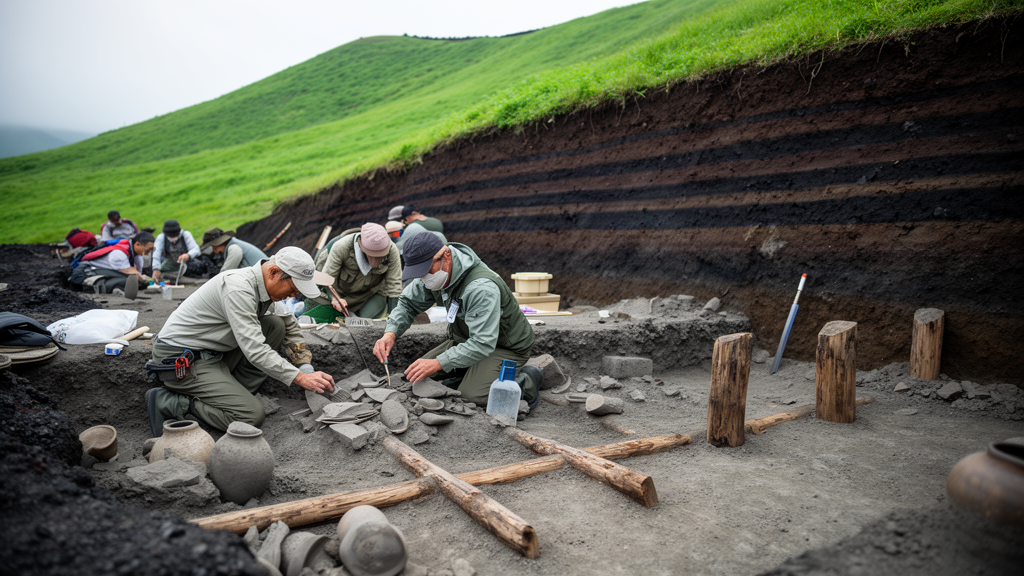
The research team set out to reconstruct what actually happened to population levels across Japan in the centuries surrounding the eruption. Rather than relying on a single line of evidence, the study examined patterns of human presence across different regions, comparing the situation before the disaster with the situation after it. The volcanic ash itself provides a convenient marker for archaeologists: the so-called disaster layer runs across the landscape of southern Kyushu like a horizontal line, and by studying what life was like below this line and above it, researchers can trace human impacts and responses across the catastrophic boundary. This approach allowed the team to move beyond sweeping narratives of total collapse or unbroken continuity and to identify regionally distinct demographic trajectories that had never been recognized before.
One of the study’s most striking findings concerns southern Kyushu, the region closest to the eruption. The evidence indicates that Jomon forager populations there were already in decline long before the volcano exploded. The disaster, in other words, struck a region that was already sparsely populated and that was only being visited by highly mobile groups rather than densely settled communities. This pre-existing pattern of low and declining population fundamentally shaped how the eruption was experienced in the area. The devastation near the epicenter was real and severe, but the human cost was distributed across a landscape that had already been largely emptied of permanent settlement, a nuance that earlier debates about the eruption had largely overlooked.
In northern Kyushu, the picture was dramatically different. Populations there had been growing before the eruption, and remarkably, this growth trend continued right through the disaster and its aftermath, despite the massive and enduring damage that the eruption inflicted on regional ecosystems. The authors suggest that this resilient growth may have been driven in part by refugees moving out of the worst-hit areas immediately after the catastrophe. Survivors fleeing the ash-buried landscapes of the south appear to have been absorbed into communities further north, where they forged new social relations and contributed to continued demographic expansion. The finding challenges any assumption that a volcanic disaster of this magnitude must produce uniform demographic collapse across an entire archipelago, and instead reveals a patchwork of local outcomes shaped by geography, mobility and social connection.
The study also identified a distinctive pattern of movement and adaptation among inland survivors. Rather than remaining in the devastated interior, these groups appear to have moved away and clustered along northern coastlines, where marine ecosystems recovered relatively quickly after the eruption. Population growth in these coastal zones may have been accelerated by new kinds of adaptation focused on exploiting the abundant resources of the sea. In this sense, the disaster did not merely destroy; it also redirected human settlement and subsistence, pushing communities toward the coast and encouraging economic innovations centered on marine resources. Lead author Enrico Crema, a professor at Cambridge University, notes that while the disaster caused major loss of life, survivors migrated, forged new social relations, innovated new kinds of economy, and appear to have found creative ways to exist and later thrive in the new post-disaster conditions.
Perhaps the most unexpected discovery lies in the more distant regions of Japan, far from the eruption itself. These areas had experienced population growth before the disaster, but after it they saw demographic stagnation or even decline. Such far-reaching effects had never been identified before, and their causes remain under investigation. The authors propose several possible explanations. The eruption may have triggered short-term climate change with consequences that rippled across the archipelago. Alternatively, or additionally, the deer and boar that the Jomon relied on for their food supplies may have suffered catastrophic tooth attrition, possibly a consequence of the animals grazing in ash-covered landscapes, undermining a critical food source for hunter-gatherer communities far from the epicenter. A suite of other volcanic impacts on human health and well-being may also have played a role. Whatever the precise mechanism, the finding demonstrates that a catastrophic eruption can reshape human demography across an entire region, not only in its immediate blast zone.
Taken together, these divergent regional trajectories paint a picture of disaster response that is contingent, uneven and deeply human. Senior author Peter Jordan, professor in archaeology at Lund University, emphasizes that the eruption must have been devastating, exploding out of the sea bed with little warning, battering the Japanese islands with powerful earthquakes and enormous tsunamis, and then blanketing the landscape with meters of volcanic ash. Yet the study shows that even in the most impossible situations, survivors and communities have choices, however limited. They need to act and make decisions, to adjust, to collaborate and to find new connections and social networks. The archaeological record of the Kikai-Akahoya aftermath captures exactly these processes: migration, alliance-building, economic reinvention and the gradual reweaving of social life in the shadow of a catastrophe.
The research also carries broader implications for how scientists and societies think about disasters today. By demonstrating how unpredictable and complex the aftermath of a major disaster can be, the study helps create a deeper understanding of the contingent ways in which cultures and societies cope with sudden shocks and catastrophes. The Jomon foragers of mid-Holocene Japan had no warning systems, no emergency services and no external aid, yet their responses, migration toward refugia, concentration along productive coastlines, and innovation in subsistence strategies, echo patterns familiar from modern disaster studies. The lesson from seven millennia ago is that demographic outcomes after catastrophe are not predetermined by the scale of the event itself, but emerge from the interplay of pre-existing population conditions, environmental recovery rates, mobility and the social capacity of survivors to reorganize.
For archaeologists, the Kikai-Akahoya eruption offers a rare natural experiment: a single, precisely dated, regionally variable catastrophe whose effects can be read in the layers of ash and the traces of human activity above and below them. The new study replaces a decades-old binary debate, total apocalypse versus local survival, with a far richer account in which some regions declined before the disaster even struck, others absorbed refugees and kept growing, coastal communities reinvented themselves around marine resources, and distant populations faltered for reasons that may connect to climate, animal health or wider volcanic impacts. In doing so, it reminds us that the deepest lessons of past disasters concern not the violence of nature but the resourcefulness of the people who endured it.
Subject of Research: Demographic responses of Jomon forager societies to the Kikai-Akahoya volcanic eruption in mid-Holocene Japan
Article Title: How one of Earth’s worst volcanic disasters affected societies
Article References: How one of Earth’s worst volcanic disasters affected societies. (n.d.). Original publication
Image Credits: AI Generated
DOI: Not provided
Keywords: Kikai-Akahoya eruption, Jomon, volcanic disaster, archaeology, demography, prehistoric Japan, Kyushu, hunter-gatherers, Science Advances, Lund University, tsunami, population resilience
Cite Scienmag News
Courtney Benton. (October 14, 2026). Ancient Japanese volcano disaster reshaped societies in unexpected ways. Scienmag. https://scienmag.com/ancient-japanese-volcano-disaster-reshaped-societies-in-unexpected-ways/
Courtney Benton. "Ancient Japanese volcano disaster reshaped societies in unexpected ways." Scienmag, 14 October 2026, https://scienmag.com/ancient-japanese-volcano-disaster-reshaped-societies-in-unexpected-ways/. Accessed 14 October 2026.
Courtney Benton. "Ancient Japanese volcano disaster reshaped societies in unexpected ways." Scienmag. October 14, 2026. https://scienmag.com/ancient-japanese-volcano-disaster-reshaped-societies-in-unexpected-ways/


