


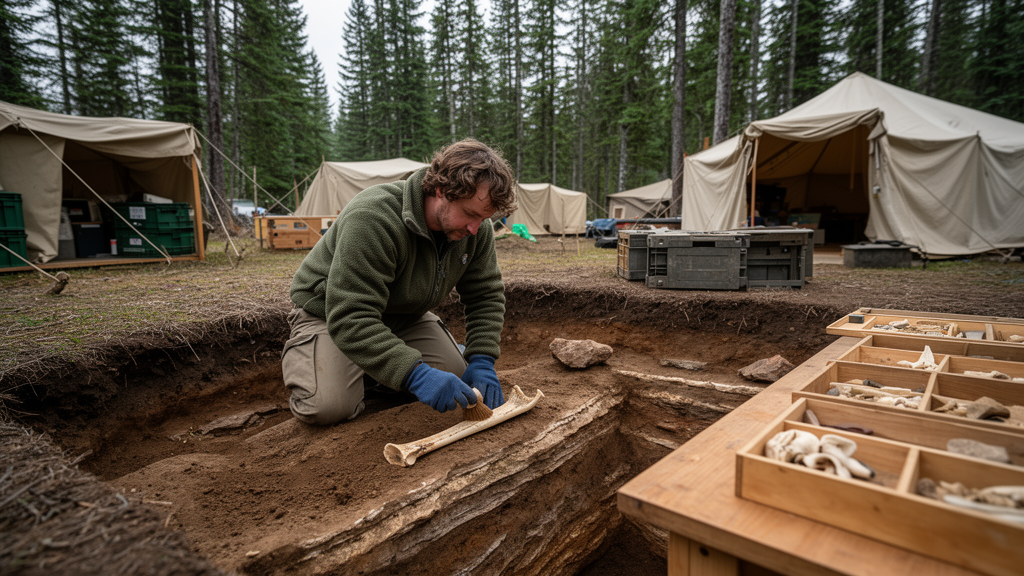
A remarkable archaeological discovery in interior Alaska is reshaping how scientists understand the peopling of the Americas. At a site known as Shég’ Xdaltth’í’—a name that means “they were there” in Alaska Native Athabascan—researchers led by Kelly Graf have documented a 13,800-year-old base camp that appears to have been occupied continuously for more than two centuries. The findings, published in Science Advances, offer the first comprehensive description of the site’s stratigraphy, radiocarbon chronology, plant and animal remains, and an extraordinary assemblage of more than 80,000 artifacts recovered from its oldest cultural layer. Together, these lines of evidence point to something archaeologists have long sought: a tangible cultural connection linking the earliest inhabitants of eastern Beringia with contemporaneous populations living far to the west, on the Asian side of the ancient Bering Land Bridge.
The significance of Shég’ Xdaltth’í’ lies not only in its age but in its character. Unlike kill sites or short-term hunting camps, which dominate the archaeological record of Late Pleistocene Beringia, this location functioned as a settled base camp—a place where people returned repeatedly over generations. Sustained occupation of this kind implies a degree of stability and familiarity with the landscape that challenges older models of rapid, restless migration. The inhabitants were not simply passing through; they were living, working, and maintaining a community in the subarctic interior of what is now Alaska during a pivotal moment in human history, when the last ice age was loosening its grip on the northern hemisphere.
The excavation team applied rigorous geoarchaeological methods to establish the site’s chronology and formation history. Careful documentation of the stratigraphic sequence allowed researchers to distinguish the oldest cultural layer from later deposits, while a series of radiocarbon dates anchored the earliest occupation to approximately 13,800 calendar years before present. This dating framework is critical, because it places the site’s foundation within the narrow window when interior Alaska was becoming habitable as glacial conditions eased. The stratigraphic integrity of the deposits means that the artifacts and ecological remains within the oldest layer can be confidently associated with a single, well-defined period of use, rather than a jumbled mixture of occupations spanning millennia.
The artifact assemblage itself is the heart of the discovery. More than 80,000 items from the oldest layer include stone tools, debitage from tool manufacture, and other material traces of daily life. Among these, one artifact class stands out for its analytical importance: a distinct hafted-biface form, a type of stone projectile point or knife blade designed to be attached to a handle or shaft. Hafted bifaces are among the most culturally diagnostic artifacts in Paleolithic archaeology, because their specific shapes and manufacturing techniques were transmitted through teaching and tradition rather than reinvented by each generation. When similar forms appear at sites separated by vast distances, archaeologists consider this strong evidence of shared cultural heritage or direct contact between populations.
That is precisely what the researchers found. The hafted-biface forms and other tools at Shég’ Xdaltth’í’ resemble those recovered from Beringian sites located further to the west, in the region of the Bering Land Bridge that once connected northeastern Asia to Alaska. During the Late Pleistocene, sea levels were substantially lower, exposing a broad plain—sometimes called Beringia—that stretched for hundreds of kilometers between the two continents. If the tool forms at the Alaskan site match those from western Beringian sites, the implication is that the people who established this base camp carried with them a technological tradition rooted in Asia, preserving a trans-Beringian cultural connection even after their ancestors had crossed into the New World.
At the same time, the assemblage contains artifacts that echo traditions known from much further south in temperate North America. Some pieces resemble forms associated with pre-Clovis, Clovis, Folsom, and Late Paleoindian complexes—the successive fluted-point and projectile-point traditions that define the early archaeological record of the American midcontinent and beyond. This dual character makes Shég’ Xdaltth’í’ an unusually valuable data point. It sits at a geographic and chronological crossroads, showing both the Asian-derived heritage of Beringia’s first peoples and hints of the technological developments that would spread southward as populations expanded into the Americas. Few sites anywhere in the North American Arctic preserve this combination of affinities in a single, well-dated context.
The ecological remains from the site add another dimension to the story. Analysis of animal and plant materials recovered from the oldest layer provides a picture of the environment in which these early Beringians lived and the resources they relied upon. Interior Alaska at the end of the Pleistocene supported a mosaic of open habitats that sustained large herbivores and the human hunters who pursued them. Documenting which species were present and exploited helps researchers reconstruct subsistence strategies at the base camp and assess how a settled, multi-generational occupation could be supported in a subarctic setting. Such paleoecological data are essential for understanding not just where people were, but how they made a living once they arrived.
The broader context of the discovery is a long-running and sometimes contentious debate in New World archaeology: how and when did humans first travel from Asia to the Americas? The classic model long held that the Clovis culture, dating to roughly 13,000 years ago, represented the first successful colonization of the continents. That consensus has eroded over recent decades as sites across both North and South America have yielded credible evidence of earlier human presence. Today, many researchers accept that people were in the Americas well before Clovis, but the routes, timing, and genetic relationships of these early populations remain actively debated. Sites in Beringia—the presumed staging ground for the entire dispersal—are therefore of outsized importance to resolving these questions.
In an accompanying Focus article, archaeologist Spencer Pelton discusses why discoveries like Shég’ Xdaltth’í’ are reviving what he calls an old idea in New World archaeology: the Beringian standstill hypothesis. According to this model, populations that entered the North American continent between roughly 20,000 and 15,000 years ago were halted in Beringia, unable to move southward until the massive ice sheets that blocked interior routes began to retreat. Only then could they continue their journey into temperate North America. A long-used base camp in interior Alaska, occupied at just the moment when southern routes were opening, fits neatly with this scenario. It suggests that Beringia was not merely a corridor people rushed through, but a homeland where founding populations lived for extended periods before dispersing to the south.
As research at Shég’ Xdaltth’í’ continues, the site is poised to become a key reference point for studies of the initial peopling of the Americas. Its combination of secure dating, exceptional artifact preservation, ecological evidence, and demonstrable cultural affinities spanning Beringia gives scientists an unusually complete window onto life at the gateway to the New World. Whether the trans-Beringian connection implied by its tools reflects direct contact across the land bridge, shared ancestry, or both, the base camp demonstrates that the earliest Alaskans were participants in a far-flung cultural world—one that stretched from the plains of Asia to the frontiers of an unexplored continent. In that sense, the site’s Athabascan name proves prophetic: they were there, and the traces they left are now rewriting the opening chapters of American history.
Subject of Research: Late Pleistocene archaeology of a 13,800-year-old base camp in Alaska and its evidence for trans-Beringian cultural connections during the peopling of the Americas
Article Title: Late Pleistocene site in Alaska yields evidence of a trans-Beringian cultural connection
Article References: Late Pleistocene site in Alaska yields evidence of a trans-Beringian cultural connection. (n.d.). Original publication
Image Credits: AI Generated
DOI: Not provided
Keywords: Shég’ Xdaltth’í’, Beringia, Bering Land Bridge, Late Pleistocene, peopling of the Americas, Alaska archaeology, hafted bifaces, base camp, Clovis, pre-Clovis, Science Advances, radiocarbon dating
Cite Scienmag News
Violet Maxwell. (October 14, 2026). Alaska Base Camp Reveals 13,800-Year-Old Trans-Beringian Cultural Link. Scienmag. https://scienmag.com/alaska-base-camp-reveals-13800-year-old-trans-beringian-cultural-link/
Violet Maxwell. "Alaska Base Camp Reveals 13,800-Year-Old Trans-Beringian Cultural Link." Scienmag, 14 October 2026, https://scienmag.com/alaska-base-camp-reveals-13800-year-old-trans-beringian-cultural-link/. Accessed 14 October 2026.
Violet Maxwell. "Alaska Base Camp Reveals 13,800-Year-Old Trans-Beringian Cultural Link." Scienmag. October 14, 2026. https://scienmag.com/alaska-base-camp-reveals-13800-year-old-trans-beringian-cultural-link/


