


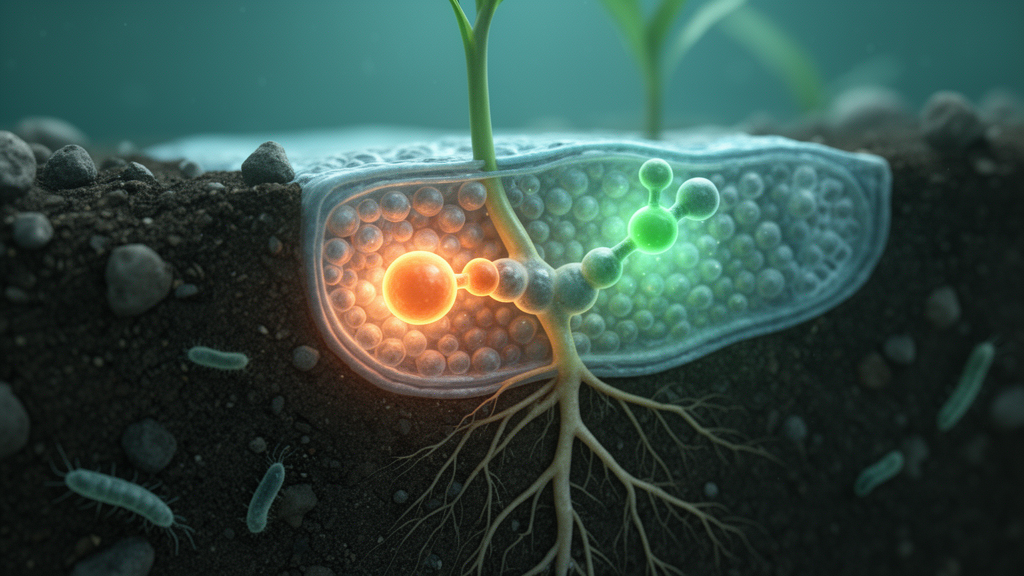
Iron sits at the heart of life on Earth. In human and animal cells it powers energy production and ferries oxygen through the bloodstream, while in immune cells it underpins the machinery that fights infection. For plants, the story begins even earlier in the food chain: crops draw iron from the soil, making them the principal gateway through which this essential mineral enters the human diet. Yet iron is frequently scarce in soils, a problem that scientists suspect will deepen as shifting weather patterns and rising global temperatures alter nutrient availability. Complicating matters further, plants are not the only organisms competing for the element. The microbes that colonize root surfaces and surrounding soil also require iron to survive, setting the stage for a molecular tug of war that has now been resolved, at least in part, by researchers at the Salk Institute for Biological Studies.
In a study published in Science Advances on October 14, 2026, a team led by professor Wolfgang Busch and former staff scientist Matthieu Pierre Platre describes a dual-purpose protein called SRF3 that performs a remarkable balancing act. The receptor both restores cellular iron balance after a microbial invasion and calibrates the plant’s immune response so that it is strong enough to repel attackers without needlessly draining the cell’s precious iron reserves. The work, funded by federal grants from the National Institutes of Health as well as private philanthropy, offers a mechanistic account that spans from a single molecule to the whole organism, and it carries implications that reach from agricultural breeding programs to fundamental questions about how animal cells, including those involved in cancer, organize their surfaces.
The connection between iron and immunity is more than incidental. Because plants anchor the entry point of iron into the food supply, understanding how they regulate the mineral matters for plant health, agriculture, and human nutrition alike. Busch, who holds the Hess Chair in Plant Science at Salk, and Platre have pursued this question for several years. In 2022 the pair published a paper in Nature Communications in which they first identified SRF3 as a mediator of plant responses to microbes. That earlier work showed that SRF3, a receptor embedded in the plasma membrane at the outer boundary of the plant cell, could sense local iron concentrations and direct root growth accordingly. It also hinted that the protein participated in nutritional immunity responses, the strategies by which hosts limit the iron available to pathogens, but the underlying molecular mechanism remained obscure.
The new study closes that gap using Arabidopsis thaliana, a small flowering plant that serves as a laboratory workhorse and stands in for agriculturally important crops such as wheat and corn. Through a sequence of experiments that included flagging and tracking iron levels inside cells, visualizing the movement of SRF3 within the membrane, and removing the protein entirely to observe the consequences, the researchers assembled a step-by-step picture of how the receptor coordinates defense and nutrient retention. What emerged is an elegant feedback loop in which the very act of fighting infection generates the signal that shuts the response back down.
The sequence unfolds as follows. When SRF3 detects an invading microbe, it promotes the generation of reactive oxygen species, chemically reactive molecules that plants deploy as a weapon against pathogens. These molecules are effective antimicrobial agents, but their production consumes the cell’s iron stores, since iron is a cofactor in the enzymes that make and manage them. As iron levels within the cell fall, SRF3 begins to move. The receptor reorganizes itself within the plasma membrane, receives a small molecular tag called ubiquitin, and is pulled from the cell surface into the interior. Once inside, SRF3 can no longer drive the production of new reactive oxygen species. Iron depletion stops, microbial killing winds down, and the cell’s internal balance is restored.
Platre, now a research associate at the Institute for Plant Sciences of Montpellier, emphasized the scope of the mechanistic account. The study, he noted, explains the process from the scale of a single molecule all the way up to the full organism, a level of integration that is rarely achievable in other biological systems. That completeness matters because it allows the researchers to connect a structural change in one membrane protein to a whole-plant outcome, linking nanoscale protein organization to root growth, pathogen resistance, and nutrient status in a single causal chain.
The findings carry two distinct sets of implications. The first is agricultural. Knowledge of how SRF3 governs the trade-off between iron uptake and immune defense could guide the development of crop varieties that resist disease, grow well in marginal soils, and deliver more nutritious food, priorities that grow more urgent as a rising global population confronts changing soil chemistry and extreme weather. The second implication is broader and touches on a conceptual shift in cell biology. Busch suggests that plants effectively use their membranes as a kind of computer, converting the movements of molecules in the external environment into actionable internal signals. In this view, the plasma membrane is not a passive barrier but an active computational surface that integrates environmental information in real time.
That computational view of the cell surface was first proposed for mammalian cells, Platre observes, and the new study demonstrates that the same principle operates in plants. Moreover, the research is the first to show that ubiquitin, one of the most widely used protein tags in cells, can reorganize proteins on the cell surface and thereby change how those proteins respond to their surroundings. Ubiquitin is best known as a mark that flags proteins for destruction, but the SRF3 work reveals a spatial role for the tag, redirecting a receptor’s position within the membrane and, with it, the cell’s behavior. Because ubiquitin signaling and surface receptor dynamics are central to many processes in animal biology, including the signaling pathways that go awry in cancer, the plant findings may illuminate mechanisms relevant well beyond the botanical world.
Future research will push further into the membrane computer concept, aiming to understand how cells integrate multiple streams of information at their surfaces. The team also plans to identify the proteins and genes with which SRF3 interacts, mapping the network that surrounds the receptor and probing how plants respond to environmental cues at a deeper level. Such knowledge, the researchers argue, could help scientists design crops that remain resilient in the face of extreme weather and shifting soil nutrition, turning a fundamental discovery about a single receptor into practical tools for food security.
The study’s author list reflects the collaborative nature of the work. Co-first authors Lukas Brent and Matias Gleason of Salk were joined by Preyanka Mehta, Ling Zhang, Olivier Kaakeh, Laura Martins, and Julie Law of Salk; Laia Armengot and Marc Valls of the Centre for Research in Agricultural Genomics and the Universitat Autònoma de Barcelona; Julie Neveu and Grégory Vert of the University of Toulouse; Min Cao of Salk and Fudan University; Santosh Satbhai of the Indian Institute of Science Education and Research; and Nuria Coll of the Centre for Research in Agricultural Genomics and the Consejo Superior de Investigaciones Científicas. Beyond its agricultural promise, the research underscores a theme that runs through modern biology: the molecules that help an organism eat are often the same ones that help it fight, and understanding how a plant cell weighs food against foe may ultimately teach us something about how our own cells do the same.
Subject of Research: A plant cell surface receptor that couples iron homeostasis with immune signaling
Article Title: Plant cell receptor balances signals from food and foe
Article References: Plant cell receptor balances signals from food and foe. (n.d.). Original publication
Image Credits: AI Generated
DOI: Not provided
Keywords: SRF3, iron homeostasis, plant immunity, Salk Institute, Arabidopsis thaliana, ubiquitin, reactive oxygen species, plasma membrane, nutritional immunity, crop resilience, Science Advances, cell signaling
Cite Scienmag News
Drew Townsend. (October 14, 2026). Plant receptor SRF3 balances iron uptake and immune defense, study finds. Scienmag. https://scienmag.com/plant-receptor-srf3-balances-iron-uptake-and-immune-defense-study-finds/
Drew Townsend. "Plant receptor SRF3 balances iron uptake and immune defense, study finds." Scienmag, 14 October 2026, https://scienmag.com/plant-receptor-srf3-balances-iron-uptake-and-immune-defense-study-finds/. Accessed 14 October 2026.
Drew Townsend. "Plant receptor SRF3 balances iron uptake and immune defense, study finds." Scienmag. October 14, 2026. https://scienmag.com/plant-receptor-srf3-balances-iron-uptake-and-immune-defense-study-finds/


