


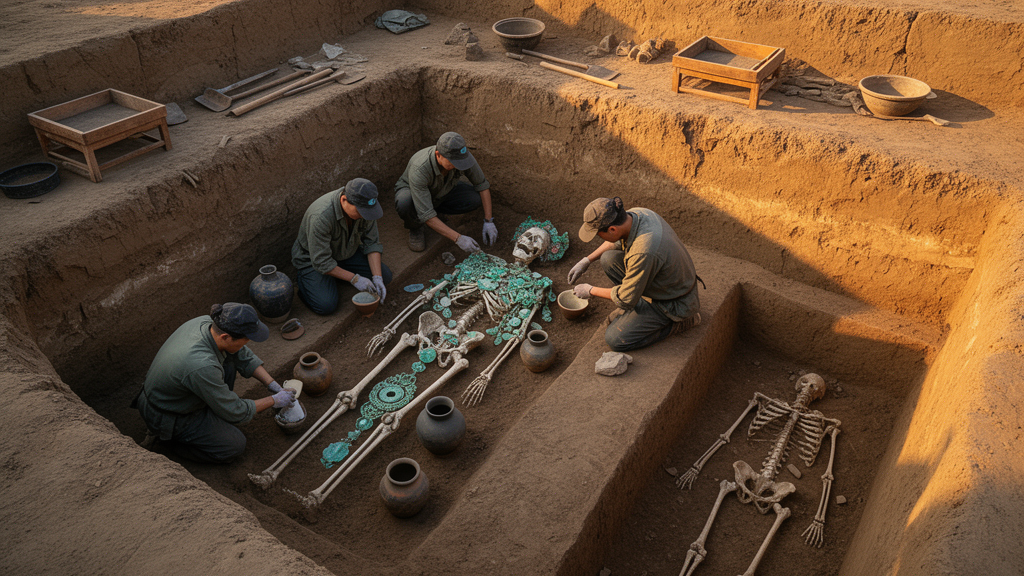
Economic inequality may be far older than the civilizations we traditionally blame for it. A new study published in Science Advances argues that the deep social hierarchies often attributed to the rise of early states were already woven into the fabric of village life in ancient China thousands of years before kings, bureaucracies, or walled cities appeared. By analyzing previously published mortuary data from more than 2,300 burials spanning roughly 6,000 years of continuous settlement in the Central Plain of China, researchers led by Dongdong Li found that inequality was rooted in social-relational networks that long preceded state formation. The finding challenges one of the most persistent assumptions in archaeology: that concentrated political power was the primary engine that created enduring disparities in wealth and status.
For decades, scholars studying the origins of inequality have pointed to two dominant explanations. One emphasizes agricultural intensification, the idea that as farming communities produced surplus food, some people gained control over that surplus and converted it into lasting advantage. The other highlights the rise of the state itself, whose institutions of taxation, law, and organized violence could lock social differences into place across generations. Both models treat hierarchy as a product of large-scale economic or political transformation. The new analysis suggests a different story. When Li and colleagues examined the burial record across the Central Plain, the differentiated social positions they documented could not be explained by agricultural intensification or by the size of the population. Something else was structuring who got more and who got less.
That something, the researchers conclude, was the architecture of social relationships themselves. The team reconstructed networks of social connection in prehistoric China using a combination of isotopic, osteological, and zooarchaeological data from sites dated between 7000 and 1500 BCE. Isotopic signatures preserved in human remains can reveal where individuals grew up and what they ate, offering clues about mobility and diet. Osteological analysis of skeletons records the physical toll of labor, disease, and violence across a lifetime. Zooarchaeological evidence, the animal remains deposited in graves and settlements, illuminates subsistence practices and the ritual significance of particular species. Read together, these lines of evidence allowed the researchers to infer the relational positions individuals occupied within their communities, positions that determined access to labor, resources, and symbolic capital such as ritual objects.
The methodological core of the study lies in how inequality was measured. Burial wealth, the quantity and quality of grave goods interred with the dead, served as one proxy for relational standing, since funerary treatment in early societies typically reflected the social identity of the deceased as perceived by the living. Skeletal health indicators provided a second proxy, because chronic nutritional stress and heavy workload leave readable marks on bone. Dietary variety offered a third, distinguishing people who consumed diverse, protein-rich diets from those constrained to narrower foodways. Crucially, these proxies capture lived experience as well as symbolic display, allowing the researchers to distinguish genuine material inequality from mere differences in mortuary fashion. Across six millennia, the pattern that emerged was one of persistent, structured disparity that predated any recognizable state apparatus in the region.
The Central Plain of China is an ideal laboratory for this question. The region, centered on the middle and lower reaches of the Yellow River, witnessed one of the world’s most consequential trajectories toward urban civilization, culminating in the Bronze Age polities often associated with the earliest Chinese dynasties. Because the study covers sites from 7000 to 1500 BCE, it brackets the entire sequence from early farming villages through escalating social complexity to the threshold of statehood. That long temporal window meant the researchers could test whether inequality appeared only when states emerged, or whether it was already entrenched in communities that lacked centralized government. The answer was unambiguous: the disparities were there from the beginning, embedded in the networks through which people accessed the things that mattered.
According to the study, differential access to valued but scarce items was the original engine of unequal social-relational networks in the region. In small-scale societies, prestige goods such as exotic raw materials, finely crafted ornaments, and ritual paraphernalia carry enormous social weight precisely because they are rare and hard to obtain. People who controlled the flow of such items could build obligations, alliances, and followings, converting access into influence. Over time, those relational advantages compounded. The networks did not merely reflect inequality; they actively produced it, channeling labor, resources, and symbolic capital toward some individuals and away from others in ways that could persist across generations even in the absence of formal political institutions.
What happened next, the researchers argue, was a reorganization rather than a creation of hierarchy. As subsistence practices changed, as wealth became more mobile and therefore more easily accumulated and defended, and as violent conflict escalated across the region, the pre-existing social networks were reshaped to concentrate control over ritual, political, military, and technological domains. Mobile wealth, in particular, changes the calculus of inequality: herds, metals, and other transferable assets can be defended, exchanged, and inherited in ways that fixed fields cannot, giving ambitious actors new tools to consolidate advantage. Escalating warfare likely reinforced the process, since communities under threat tend to concentrate authority in leaders who command violence. The old relational disparities did not disappear; they were repurposed and intensified, their benefits flowing increasingly toward a narrowing elite.
The study’s most striking conclusion concerns the role of the early state itself. Rather than inventing inequality, Li and colleagues conclude, early states stabilized disparities that already existed, institutionalizing control over resources, violence, and network-based access. In this view, the state is best understood not as the author of hierarchy but as its codifier, taking informal, relationship-based advantages and hardening them into law, tribute systems, and hereditary office. This reframing has implications well beyond ancient China. If states institutionalized rather than created inequality, then the search for hierarchy’s origins must look to the micro-level dynamics of human relationships, exchange, and access, not only to the macro-level emergence of governments. It also suggests that dismantling entrenched inequality requires addressing the relational structures, the networks of access and obligation, that underlie formal institutions, not merely reforming the institutions themselves.
The research also demonstrates the power of synthesizing existing data at scale. Rather than excavating new sites, the team reanalyzed previously published mortuary records, integrating isotopic, osteological, and zooarchaeological evidence into a single framework covering more than two millennia of burials. This kind of large-scale comparative approach is increasingly central to archaeology, allowing researchers to detect patterns invisible at any single site and to test long-standing theories against region-wide datasets. The 6,000-year sweep of the Central Plain record offers a rare opportunity to watch social inequality emerge, deepen, and transform across the full arc from Neolithic village to Bronze Age polity, and the results suggest that the roots of hierarchy reach down into the ordinary fabric of social life, far deeper than the rise of states alone can explain.
Subject of Research: The origins of social inequality in Neolithic and Bronze Age China as revealed by mortuary evidence
Article Title: Burial data in ancient China reveal inequality’s deep roots before the rise of states
Article References: Burial data in ancient China reveal inequality’s deep roots before the rise of states. (n.d.). Original publication
Image Credits: AI Generated
DOI: Not provided
Keywords: archaeology, inequality, ancient China, Central Plain, burial analysis, state formation, social networks, Science Advances, Neolithic, Bronze Age, mortuary data, isotopic analysis
Cite Scienmag News
Courtney Benton. (October 14, 2026). Ancient Chinese Burials Show Inequality Predated the Rise of States by Millennia. Scienmag. https://scienmag.com/ancient-chinese-burials-show-inequality-predated-the-rise-of-states-by-millennia/
Courtney Benton. "Ancient Chinese Burials Show Inequality Predated the Rise of States by Millennia." Scienmag, 14 October 2026, https://scienmag.com/ancient-chinese-burials-show-inequality-predated-the-rise-of-states-by-millennia/. Accessed 14 October 2026.
Courtney Benton. "Ancient Chinese Burials Show Inequality Predated the Rise of States by Millennia." Scienmag. October 14, 2026. https://scienmag.com/ancient-chinese-burials-show-inequality-predated-the-rise-of-states-by-millennia/


