


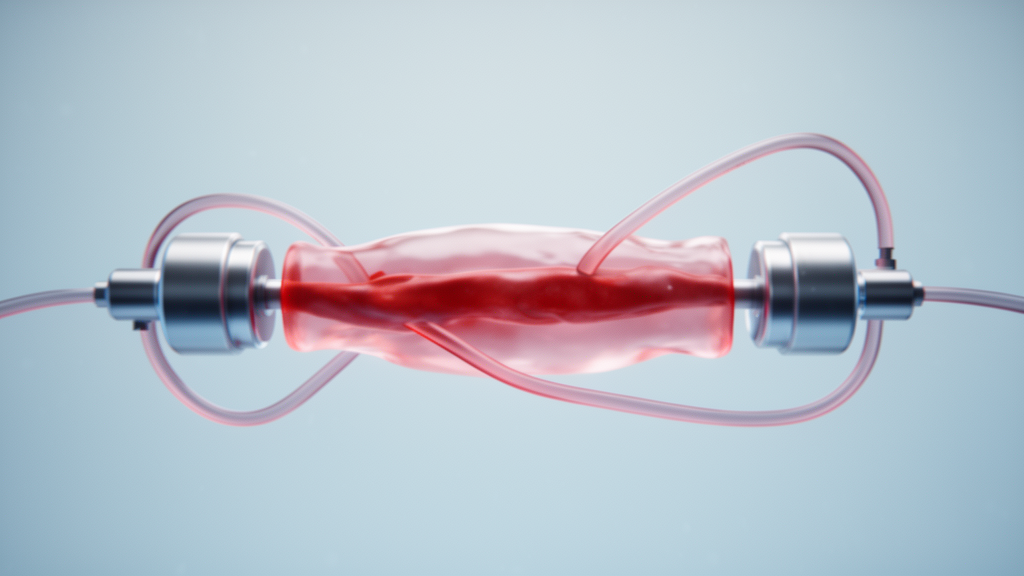
Every heartbeat sends a pressure wave racing down the arteries, and the way that wave is shaped, delayed, and damped carries hidden information about the vessel it travels through. For decades, biomedical engineers have tried to decode that information to assess arterial stiffness, grade blockages, and judge how well synthetic vascular grafts will perform once sewn into the circulation. Now a team of researchers in Israel has introduced a strikingly simple addition to this toolkit: instead of measuring pressure and flow, or stretching tissue samples in a mechanical testing machine, they plot one pressure waveform against another, recorded at two nearby points inside the same vessel. The closed curve that emerges—a pressure–pressure loop—turns out to be a distinctive mechanical fingerprint of the vessel segment, one that changes in recognizable ways as the vessel stiffens or becomes obstructed.
The method, described in the Annals of Biomedical Engineering by Zehava Ovadia-Blechman of Afeka Tel-Aviv Academic College of Engineering, vascular surgeon Moshe Halak of Sheba Medical Center, and colleagues, was tested in a closed-loop pulsatile flow system that mimics the cyclic loading the cardiovascular system imposes on blood vessels. The team examined seven vascular models and grafts spanning a wide range of materials: compliant silicone and latex tubes on the elastic end of the spectrum, and expanded polytetrafluoroethylene (ePTFE) and Dacron grafts—the workhorses of vascular surgery—on the stiff end. Each specimen was run under three conditions of lumen narrowing: no stenosis, a 50 percent narrowing, and a severe 90 percent blockage, allowing the researchers to see how obstruction severity interacts with the intrinsic mechanical behavior of the vessel wall.
The core idea borrows conceptually from the pressure–volume loops that cardiologists have used for a century to characterize the heart. In cardiac physiology, plotting pressure against volume over the cardiac cycle reveals the work the ventricle performs and the elastic properties of the chamber. The new approach replaces volume with a second pressure measurement. Two high-fidelity sensors positioned proximally along the vessel record intraluminal pressure waveforms simultaneously, and the instantaneous pressure at one site is plotted against the instantaneous pressure at the other. Because the wave traveling between the two sites is delayed, reflected, and attenuated by the intervening vessel wall and any narrowing, the resulting loop encodes the integrated dynamic response of that segment—its elasticity, its damping behavior, and its wave-travel characteristics—all captured without any flow probe, diameter gauge, or external deformation device.
What the researchers found was that different materials produce dramatically different loop shapes. The silicone models generated broad, open loops, reflecting the substantial phase lag and deformation that a highly compliant wall imposes on the pressure wave. Latex models displayed more complex patterns in which the loop crossed over itself, a signature of the interplay between wave propagation and the viscoelastic properties of the material. The commercial vascular grafts, by contrast, produced narrow, nearly linear loops—exactly what one would expect from stiff, low-compliance synthetic materials that transmit pressure with minimal distortion. These qualitative differences in loop morphology were consistent and repeatable, suggesting that the shape of the loop alone can distinguish a compliant conduit from a rigid one at a glance.
To move beyond visual inspection, the team distilled the loop into a quantitative descriptor: the slope, denoted α. This parameter captures the dominant orientation of the loop and proved reproducible across repeated measurements. Importantly, the slope descriptor did not replace the morphological information but complemented it. Together, loop shape and slope value differentiated the integrated, configuration-specific dynamic responses of all the tested vessels. The authors are careful about what the loop represents: it is not a single intrinsic material property like Young’s modulus, but rather a composite signature of how the entire vessel segment responds dynamically to pulsatile loading in its specific configuration. To anchor their findings, the team also performed conventional uniaxial tensile testing on the materials, obtaining independent measurements of Young’s modulus that provided context for the loop-based characterization.
The stenosis experiments added a clinically relevant dimension. Increasing the degree of narrowing altered the magnitude of the pressure waveforms, as expected, since a blockage impedes transmission and generates reflections. Yet the characteristic loop patterns remained recognizable across all three stenosis levels. Severe 90 percent narrowing modified specific features of the loops without eliminating the broader patterns that identified the underlying material. This robustness matters because it suggests the method could, in principle, distinguish between ‘what the vessel is made of’ and ‘what is obstructing it’—two questions that clinicians must answer separately when evaluating diseased arteries or failing grafts.
The clinical motivation behind the work is substantial. Current functional assessments of arterial narrowing, such as fractional flow reserve, rely on pressure measurements but require pharmacological-induced hyperemia and, in many cases, intracoronary instrumentation. Arterial stiffness indices such as pulse wave velocity are well-validated predictors of cardiovascular events, but they are influenced by blood pressure itself and integrate stiffness over long arterial paths rather than characterizing a local segment. Compliance mismatch between a graft and the native artery it is connected to has long been associated with poor graft patency, yet graft selection is still largely guided by static material data rather than dynamic, in-situ behavior. A pressure-only technique that can be applied with the kind of sensors already used in catheterization labs could offer a localized, functional readout that complements these existing tools.
The study also connects to a broader research program. Ovadia-Blechman’s group has previously explored pressure-based and photoplethysmographic methods for characterizing arterial stenosis and microcirculatory function, including earlier work on the area of the pressure–flow loop as a stenosis index and on high-frequency components of pressure waves as markers of arterial elasticity. The pressure–pressure loop extends this lineage by eliminating the need for flow measurement entirely, which simplifies instrumentation considerably. Because the method requires only two pressure waveforms, it is inherently minimally invasive in concept and potentially adaptable to endovascular pressure-sensing catheters or wire-based sensors already in clinical use.
Several caveats temper the enthusiasm, and the authors acknowledge them. All experiments were conducted in vitro on synthetic models and commercial grafts, not on living arteries. Native vessels are anisotropic, nonlinearly elastic, tethered to surrounding tissue, and lined with endothelium that actively regulates tone—complexities that silicone and latex tubes only crudely approximate. The relationship between loop descriptors and specific biomechanical parameters such as compliance or characteristic impedance remains to be formally established, and the method’s sensitivity to physiological variables like heart rate, mean pressure, and blood viscosity was not the focus of this initial study. Validation in native blood vessels, whether in animal models or excised human segments, is the necessary next step before any clinical translation can be contemplated.
Even so, the demonstration that meaningful, repeatable descriptors can be extracted from nothing more than two intraluminal pressure waveforms is a genuine methodological contribution. It opens the possibility of monitoring vascular graft behavior over time in patients, detecting early stiffening or stenosis progression without repeated imaging, and providing engineers with a dynamic functional metric to guide the design of next-generation compliant grafts. As computational tools for loop analysis mature, machine learning could further enrich the information extracted from loop morphology, in the same way that automated analysis has transformed photoplethysmography and electrocardiography. For now, the pressure–pressure loop stands as an elegant reminder that sometimes the richest signals in physiology are already being measured—we simply need new ways to plot them against each other.
Subject of Research: A pressure-only loop method for biophysical characterization of blood vessels and vascular grafts
Article Title: Pressure–Pressure Loop: A Novel Method for Biophysical Characterization of Blood Vessels
Article References: Pressure–Pressure Loop: A Novel Method for Biophysical Characterization of Blood Vessels. (n.d.). https://doi.org/10.1007/s10439-026-04422-0
Image Credits: AI Generated
DOI: 10.1007/s10439-026-04422-0
Keywords: pressure–pressure loop, arterial stiffness, vascular grafts, stenosis, biomechanics, pulsatile flow, compliance mismatch, ePTFE, Dacron, pressure waveform analysis, cardiovascular engineering, fractional flow reserve
Cite Scienmag News
Ophelia Keating. (October 14, 2026). Two Pressure Sensors, One Loop: A New Way to Read the Mechanical Fingerprint of Blood Vessels. Scienmag. https://scienmag.com/two-pressure-sensors-one-loop-a-new-way-to-read-the-mechanical-fingerprint-of-blood-vessels/
Ophelia Keating. "Two Pressure Sensors, One Loop: A New Way to Read the Mechanical Fingerprint of Blood Vessels." Scienmag, 14 October 2026, https://scienmag.com/two-pressure-sensors-one-loop-a-new-way-to-read-the-mechanical-fingerprint-of-blood-vessels/. Accessed 14 October 2026.
Ophelia Keating. "Two Pressure Sensors, One Loop: A New Way to Read the Mechanical Fingerprint of Blood Vessels." Scienmag. October 14, 2026. https://scienmag.com/two-pressure-sensors-one-loop-a-new-way-to-read-the-mechanical-fingerprint-of-blood-vessels/


