


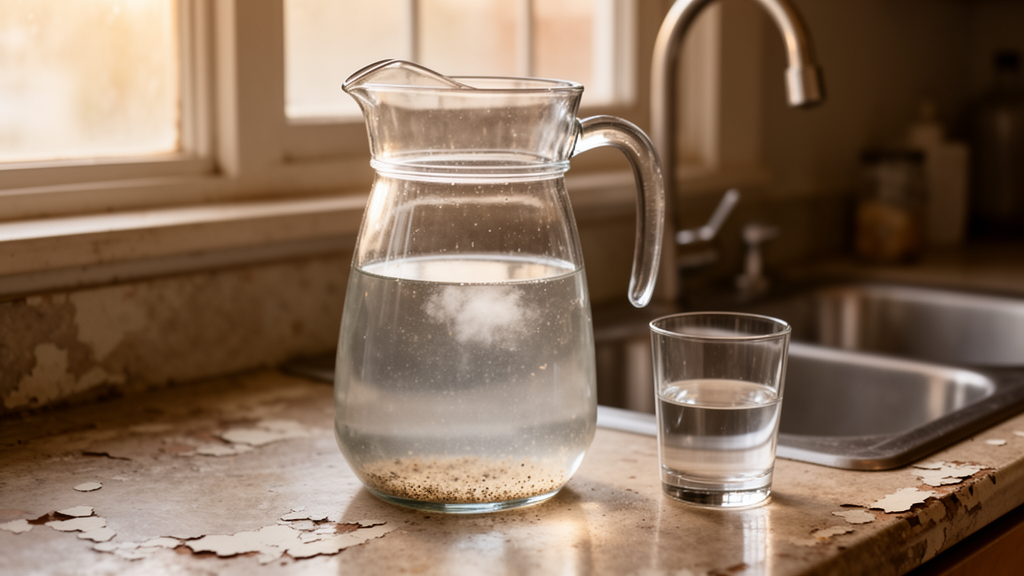
For hundreds of millions of people around the world, the moment water leaves a pipe is not the moment it becomes safe to drink. A new study from Beira, Mozambique, offers some of the most detailed evidence yet that the humble household storage container, a fixture of daily life wherever piped supply is intermittent, can quietly undo the protections that a well-run water system is supposed to provide. Researchers from the PAASIM Study Authorship Consortium, publishing in PLOS Water, found that stored drinking water in Beira homes carried enteric pathogens, antimicrobial resistance markers, and human genetic material far more often than water drawn directly from the household tap, even though the city’s supply is officially classified as safely managed.
The classification matters because it shapes how governments and donors spend billions of dollars. Under the monitoring framework used by international agencies, a safely managed drinking water service is one that is located on premises, available when needed, and free from contamination, at least as measured at the point of service. What happens after the water reaches the home has largely been invisible to that framework. In Beira, as in many cities across sub-Saharan Africa and South Asia, piped water arrives intermittently, so families fill buckets, jerrycans, and other containers during the hours when supply flows and drink from them over the following hours or days. Each transfer and each hour of storage is an opportunity for contamination to enter, and for any pathogens already present to multiply.
To capture that hidden deterioration, the research team used large-volume sampling methods, a technique that concentrates water from much bigger volumes than a standard laboratory test would use. Rather than testing a few hundred milliliters, the researchers processed large samples and then screened the concentrates with reverse-transcription quantitative polymerase chain reaction, or RT-qPCR, using a custom TaqMan Array Card. This platform allowed them to look simultaneously for a broad panel of targets: bacteria, protozoan parasites, viruses, helminths, antimicrobial resistance genes, and microbial source tracking markers that indicate whether contamination is of human or animal origin. The approach is far more sensitive than conventional culture-based testing, which often misses low-level contamination and cannot easily detect viruses or parasites.
The results were striking. Stored drinking water samples were more likely than household tap water samples to contain enteric pathogens, antimicrobial resistance targets, and human mitochondrial DNA, a genetic fingerprint suggesting that human waste had entered the water somewhere along the chain from pipe to cup. In other words, the very act of storing water at home, under the conditions typical of an intermittent supply system, was associated with a measurable decline in microbiological quality. The finding challenges the assumption that once water is delivered through an improved, on-premises connection, the remaining risks are negligible.
Equally important was what the team found in the piped supply itself. Enteric pathogens, including the protozoan parasites Cryptosporidium and Giardia, pathogenic strains of Escherichia coli, and rotavirus, were detected directly in 13 percent of the piped source samples, 11 out of 87, drawn from a system the researchers describe as well managed but intermittent. That figure is lower than the detection rates in stored water, but it is not zero, and it points to two distinct vulnerabilities. The first is the intermittent operation of the network itself: when pipes run dry, pressure drops, and contaminated groundwater or soil water can be drawn inward through joints and cracks, a phenomenon engineers call intrusion. The second is the household environment, where unclean containers, hands, and utensils can introduce fecal organisms into water that left the treatment plant clean.
The detection of protozoan parasites is particularly significant from a public health standpoint. Cryptosporidium and Giardia form tough, chlorine-resistant oocysts and cysts that survive standard disinfection far better than bacteria do. Their presence in piped water suggests that chlorine residual alone, the backbone of most municipal disinfection programs, cannot be relied upon to guarantee safety when the network is compromised by intermittent operation. Rotavirus, meanwhile, remains one of the leading causes of severe diarrheal disease in young children worldwide, and its detection in drinking water underscores that viral pathogens can move through municipal systems in ways that routine monitoring rarely catches.
The study’s setting gives its findings global weight. Beira, a port city of roughly half a million people, is representative of a vast middle ground in global water access: households that are connected to a real piped network, counted as safely served in international statistics, but whose water arrives unpredictably and must be stored. Nearly three-quarters of the world’s population now uses safely managed drinking water services according to official estimates, yet the Beira data suggest that the true picture at the point of consumption may be considerably worse than those numbers imply. If contamination between the tap and the mouth is common, then progress measured at the point of service overstates progress in health protection.
The researchers’ conclusions point toward a combination of fixes rather than a single silver bullet. Continuity of service delivery is the first pillar: keeping pipes pressurized around the clock would reduce intrusion events and, over time, could reduce the need for household storage altogether. The second is effective filtration treatment within the piped supply, which matters because filtration, unlike chlorination, can physically remove the protozoan oocysts and other particles that resist disinfection. The third is safe storage practice at the household level, including narrow-mouthed containers with lids and taps that minimize hand contact with the water. Without all three, the authors warn, microbial contamination of drinking water at the point of use may continue to occur even in systems that look exemplary on paper.
For policymakers, the study is a reminder that water safety is a chain, and that the weakest link is often the least monitored one. Household water treatment and safe storage have long been championed in public health circles, but they have struggled to attract the infrastructure investment that piped systems command, partly because global monitoring frameworks do not systematically measure what happens inside the home. Techniques like the large-volume sampling and multiplex molecular screening used in Beira could change that, by making the hidden segment of the water chain visible and by giving utilities and regulators a way to audit safety where it actually matters: in the glass of water a family drinks. As climate change intensifies pressure on urban water supplies and intermittency becomes more common even in well-resourced systems, the gap between safely managed on paper and safely consumed in practice is one that the world can no longer afford to ignore.
Subject of Research: Microbial contamination of household-stored versus piped drinking water in an intermittently supplied urban water system in Mozambique
Article Title: Household water storage compromises drinking water safety in a “safely managed” system
Article References: Linden, Y., Kowalsky, E., Zhu, K., Fagnant-Sperati, C., McGunegill, S., Cumbana, A., Mangamela, M., Nalá, R., Freeman, M. C., Levy, K., Brown, J., & The PAASIM Study Authorship Consortium (2026). Household water storage compromises drinking water safety in a “safely managed” system. PLOS Water, 5(10), e0000523. https://doi.org/10.1371/journal.pwat.0000523
Image Credits: AI Generated
DOI: 10.1371/journal.pwat.0000523
Keywords: drinking water safety, household water storage, intermittent water supply, enteric pathogens, Cryptosporidium, Giardia, rotavirus, Escherichia coli, antimicrobial resistance, RT-qPCR, Mozambique, PLOS Water
Cite Scienmag News
Kristina Jarvis. (October 14, 2026). Storing Tap Water at Home May Undo the Promise of Safe Drinking Supplies. Scienmag. https://scienmag.com/storing-tap-water-at-home-may-undo-the-promise-of-safe-drinking-supplies/
Kristina Jarvis. "Storing Tap Water at Home May Undo the Promise of Safe Drinking Supplies." Scienmag, 14 October 2026, https://scienmag.com/storing-tap-water-at-home-may-undo-the-promise-of-safe-drinking-supplies/. Accessed 14 October 2026.
Kristina Jarvis. "Storing Tap Water at Home May Undo the Promise of Safe Drinking Supplies." Scienmag. October 14, 2026. https://scienmag.com/storing-tap-water-at-home-may-undo-the-promise-of-safe-drinking-supplies/


