


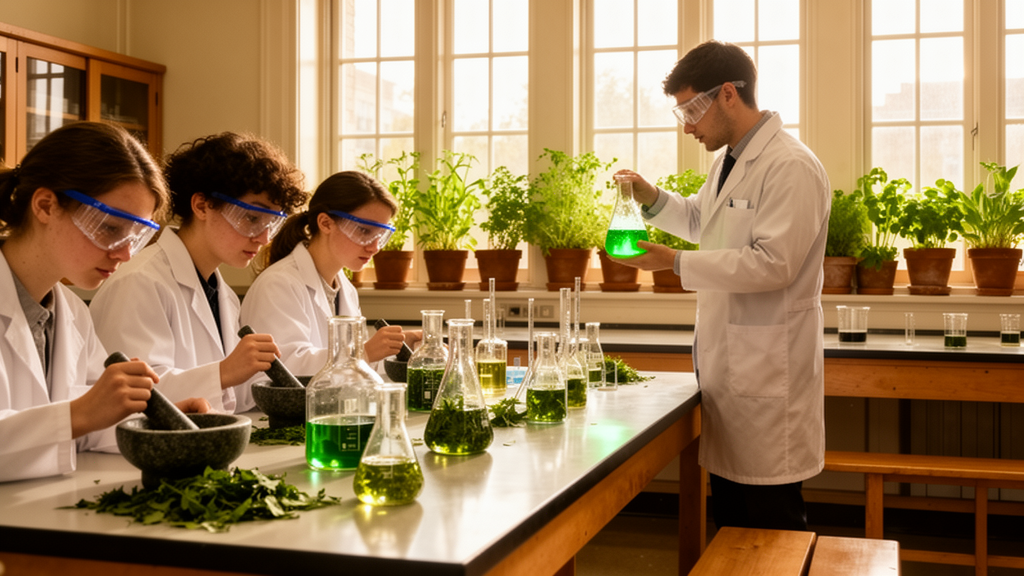
Chemistry classrooms around the world may be on the verge of a quiet revolution, and the catalyst is growing in gardens, fields, and hedgerows. A new narrative review published in the journal Discover Sustainability argues that plants, in all their biochemical variety, represent one of the most underused yet strategically important resources for teaching green chemistry, the branch of chemistry devoted to designing products and processes that reduce or eliminate hazardous substances. Drawing on 44 peer-reviewed articles published between 2017 and 2026 and indexed in the Scopus database, researchers from Universitas Sebelas Maret and Universitas Maritim Raja Ali Haji in Indonesia systematically mapped how educators have turned leaves, flowers, seeds, and fruit into laboratory reagents, indicators, and project materials, and what that has meant for student learning.
The review, led by Ardi Widhia Sabekti with co-authors Muzzazinah Muzzazinah and Nur Eka Kusuma Hindrasti, set out to fill a gap that has persisted even as green chemistry education has gained global momentum. Although plants are abundant, renewable, and readily accessible, comprehensive syntheses of the literature on their use in green chemistry teaching have been strikingly scarce. To address this, the team analyzed the selected studies thematically, categorizing the ways plants were deployed, identifying the plant species and key compounds involved, cataloguing which of the twelve principles of green chemistry were embodied in each application, and assessing the reported impacts on learners across schools and universities.
The analysis revealed that plant-based learning falls into five main dimensions. The first involves the extraction of bioactive compounds from plant material to serve as environmentally friendly laboratory substances, replacing synthetic chemicals that often require hazardous solvents or generate toxic waste. The second centers on natural plant colorants, such as anthocyanin-rich pigments from flowers, leaves, and fruit, which function as acid-base indicators and dyeing agents in analytical chemistry exercises. Because many plant pigments change color across a range of pH values, they allow students to perform titrations and qualitative tests with vivid visual feedback while avoiding synthetic indicator chemicals altogether.
The third dimension identified in the review concerns plant secondary metabolites, the diverse family of compounds that plants produce for defense, pigmentation, and signaling, which can act as green analytical reagents in place of conventional synthetic chemicals. The fourth, and perhaps the most technologically ambitious, involves using plant extracts in the green synthesis of nanoparticles. In these experiments, phytochemicals serve simultaneously as reducing and stabilizing agents, converting metal salts into nanoscale particles without the toxic reducing agents and organic solvents that classical nanoparticle synthesis typically demands. For students, this offers a hands-on encounter with nanotechnology that is both safer and more aligned with sustainability goals than traditional protocols.
The fifth dimension treats plant products as substrates and real-world contexts for organic, analytical, and project-based chemistry learning. Rather than isolating chemistry in abstract equations, educators use locally available plant materials, from food waste to garden species, as the starting point for investigations that connect molecular concepts to agriculture, nutrition, and environmental stewardship. The review found that this contextual grounding is one of the recurring strengths of the plant-based approach, because it situates chemical knowledge inside familiar, tangible material that students can see, smell, and handle.
Crucially, the review connected these five dimensions back to the formal principles of green chemistry, showing that plant utilization directly supports several of them at once. The use of renewable feedstocks, the prevention of waste, the design of less hazardous chemical syntheses, the reduction of hazardous solvents, and the enhancement of chemical safety were all reported as principles embodied in plant-based teaching practices. In a conventional teaching laboratory, a single experiment can generate solvent waste, consume non-renewable reagents, and expose students to corrosive or toxic substances. In the plant-based equivalents documented in the literature, the starting material is biodegradable, the solvents are often water or ethanol, and the worst outcome of a spill is a stain rather than a hazard.
The educational payoff appears to be substantial. Across the studies reviewed, plant-based approaches were generally reported to enhance student engagement, motivation, and learning outcomes at multiple levels of education, from secondary school through university. The authors attribute this to a combination of factors: the novelty and sensory richness of working with natural materials, the low cost and wide availability of plants that makes inquiry accessible even in resource-limited settings, and the alignment of the activities with the environmental values that many students already hold. When a chemistry lesson doubles as an exercise in sustainability, the review suggests, it speaks to students’ broader concerns and not merely to their exam performance.
The findings carry particular weight for chemistry education in developing regions, where laboratory budgets are tight and access to commercial reagents can be inconsistent. Plants are, in effect, a distributed and self-renewing chemical inventory. A school with a courtyard garden or a nearby market can stock a teaching laboratory with indicators, extracts, and substrates at minimal cost. The review’s emphasis on locally sourced plant materials also opens the door to culturally responsive science teaching, in which students investigate species that are part of their own food, medicine, and craft traditions, thereby linking chemistry content to community knowledge.
At the same time, the authors are careful to frame their conclusions within the limits of a narrative review. The synthesis was conducted narratively based on the patterns and themes identified across the 44 articles, rather than through a formal meta-analysis with quantitative effect sizes. The reviewed studies span a decade of rapid growth in green chemistry education, and the reported learning benefits, while consistent, come from heterogeneous educational settings and research designs. The authors note that comprehensive studies synthesizing the literature on plant utilization in green chemistry education remain very limited, which is precisely why they undertook the review, and their work signals a need for more rigorous, comparative studies that can quantify how much plant-based learning improves conceptual understanding relative to conventional approaches.
Even with those caveats, the review’s central message is clear and timely. As universities and ministries of education worldwide push to embed sustainability across curricula, chemistry has often lagged behind, burdened by laboratory traditions that are expensive, hazardous, and wasteful. The Indonesian team’s synthesis confirms that plants constitute a highly relevant and strategic green chemistry learning resource, one that can be integrated into sustainability-oriented chemistry curricula at scale. From anthocyanin indicators extracted from flower petals to nanoparticles grown in beakers with leaf extracts, the humble plant is proving that the path to greener, more engaging chemistry education may have been growing outside the classroom window all along.
Subject of Research: Plant-based resources and green chemistry principles in chemistry education
Article Title: A narrative review of plant utilization patterns and embodied green chemistry principles in shaping education learning outcomes
Article References: A narrative review of plant utilization patterns and embodied green chemistry principles in shaping education learning outcomes. (n.d.). https://doi.org/10.1007/s43621-026-05017-4
Image Credits: AI Generated
DOI: 10.1007/s43621-026-05017-4
Keywords: green chemistry education, plants, learning resources, sustainable chemistry, narrative review, bioactive compounds, natural indicators, nanoparticle synthesis, secondary metabolites, chemistry curriculum, sustainability education, student engagement
Cite Scienmag News
Roy Phillips. (October 14, 2026). Plants Emerge as Powerful Green Chemistry Teaching Tools, Review Finds. Scienmag. https://scienmag.com/plants-emerge-as-powerful-green-chemistry-teaching-tools-review-finds/
Roy Phillips. "Plants Emerge as Powerful Green Chemistry Teaching Tools, Review Finds." Scienmag, 14 October 2026, https://scienmag.com/plants-emerge-as-powerful-green-chemistry-teaching-tools-review-finds/. Accessed 14 October 2026.
Roy Phillips. "Plants Emerge as Powerful Green Chemistry Teaching Tools, Review Finds." Scienmag. October 14, 2026. https://scienmag.com/plants-emerge-as-powerful-green-chemistry-teaching-tools-review-finds/


