


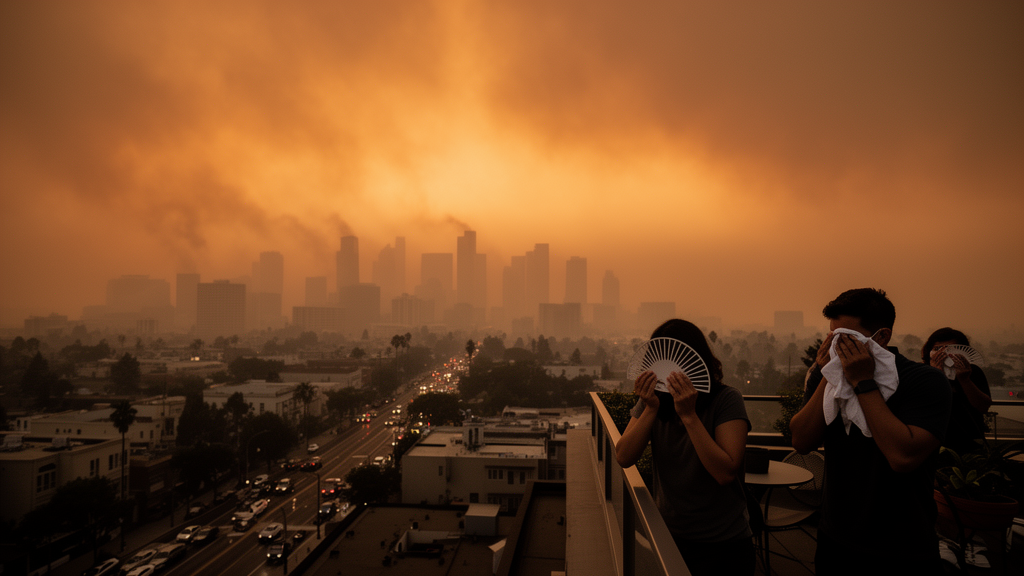
A sweeping new global analysis has quantified a threat that public health researchers have long worried about but never fully mapped: the growing overlap between extreme heat events and the air pollution released by landscape fires. According to the study, published in Science Advances by Yao Wu and colleagues, more than half of the world’s population experienced an increasing double burden of heatwaves and fire-related smoke pollution between 2000 and 2019. The finding transforms what might have seemed like a regional or seasonal hazard into a genuinely planetary trend, one that has intensified steadily across two decades of warming and shifting fire regimes.
The scale of the exposure is striking. On average, 916 million people each year endured at least one day on which they were simultaneously exposed to heatwave conditions and to air pollution originating from landscape fires, a category that includes wildfires, and the burning of forests, grasslands, and agricultural land. That figure is not static. The analysis found that the number of people experiencing co-exposure grew by 287 million people per decade, meaning that the population caught in the crossfire of heat and smoke expanded dramatically within the study window itself. In total, 55.9 percent of the global population lived through an increasing trend in co-exposure over the twenty-year period.
The intensity of exposure rose alongside its reach. The global annual average of co-exposure days was 1.3 days per person across the full study period, but that average conceals a clear temporal shift: the figure climbed from 1 day per person in 2000 to 2009 to 1.7 days per person in 2010 to 2019. That near-doubling within a single decade suggests that the mechanisms driving joint exposure are accelerating rather than plateauing. Researchers measure these exposures using person-days, a metric that combines the number of affected individuals with the duration of their exposure, which allows comparisons across countries of very different population sizes and fire climates.
The geography of the burden is uneven in ways that carry significant implications for public health policy. The five countries with the highest annual averages of person-days of co-exposure were the Democratic Republic of the Congo, Indonesia, Mexico, Brazil, and the Russian Federation. This list spans tropical, temperate, and boreal fire regimes, underscoring that the problem is not confined to any single biome or latitude. The Democratic Republic of the Congo’s prominence reflects the intense and recurring fire activity associated with savanna and agricultural burning in central Africa, while Indonesia’s position recalls the catastrophic peatland fire episodes that have repeatedly blanketed Southeast Asia in hazardous smoke.
Brazil and the Russian Federation round out the list from opposite ends of the fire spectrum. Brazil’s exposure is tied to deforestation-related and drought-driven fires in the Amazon basin, where fire activity has intensified during severe dry years, and Russia’s reflects the enormous boreal wildfires that have burned across Siberia with increasing frequency as high northern latitudes warm faster than the global average. Mexico’s inclusion highlights the role of seasonal fire activity interacting with heat episodes in North and Central America. Together, these five countries illustrate that co-exposure is a shared global challenge shaped by local land management, climate variability, and the underlying warming trend.
Why does the combination of heat and fire smoke matter more than either hazard alone? The health risks of each component are individually well documented. Extreme heat is associated with heat exhaustion, heat stroke, and elevated mortality, particularly among elderly people, outdoor workers, and those with pre-existing conditions. Landscape fire smoke contains a complex mixture of fine particulate matter, known as PM2.5, along with ozone precursors, carbon monoxide, and volatile organic compounds. Chronic and acute exposure to this mixture is linked to respiratory illnesses such as asthma exacerbations and chronic obstructive pulmonary disease, as well as cardiovascular outcomes including heart attacks, strokes, and increased all-cause mortality.
The critical insight motivating this line of research is that these risks do not simply add together; they interact. Stretches of extreme temperatures amplify both the incidence of landscape fires and the severity of the health harms that follow from smoke exposure. Hot, dry conditions desiccate vegetation and extend the window in which ignitions can spread into large, uncontrollable fires. At the same time, heat stresses the human body’s cardiovascular and respiratory systems, which are precisely the systems most burdened by inhaled particulate pollution. When a heatwave and a smoke event coincide, populations face compounded physiological stress, and the most vulnerable groups, including children, the elderly, and people with chronic disease, face the steepest risks.
The methodological achievement of the new analysis lies in its global scope and its explicit treatment of co-exposure as a distinct metric. Rather than assessing heatwaves and fire pollution in separate silos, Wu and colleagues constructed a joint measure that identifies days on which both hazards affected the same populations at the same time. This approach matters because risk assessments and public health preparedness plans have historically treated heat and air quality as separate hazards, managed by separate warning systems and separate response protocols. A population experiencing both hazards simultaneously may require different and more urgent interventions than one facing either alone, from cooling-and-clean-air shelters to integrated emergency communications.
The upward trajectory documented in the study aligns with broader patterns that climate scientists have observed across the early twenty-first century. Heatwaves have become more frequent, more intense, and longer-lasting in many regions, and fire seasons have lengthened in parts of the Americas, Australia, the Mediterranean, and the boreal zone. The study’s finding that the co-exposure trend affected a majority of humanity indicates that these two trends are converging on the same places and the same people, rather than unfolding in separate geographic or demographic spheres. The increase of 287 million exposed people per decade provides a quantified measure of how rapidly that convergence is proceeding.
For policymakers and public health officials, the results carry a clear message about preparedness. Regions identified as co-exposure hotspots, including the five countries with the highest person-day averages, may need to plan for compound emergencies in which heat response and smoke response must operate in tandem. The study also provides a baseline against which future changes can be measured, and its person-day framework offers a template for tracking how the compound burden evolves as the century progresses. As the authors’ analysis demonstrates, the era in which heat and fire smoke could be managed as separate problems is receding; for more than half the world’s population, and for hundreds of millions more each decade, the two hazards now arrive together, and the institutions charged with protecting public health are only beginning to adapt to that reality.
Subject of Research: Global trends in human co-exposure to heatwaves and landscape fire smoke air pollution from 2000 to 2019
Article Title: Co-exposure to heatwaves and landscape fire smoke is rising globally
Article References: Co-exposure to heatwaves and landscape fire smoke is rising globally. (n.d.). Original publication
Image Credits: AI Generated
DOI: Not provided
Keywords: heatwaves, landscape fires, wildfire smoke, air pollution, PM2.5, co-exposure, public health, climate change, Science Advances, global burden, cardiovascular risk, respiratory disease
Cite Scienmag News
Russell Cooper. (October 14, 2026). Heatwaves and Wildfire Smoke Now Overlap for More Than Half the World’s Population. Scienmag. https://scienmag.com/heatwaves-and-wildfire-smoke-now-overlap-for-more-than-half-the-worlds-population/
Russell Cooper. "Heatwaves and Wildfire Smoke Now Overlap for More Than Half the World’s Population." Scienmag, 14 October 2026, https://scienmag.com/heatwaves-and-wildfire-smoke-now-overlap-for-more-than-half-the-worlds-population/. Accessed 14 October 2026.
Russell Cooper. "Heatwaves and Wildfire Smoke Now Overlap for More Than Half the World’s Population." Scienmag. October 14, 2026. https://scienmag.com/heatwaves-and-wildfire-smoke-now-overlap-for-more-than-half-the-worlds-population/


