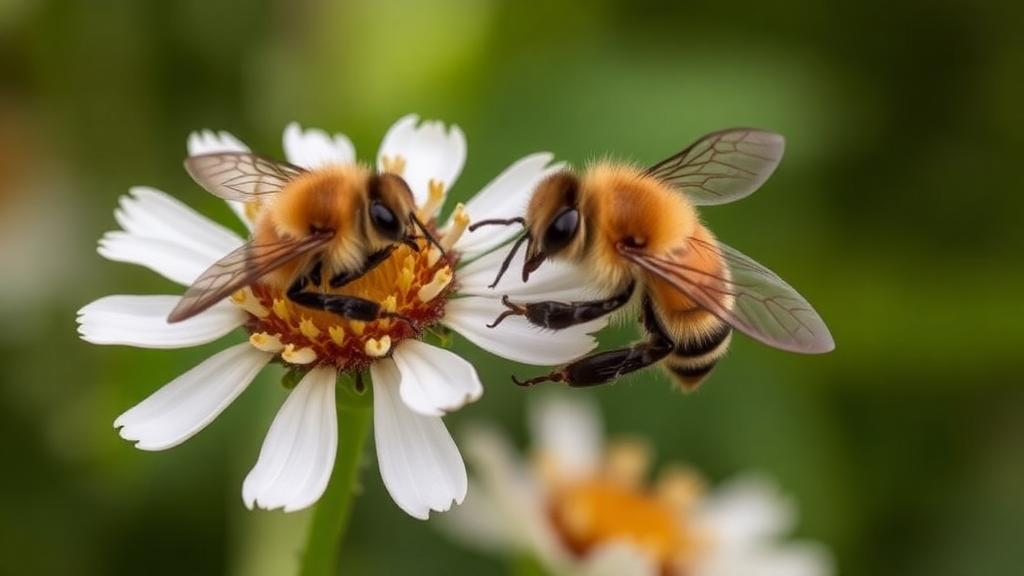
In the crowded world of flowers, the honeybee is not the gentle ambassador of spring that popular culture often imagines. A two-year field study conducted in and around Cambridge, England, has documented for the first time the full extent to which managed honeybees dominate shared foraging grounds, systematically excluding, displacing and even chasing away the wild insects that depend on the same nectar and pollen resources. The research, led by scientists at Anglia Ruskin University and published in the journal Ecological Entomology, provides some of the most detailed behavioural evidence yet that competition between managed and wild pollinators is not merely a theoretical concern but an observable, measurable and increasingly one-sided struggle playing out on bramble blossoms and ivy flowers across the British countryside.
The study focused on two plant species of exceptional importance to late-season pollinators: bramble (Rubus fruticosus) and ivy (Hedera helix). Both are prolific sources of nectar and pollen and both attract enormous numbers of flower-visiting insects when in bloom, making them natural arenas in which competitive dynamics can be observed at scale. The researchers selected five sites, all situated within 300 metres of known honeybee colonies, ensuring that honeybee presence at the flowers was substantial and consistent. Over 93 hours of direct observation spread across two years, the team recorded every instance in which one pollinator disrupted or prevented another from accessing a flower, categorising each encounter according to the species involved and its outcome.
The methodological framework was elegantly simple. Flower visitors were sorted into five categories: honeybees, bumblebees, solitary bees, hoverflies, and an ‘other’ group that included butterflies, beetles and wasps. Each recorded interaction was scored either as a ‘win’, in which one insect gained access to a flower at the direct expense of another, or as a ‘share’, in which both insects fed without conflict. This binary scoring system allowed the researchers to quantify not just the frequency of competitive encounters but also which species consistently emerged victorious, and to correlate those outcomes with the local density of honeybees at each site.
The results were striking. Higher densities of honeybees were associated with both lower numbers of other pollinators and a greater frequency of competitive interactions, with honeybees claiming a disproportionately high share of ‘wins’ in their encounters with other flower visitors. The effect was quantifiable in ways that carry real ecological weight. On bramble, a doubling of honeybee density was associated with a 14 per cent reduction in bumblebee abundance. On ivy, increases in honeybee numbers were linked to declines in solitary bees and hoverflies, two groups that include many species of conservation concern. These are correlational findings drawn from field observation, but their consistency across sites and plant species lends them considerable persuasive force.
What distinguishes this study from earlier work on pollinator competition is its behavioural granularity. Honeybees did not simply outcompete rivals by arriving earlier or in greater numbers; they actively instigated aggressive interactions, winning resources by physically displacing or chasing other insects away from flowers. Other pollinators appeared to recognise the threat: honeybees were actively avoided by their wild counterparts in 28 per cent of interactions on bramble and 36 per cent of interactions on ivy. In at least one in five of the honeybees’ winning outcomes on both plant species, the victory involved physical displacement or pursuit. Crucially, the researchers recorded very few aggressive interactions that were not initiated by honeybees, underscoring the asymmetry of the conflict.
There was, however, one remarkable exception to honeybee dominance. The ivy bee, Colletes hederae, a solitary bee species that is itself a relatively recent arrival to Britain, having first been recorded there in 2001, was the only insect observed contesting encounters with honeybees and winning. Ivy bees were seen defending their food source by displacing and chasing honeybees, turning the usual hierarchy on its head. The study’s lead author, Victoria Buckle, a PhD student at Anglia Ruskin University, noted that this was the first time, to the researchers’ knowledge, that such behaviours had been observed, and that ivy bees appear able to hold their own in direct confrontations with the otherwise dominant honeybee.
The findings arrive at a moment of rapid change in British beekeeping. The number of registered beekeepers in the United Kingdom has risen from approximately 19,000 in 2010 to 47,000 last year, a trajectory that implies a substantial and ongoing increase in managed honeybee hive density. Because honeybee colonies can contain tens of thousands of foragers, even modest increases in hive numbers translate into very large increases in the number of individual insects competing at local flowers. The Cambridge study suggests that this numerical advantage is compounded by a behavioural one: honeybees are not passive competitors but active aggressors that shape the foraging environment for every other species around them.
Climate change adds a further and potentially alarming layer to the picture. The researchers found that periods of higher temperature were associated with an increase in competitive interactions between flower visitors. One plausible mechanism lies in the physiology of the plants themselves: heat stress is known to cause flowers to produce less nectar, shrinking the total forage available and forcing pollinators into more frequent and more intense conflict over what remains. As UK summers warm, this mechanism could operate over ever wider areas and longer seasons, intensifying the very competition the study documents.
Temperature also acts directly on the insects, and here the asymmetry between species becomes starker. Low temperatures favour the foraging capacity of hoverflies and bumblebees, both of which are sensitive to heat, while the opposite holds for honeybees. A previous study cited by the researchers found that a 12°C increase in temperature led to a tenfold increase in the number of honeybees leaving their nests. In a warming climate, then, honeybees are likely to become more active foragers precisely when bumblebees and hoverflies are becoming less able to compete, a combination that the study’s authors warn is only likely to exacerbate interference competition from dominant honeybees under future predicted warming in the UK.
The research team is careful to frame the work not as an indictment of beekeeping but as a contribution to coexistence. Buckle emphasised that the aim of the study was not to discourage beekeeping but to better understand how competition unfolds between wild and managed pollinators, with the goal of helping to conserve wild species that play an essential ecological role in pollinating both crops and wild plants. The practical implications, however, are clear: in locations with high densities of hives, such as urban areas where hobbyist beekeeping has surged in popularity, the pressure on wild pollinators may be greatest. Finding ways to ensure that honeybees and wild pollinators can continue to share the landscape, whether through careful siting of hives, habitat restoration that increases total forage availability, or monitoring of wild pollinator populations near apiaries, will be a central challenge for pollinator conservation in the decades ahead. What this study makes unmistakably clear is that the flowers of Britain are contested ground, and that the contest is neither neutral nor gentle.
Subject of Research: Interference competition between managed honeybees and wild pollinators on bramble and ivy flowers in the UK
Article Title: Honeybees exert flower power over other species
Article References: Honeybees exert flower power over other species. (n.d.). Original publication
Image Credits: AI Generated
DOI: Not provided
Keywords: honeybees, wild pollinators, bumblebees, hoverflies, ivy bee, interference competition, nectar, climate change, heat stress, beekeeping, Cambridge, Ecological Entomology
Cite Scienmag News
Julie Wynn. (October 14, 2026). Honeybees bully wild rivals at flowers, two-year Cambridge study reveals. Scienmag. https://scienmag.com/honeybees-bully-wild-rivals-at-flowers-two-year-cambridge-study-reveals/
Julie Wynn. "Honeybees bully wild rivals at flowers, two-year Cambridge study reveals." Scienmag, 14 October 2026, https://scienmag.com/honeybees-bully-wild-rivals-at-flowers-two-year-cambridge-study-reveals/. Accessed 14 October 2026.
Julie Wynn. "Honeybees bully wild rivals at flowers, two-year Cambridge study reveals." Scienmag. October 14, 2026. https://scienmag.com/honeybees-bully-wild-rivals-at-flowers-two-year-cambridge-study-reveals/