


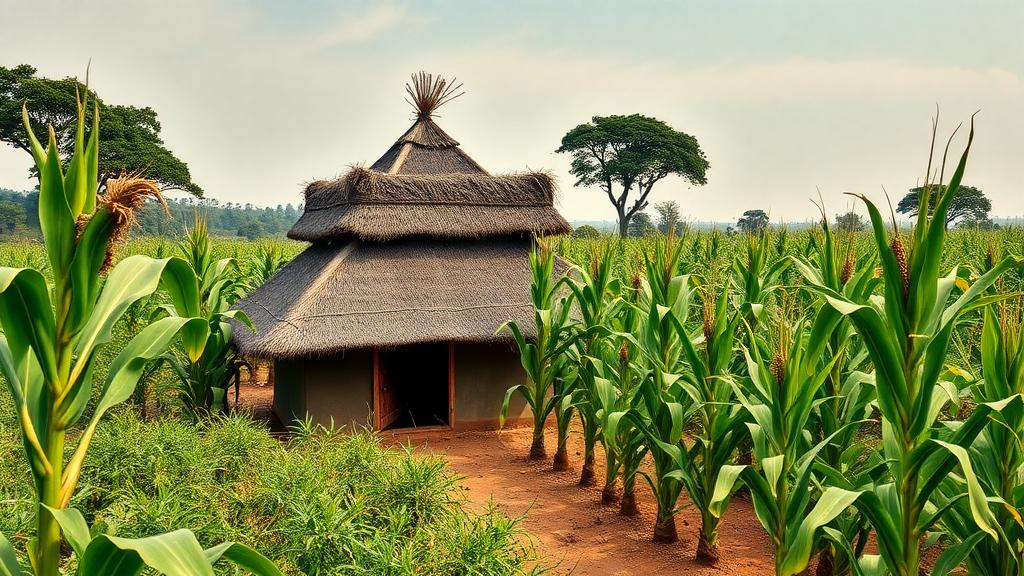
For more than a century, archaeologists have argued about how the densely populated villages of pre-colonial Brazil fed themselves. Were the people who built sprawling settlements across the Cerrado, the country’s vast tropical savanna, mobile hunter-gatherers who supplemented their diets with occasional crops? Or were they rigid monoculture farmers who staked everything on a single domesticated plant? A new study published in the journal Science Advances offers a decisive answer, and in doing so rewrites a foundational chapter of South American history. Corn, the research shows, was the dietary engine that sustained large, socially complex villages in the Brazilian savanna between the ninth and seventeenth centuries, cultivated not in isolation but as part of sophisticated polyculture systems that incorporated a wide range of native species.
The study was led by archaeologists at the University of São Paulo’s Museum of Archaeology and Ethnology, known as MAE-USP, with support from the São Paulo Research Foundation, FAPESP. Its lead author, Eliane Chim, conducted the work as part of her doctoral dissertation, and the project was coordinated by André Strauss, an archaeologist and professor at MAE-USP, together with Patrick Roberts of the Max Planck Institute in Germany. The research team describes the findings as a milestone for Brazilian archaeology, not least because the paper appeared in a high-impact international journal with Brazilian authors listed in the first and last author positions, a rare achievement for a field that has long been dominated by institutions abroad.
The technical heart of the study lies in a method that turns human remains into dietary archives. The researchers analyzed the stable isotopes of carbon, nitrogen, and oxygen preserved in the teeth and bones of more than 100 individuals recovered from 37 archaeological sites spanning three Brazilian biomes: the Cerrado, the semi-arid Caatinga of the northeast, and the Atlantic Forest. Isotopes are natural variants of a chemical element that differ in the number of neutrons in their nuclei, and because different foods carry distinct isotopic signatures, those signatures become locked into body tissues as they form. Carbon isotopes reveal which types of plants dominated a person’s diet, allowing corn to be distinguished from the fruits and other plants typical of the savanna. Nitrogen isotopes estimate the amount of animal protein consumed and an individual’s position in the food chain, while oxygen isotopes provide information about water sources and environmental conditions.
Together, these measurements amount to a chemical record of what each person ate throughout their life. The results were striking. Chim explained that the team identified corn consumption comparable to that of Mayan or Andean populations, something completely unexpected in the Brazilian context. The analysis also revealed marked variability between two distinct archaeological traditions, corroborating the social and cultural diversity of the region’s pre-colonial inhabitants. To anchor the dietary data in time, the scientists performed radiocarbon dating on the collagen of roughly 40 percent of the bones that still preserved protein, establishing that the samples date from a period between 1,100 and 400 years ago. The team supplemented the human isotope data with paleoecological records, natural remains such as seeds, sediments, and plant and animal materials that reconstruct the vegetation, climate, and environment of different periods.
The samples came from the villages of two populations whose ways of life could hardly have been more different. The Aratu lived in the open, building large villages that, according to Strauss, held as many as 2,000 inhabitants, a population comparable to that of most European towns of the same era. The Una, by contrast, were among the earliest pottery-making horticulturalists of the Cerrado and frequented rock shelters, usually near riverbeds or ponds. Among the Aratu, bone collagen and dental enamel from the oldest individuals revealed clear evidence of corn consumption, and earlier studies had documented wear marks on ceramic vessels consistent with the fermentation of alcoholic beverages. Taken together, these findings suggest that corn was a dietary staple for the Aratu and may also have played a role in communal or ritual practices woven into daily village life.
The Una presents a fascinating counterpoint. The rock-shelter populations of this culture maintained a more diverse diet with a noticeably lower intake of corn. Because the two groups occupied broadly similar environments, the scientists concluded that ecology alone cannot explain the difference. Instead, distinct cultural traditions and economic strategies coexisted within the same biome, each with its own approach to food production. Both practiced polyculture, cultivating multiple species rather than a single crop, but corn served as the primary source of subsistence for the more populous Aratu communities. This nuance matters: the study does not simply replace one oversimplified label with another, but documents genuine diversity in how indigenous societies engineered their food systems.
For Strauss, the findings settle a debate that has run through Brazilian archaeology for generations. He noted that for over a century the discipline has discussed the role of corn in pre-colonial societies, especially those with high population densities and more elaborate pottery, and that this is the first time corn’s central role in the subsistence of those populations has been demonstrated in Brazil. Just as in the Andes and Mesoamerica, he observed, corn cultivation in the Cerrado is associated with societies that had larger populations and left more evident marks on the landscape. The parallel is historically resonant: corn originated in Mexico, where it first appeared roughly 9,000 years ago, and previous research has traced its dispersal across Latin America, showing that it arrived in Brazil via the southwestern Amazon rainforest at least 6,000 years ago.
That deep history of dispersal makes the Cerrado findings all the more remarkable from a biotechnological standpoint. The savanna’s environmental conditions differ greatly from the plant’s place of origin, and the study highlights the ingenuity of pre-colonial indigenous Brazilian societies in adapting corn to a biome with distinct soils, rainfall patterns, and fire regimes. Beyond illuminating subsistence strategies, the research contributes to understanding the history of human influence on one of the most biodiverse tropical savannas on the planet, suggesting that the landscapes of the modern Cerrado were shaped in part by the food production and land use practices of these ancient villages. The idea that the savanna was a pristine wilderness untouched by human hands becomes harder to sustain with each new dataset.
The scale of the undertaking reflects the ambition of the questions. The project has been underway for more than ten years and brought together 31 researchers from 10 Brazilian universities in collaboration with the Max Planck Society and institutions in Portugal, Poland, and the United States. Strauss emphasized that archaeology operates on a different timeline than many sciences: fieldwork, excavation, laboratory analysis, and curation must all precede the analytical phase, and the long project also served as a mechanism for training personnel, with Chim as a prime example. Preserving archaeological material posed one of the study’s greatest challenges, particularly when analyzing fragile collagen, and more than 270 artifacts were evaluated to obtain the final sample.
The team’s ambitions now extend beyond the cemeteries and urn fields they know so well. Chim outlined plans to resume field research at the archaeological sites in an effort to locate the farmlands where people cultivated their crops, noting that while the cemeteries, urn fields, and the size of some villages are documented, the other areas occupied by these communities remain to be found. If those fields can be identified, they would complete the picture of a landscape transformed by maize-based polyculture, connecting the chemical signatures in ancient bones to the physical furrows where the savanna’s first great farming villages took root. The work was funded by FAPESP through a Young Investigators grant awarded to Strauss, multiple fellowships, and two additional projects, including one supporting publication in the journal.
Subject of Research: Pre-colonial maize-based subsistence and land use in the Brazilian Cerrado
Article Title: Corn farming sustained large pre-colonial villages in the Brazilian savanna
Article References: Corn farming sustained large pre-colonial villages in the Brazilian savanna. (n.d.). Original publication
Image Credits: AI Generated
DOI: Not provided
Keywords: archaeology, maize, Cerrado, pre-colonial Brazil, stable isotopes, polyculture, Aratu, Una culture, Science Advances, FAPESP, subsistence strategies, radiocarbon dating
Cite Scienmag News
Courtney Benton. (October 14, 2026). Ancient Corn Farming Powered Vast Pre-Colonial Villages in Brazil’s Savanna. Scienmag. https://scienmag.com/ancient-corn-farming-powered-vast-pre-colonial-villages-in-brazils-savanna/
Courtney Benton. "Ancient Corn Farming Powered Vast Pre-Colonial Villages in Brazil’s Savanna." Scienmag, 14 October 2026, https://scienmag.com/ancient-corn-farming-powered-vast-pre-colonial-villages-in-brazils-savanna/. Accessed 14 October 2026.
Courtney Benton. "Ancient Corn Farming Powered Vast Pre-Colonial Villages in Brazil’s Savanna." Scienmag. October 14, 2026. https://scienmag.com/ancient-corn-farming-powered-vast-pre-colonial-villages-in-brazils-savanna/


