


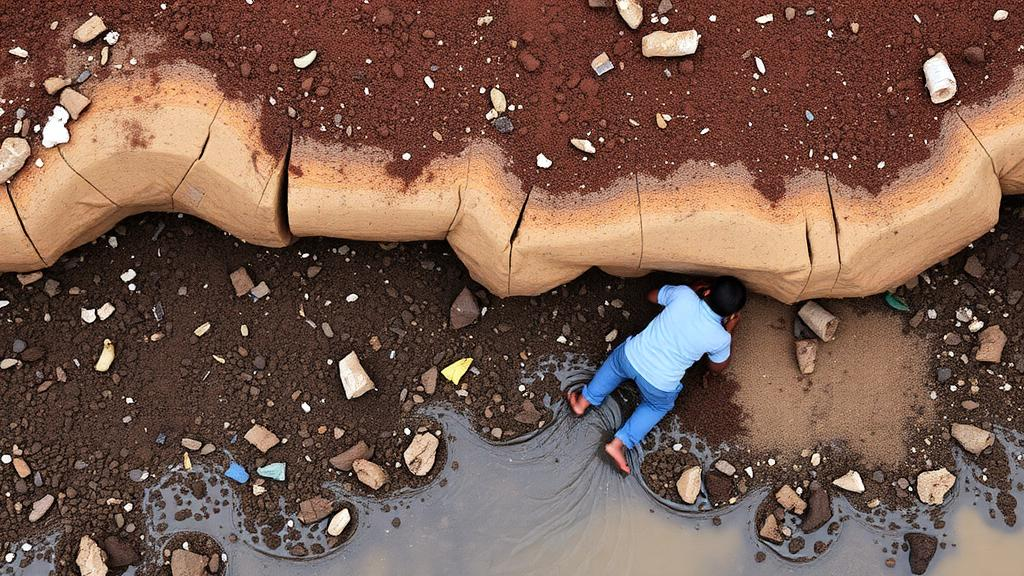
In the rolling hills outside Imphal, the capital of the northeastern Indian state of Manipur, a municipal waste facility meant to solve one environmental problem may be quietly creating several others. A new study from researchers at Manipur University, published in Environmental Science and Pollution Research, reports that leachate—the dark, chemically rich liquid that forms when rainwater percolates through decomposing garbage—is degrading both soil and surface water quality around the Lamdeng Municipal Solid Waste Management Plant. The work, led by Ningombam Sharda Devi and Maibam Dhanaraj Meitei, is being described by the authors as a pioneering assessment of the facility’s environmental footprint, and its findings paint a sobering picture of how unmanaged waste infrastructure can ripple outward into farmland, fisheries, and drinking water supplies.
The research team spent 2022 and 2023 systematically sampling leachate, soil, and surface water in and around the Lamdeng site. Their analytical approach combined standard physicochemical characterization—measuring electrical conductivity, total dissolved solids, turbidity, dissolved oxygen, alkalinity, total hardness, and major ions such as calcium, magnesium, sodium, nitrate, and phosphate—with targeted quantification of four heavy metals: iron, copper, zinc, and cadmium. This dual strategy matters because physicochemical parameters reveal the overall stress imposed on an aquatic system, while heavy metal concentrations point to specific toxicological hazards that can accumulate in crops, fish, and ultimately human tissue. By tracking the same suite of variables across leachate, soil, and water, the researchers could trace the chemical signature of the landfill as it migrated into the surrounding environment.
The results for surface water were unambiguous. Nearly every key indicator—electrical conductivity, total dissolved solids, turbidity, dissolved oxygen, alkalinity, total hardness, calcium, magnesium, sodium, nitrate, and phosphate—registered values beyond the thresholds set by the World Health Organization for safe drinking water. Elevated electrical conductivity and dissolved solids signal a heavy load of ionized contaminants; depressed dissolved oxygen points to organic enrichment that can suffocate aquatic life; and excess nitrate and phosphate indicate nutrient loading capable of triggering algal blooms and eutrophication. Together, these deviations describe a water body under sustained chemical assault, consistent with leachate infiltration from an inadequately contained waste site.
To translate these measurements into a form that regulators and residents can act on, the team calculated a Water Quality Index, or WQI, a composite score that condenses multiple parameters into a single number. The values they obtained for surface waters near the facility ranged from 130.56 to 511.74—figures that fall squarely into the category deemed unsuitable for drinking. For context, a WQI below 100 is generally required for water to be considered acceptable for human consumption, and scores climb as contamination worsens. The upper end of the observed range, exceeding 500, represents water so degraded that direct use would pose serious health concerns. That such readings occur in a region where communities depend on streams and ponds for daily needs makes the numbers more than an academic abstraction.
The soil story is equally consequential, particularly for agriculture. The study found that crops cultivated in fields near the facility are being exposed to high levels of electrical conductivity, total dissolved solids, salinity, and magnesium ions. Salinity stress is a well-documented constraint on crop physiology: excess dissolved salts interfere with a plant’s ability to take up water through its roots, a phenomenon known as osmotic stress, while specific ions such as sodium and magnesium can disrupt nutrient balance, impair enzyme function, and damage root architecture. Research on rice and other staple crops has shown that salt-affected soils reduce germination, stunt growth, and lower yields, and prolonged exposure can permanently alter soil structure and microbial communities. In Manipur, where smallholder farming is central to local livelihoods, the slow salinization of fields adjacent to a waste facility represents a threat to both food security and income.
Heavy metals add a more insidious dimension. The researchers quantified iron, copper, zinc, and cadmium in leachate, soil, and surface water, and then used those concentrations to estimate human health risks for local residents. Cadmium emerged as the element of greatest concern. This transition metal, which enters leachate from discarded batteries, electronics, plastics, and pigments, is notorious for its persistence in soils and its capacity to accumulate in the kidneys and bones of exposed individuals. It is also classified as a human carcinogen. Unlike organic pollutants that may degrade over time, cadmium binds to soil particles and can be taken up by crops, entering the food chain in a form that the human body excretes only very slowly.
The formal health risk assessment quantified the carcinogenic risk from cadmium exposure at 1.77 × 10⁻⁶ for adults and 7.08 × 10⁻⁶ for children. In plain terms, these figures exceed the widely used benchmark of one additional cancer case per one million people, which the study describes as indicating an acceptable carcinogenic risk level. Notably, the estimated risk for children is roughly four times that for adults, a pattern that reflects children’s higher relative intake of water and food per unit of body weight, as well as their developing physiology. Risk assessments of this kind do not predict individual cancer cases; rather, they estimate the statistical probability of excess cancer incidence across an exposed population, providing a standardized basis for comparison against regulatory limits.
What makes the situation particularly troubling is the disconnect between the measured hazard and the community’s awareness. According to the study, local residents—largely oblivious to the contamination documented by the researchers—continue to practice agriculture and fishing in the affected areas, harvest wild edible plants, and rely on surface water from the surroundings of the waste management facility. This pattern is common in many developing regions, where environmental monitoring is sparse and the invisible nature of chemical contamination allows daily routines to continue unchanged even as exposure accumulates. Wild edibles and fish are especially effective vectors for metal uptake, since aquatic organisms and plants can bioaccumulate cadmium and other metals to concentrations far exceeding those in the water or soil itself.
The Lamdeng findings sit within a broader and rapidly growing global problem. Municipal solid waste generation is rising across Asia and Africa faster than treatment infrastructure can keep pace, and landfills without engineered liners and leachate collection systems are the norm rather than the exception in many cities. When leachate escapes containment, it migrates through soil as a contaminant plume, following groundwater flow paths and discharging into streams and wetlands. Manipur’s landscape, dotted with ecologically significant wetlands including the Ramsar-listed Loktak Lake, heightens the stakes: contaminated surface flows from sites like Lamdeng can travel considerable distances and affect ecosystems of regional and international conservation value.
The study’s authors frame their work as a first step, and its implications point toward several practical interventions. Engineered leachate collection and treatment, impermeable liners, routine monitoring of soil and water around waste facilities, and public health communication to affected communities are all standard components of modern landfill management that appear to be lacking or insufficient at Lamdeng. The research also underscores the value of tools like the Water Quality Index and formal risk assessment for making contamination legible to policymakers. Without such measurements, the slow chemical erosion of soil and water around a waste site proceeds silently, borne by farmers, fishers, and children who have no way of seeing what is dissolved in the water they drink. The Manipur team’s work brings that hidden burden into the open, offering both a warning and a baseline against which future remediation efforts can be judged.
Subject of Research: Landfill leachate contamination of soil and surface water quality and associated human health risks near a municipal solid waste site in Manipur, Northeast India
Article Title: Evaluation of the effect of landfill leachate on soil and surface water quality: a case study of the Lamdeng landfill site, Manipur, Northeast India
Article References: Evaluation of the effect of landfill leachate on soil and surface water quality: a case study of the Lamdeng landfill site, Manipur, Northeast India. (n.d.). https://doi.org/10.1007/s11356-026-38200-1
Image Credits: AI Generated
DOI: 10.1007/s11356-026-38200-1
Keywords: landfill leachate, municipal solid waste, water quality index, heavy metals, cadmium, soil salinity, surface water contamination, health risk assessment, Manipur, Northeast India, carcinogenic risk, environmental pollution
Cite Scienmag News
Violet Maxwell. (October 14, 2026). Landfill Leachate Is Quietly Poisoning Soil and Water in Northeast India, Study Finds. Scienmag. https://scienmag.com/landfill-leachate-is-quietly-poisoning-soil-and-water-in-northeast-india-study-finds/
Violet Maxwell. "Landfill Leachate Is Quietly Poisoning Soil and Water in Northeast India, Study Finds." Scienmag, 14 October 2026, https://scienmag.com/landfill-leachate-is-quietly-poisoning-soil-and-water-in-northeast-india-study-finds/. Accessed 14 October 2026.
Violet Maxwell. "Landfill Leachate Is Quietly Poisoning Soil and Water in Northeast India, Study Finds." Scienmag. October 14, 2026. https://scienmag.com/landfill-leachate-is-quietly-poisoning-soil-and-water-in-northeast-india-study-finds/


