


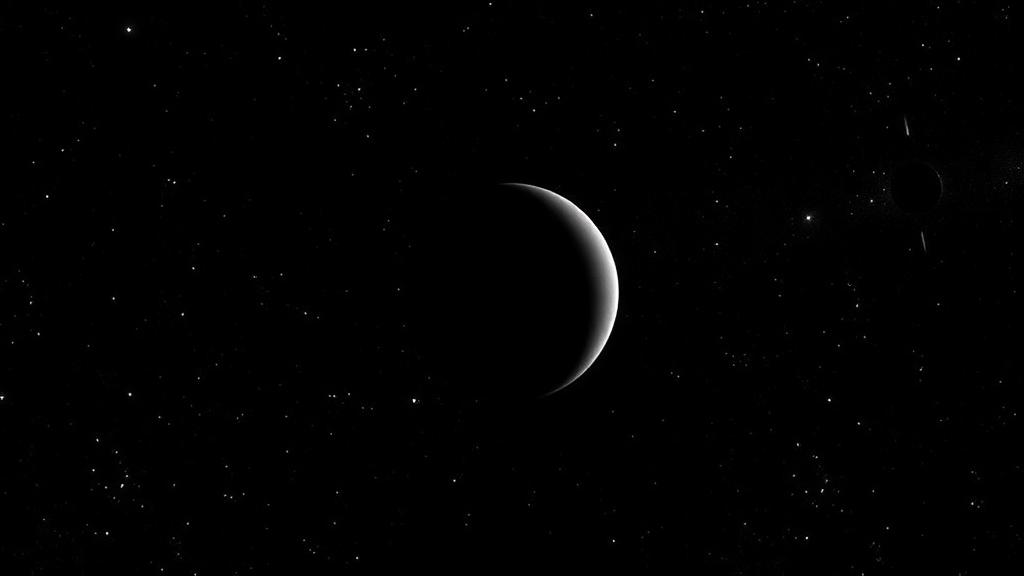
For more than three decades, astronomers studying worlds beyond the solar system have had to accept a humbling simplification: every exoplanet, no matter how exotic, was treated in their models as a perfect circle. Now that assumption has been swept aside. A Cornell-led international team has, for the first time, resolved the actual, uneven contours of a planet orbiting another star, revealing that the hot Jupiter WASP-17b is subtly egg-shaped, with one side of its atmosphere bulging outward more than the other. The achievement, published on Oct. 14 in Nature Astronomy, relies on a new analytical technique called transmission strings, applied to observations from NASA’s James Webb Space Telescope of a giant world more than 1,000 light years from Earth.
The method, also known as transit mapping, exploits the moments when an exoplanet crosses in front of its host star. During such a transit, starlight filters through the thin annulus of atmosphere around the planet’s edge, or limb, picking up the chemical fingerprints of gases at different altitudes. Conventional transmission spectroscopy collapses all of that information into a single spectrum averaged around the entire limb, effectively assuming the planet is a circle with the same radius all the way around. Transmission strings instead tracks the planet’s progress across the stellar disk, capturing the composition of light around the limb from different angles as the transit unfolds, and mathematically reconstructing how the distance from the planet’s center to its atmospheric edge varies from point to point.
“Rather than assuming your planet is a circle with the same radius all the way around, our technique allows you to pull out different distances from the center to the edge of the planet,” said Lili Alderson, a Klarman Postdoctoral Fellow in Cornell’s College of Arts and Sciences and first author of the study. “We’re able to go around the edge. So, we’ve gone from a ring to understanding where on the ring the gemstones are, so to speak.” In other words, the technique transforms what was previously a one-dimensional ring of averaged data into a genuinely spatial map of the atmospheric limb, capable of distinguishing the morning side of the planet from the evening side and the equator from the poles.
What the team found on WASP-17b was strikingly consistent with theoretical expectations. The planet’s atmosphere proved to be slightly extended on the evening side of its equator, the region where powerful jet streams carry heat from the planet’s permanently illuminated day side around toward its permanently shadowed night side. That redistribution of energy inflates the atmosphere on the evening limb relative to the cooler morning side, producing the subtle asymmetry that the new method detected. “Theory predicts that the morning and the evening sides should have a strong temperature difference, and WASP-17b fits really nicely in that trend – pretty much bang-on what we thought it would be,” Alderson said. The mapping also confirmed that key molecules, including water vapor and carbon dioxide, remain remarkably consistent in abundance all the way around the limb, even as temperatures and atmospheric heights shift dramatically.
“This is proof of concept that planets are in fact 3D objects, and that consistently, as they go around their star, what we predict should be happening is happening,” Alderson said. “To move beyond computational exercises and see it for real is a different matter.” That distinction matters because atmospheric models of hot Jupiters – gas giants that orbit scorchingly close to their stars – have long predicted strong day-night temperature contrasts, supersonic winds and asymmetric atmospheric expansion. Until now, however, testing those predictions observationally has been largely limited to comparing averaged spectra with simulations, leaving a persistent gap between what theorists compute and what telescopes can actually measure.
The study is the product of a collaboration spanning two continents and multiple career stages. Twenty co-authors include Nikole Lewis, associate professor of astronomy at Cornell and Alderson’s fellowship adviser, along with Cornell doctoral students Maura Lally and Elijah Mullens. From the University of Bristol in the United Kingdom, where Alderson earned her doctorate and began the work, the team includes second author Hannah Wakeford, associate professor of astrophysics, Senior Postdoctoral Associate David Grant and doctoral student Daniel Valentine. “Planets are temperamental, their atmospheres complex and chaotic,” Wakeford said. “The fact that all of these numbers came together and showed us this very structured, dynamical picture of this giant world over 1,000 light years away was just really exciting.”
Transmission strings is not the only mapping technique that Webb’s extraordinary sensitivity has unlocked. Cornell-led research has previously pioneered eclipse mapping, which builds spatial maps of a planet’s dayside by measuring subtle changes in infrared light as the world swings behind its host star and disappears from view. The two approaches are complementary: eclipse mapping resolves brightness variations across the illuminated face of a planet, while transit mapping probes the atmospheric limb, the boundary layer where starlight passes through on its way to our telescopes. Together, the team says, these techniques are producing one of the most comprehensive three-dimensional views of any exoplanet atmosphere among the more than 6,000 worlds confirmed to date, establishing WASP-17b as a benchmark against which other planets can be compared.
The technical achievement rests on data gathered through the JWST Telescope Scientist Team Deep Reconnaissance of Exoplanet Atmospheres through Multi-instrument Spectroscopy, or TST DREAMS, Guaranteed Time Observations program, for which Lewis served as principal investigator. Guaranteed time programs are reserved for the instrument scientists who built and calibrated Webb’s instruments, and they provide the kind of exceptionally stable, high-precision observations that a technique as demanding as transit mapping requires. Detecting the difference between a circular limb and a slightly egg-shaped one means teasing out minute variations in how much starlight is blocked at different points during the transit, a measurement only feasible with Webb’s combination of sensitivity and spectral resolution. Funding for the research came from NASA, the U.K. Research and Innovation Science and Technology Facilities Council, and the Klarman Fellowship.
The implications extend well beyond a single planet. Alderson and Wakeford said the successful demonstration of transmission strings on WASP-17b paves the way for mapping many more candidates in the coming years. The technique is already beginning to differentiate atmospheric conditions across exoplanet latitudes, not merely between day and night hemispheres, and the researchers describe it as a first step toward resolving weather-scale patterns in exoplanet climates – the winds, storms and circulation cells that models predict but observations have never directly captured. “Having this very robust mathematical model that we can apply to this state-of-the-art data is incredibly exciting,” Wakeford said. “The results are a really beautiful demonstration of the dynamics that are going on in these multidimensional and multifaceted worlds.”
For a field that has spent decades inferring the properties of alien worlds from averaged, one-dimensional spectra, the ability to see a planet’s shape and atmospheric structure directly represents a genuine turning point. “The first-ever use of this new technique shows us that our understanding of these planets is correct, that our different methods all agree with each other,” Alderson said. “And that the future is very bright for being able to use these techniques to get deep dives on many different planets in the coming years.” As Webb continues to observe transiting worlds across the sky, the era in which exoplanets were idealized circles has effectively ended, replaced by a far richer picture of planets as the complex, three-dimensional, dynamically active bodies they truly are.
Subject of Research: First spatial mapping of an exoplanet's atmospheric limb using transit mapping with JWST observations of WASP-17b
Article Title: Pulling strings: New method maps exoplanet’s true shape
Article References: Pulling strings: New method maps exoplanet’s true shape. (n.d.). Original publication
Image Credits: AI Generated
DOI: Not provided
Keywords: exoplanets, WASP-17b, James Webb Space Telescope, transmission strings, transit mapping, hot Jupiter, atmospheric limb, Cornell University, Nature Astronomy, eclipse mapping, exoplanet atmospheres, 3D mapping
Cite Scienmag News
Grant Pearson. (October 14, 2026). Astronomers map an exoplanet’s true egg-shaped outline for the first time. Scienmag. https://scienmag.com/astronomers-map-an-exoplanets-true-egg-shaped-outline-for-the-first-time/
Grant Pearson. "Astronomers map an exoplanet’s true egg-shaped outline for the first time." Scienmag, 14 October 2026, https://scienmag.com/astronomers-map-an-exoplanets-true-egg-shaped-outline-for-the-first-time/. Accessed 14 October 2026.
Grant Pearson. "Astronomers map an exoplanet’s true egg-shaped outline for the first time." Scienmag. October 14, 2026. https://scienmag.com/astronomers-map-an-exoplanets-true-egg-shaped-outline-for-the-first-time/


