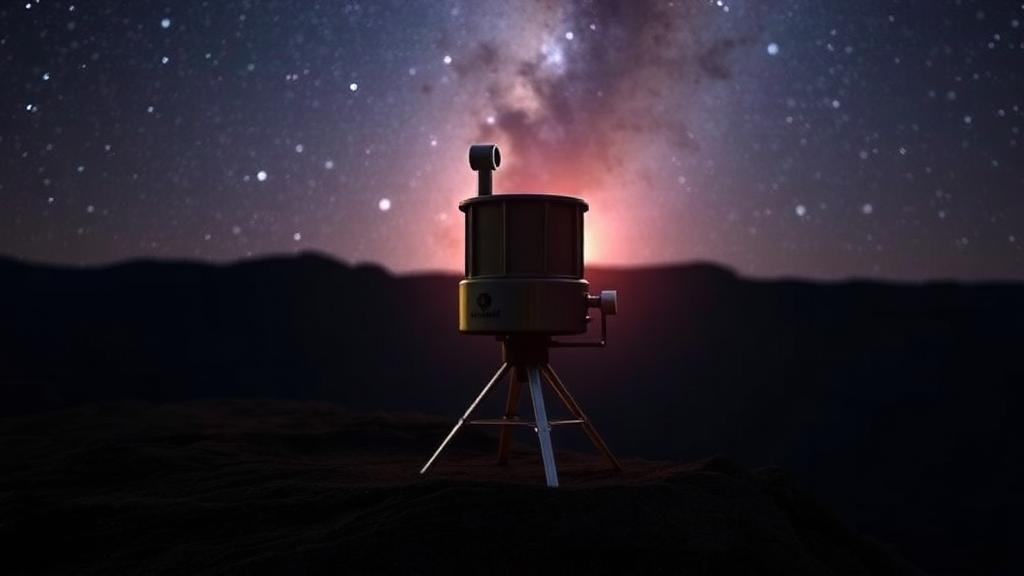
A compact spacecraft barely larger than a piece of orbital hardware luggage is now peering deep into the cosmos, and its first images are turning heads across the astronomy community. VERTECS, an astronomical nano-satellite developed by a Japanese consortium led by the Kyushu Institute of Technology, has successfully completed its initial on-orbit checkout phase and entered routine scientific operations, the project team announced. The milestone follows a meticulously staged commissioning campaign in which engineers verified every major subsystem, from electrical power generation to attitude control and data transmission, before declaring the satellite ready for its primary mission: measuring the faint visible-light glow of the extragalactic background radiation, a diffuse luminous fingerprint left behind by all the stars and galaxies that have ever formed in the history of the universe.
VERTECS rode to orbit aboard H3 Launch Vehicle No. 6, the H3-30 test vehicle configuration, lifting off from the Japan Aerospace Exploration Agency’s Tanegashima Space Center at 9:53:59 a.m. Japan Standard Time on June 12, 2026. Once the launch vehicle delivered the nano-satellite into its designated orbit, the operations team established contact with the spacecraft through its designated ground stations, a critical first step that confirmed the separation sequence had unfolded as designed. From that moment, the commissioning schedule proceeded methodically. Engineers activated and validated the power subsystem in turn, then communications, then the attitude-control system that keeps the telescope steady against the gentle but relentless torques of orbital flight, followed by the data-processing chain and, finally, the observation instrument itself. Each stage of verification had to succeed before the next could begin, a discipline that protects a mission from masking one fault behind another.
The payoff of that patience came in the form of images. During initial operations the team commanded VERTECS to point at selected sky regions and capture exposures with its onboard visible-light camera, then downlinked the data for inspection. The results, released as multicolor composite images of the Cygnus Loop, the Lagoon Nebula, and the North America Nebula, showcase stars and glowing clouds of interstellar gas in striking detail. Beyond their aesthetic appeal, the images serve as hard engineering evidence: by pointing precisely at the intended coordinates and returning sharp frames, the satellite demonstrated the high-precision attitude-control performance that its scientific mission demands. Perhaps most striking is the efficiency. VERTECS obtained its crisp images with exposures of just one minute, whereas producing comparable images with ground-based telescopes would require hours of integration time, since Earth’s atmosphere blurs and absorbs incoming light in ways no spacecraft ever has to fight.
The scale of VERTECS’s view of the sky is what sets the mission apart. Its main camera covers a field of view of 3 degrees by 3 degrees in each wavelength band, meaning a single observation captures an area roughly 40 times the apparent area of the full Moon. Established space observatories such as the James Webb Space Telescope and the Euclid satellite, both optimized for different science goals, would require many individual pointings to tile an equivalent patch of sky. Wide-field capability is not a luxury for this mission; it is the entire point. Mapping the extragalactic background light requires summing enormous numbers of faint, unresolved sources, and a telescope that can swallow vast regions of sky in a single exposure can build the necessary map in a fraction of the observing time that narrower instruments would need.
To validate the instrument for that task, the team imaged the Boötes region, a patch of sky deliberately chosen because it contains no bright astronomical objects that could drown out the dim background signal the mission is hunting. Analysis of the resulting frame confirmed that VERTECS meets its specified spatial resolution and sensitivity requirements, matching the performance predicted during ground testing and simulation. As a final checkout exercise, the satellite’s secondary camera photographed Earth while the spacecraft communicated with an operational ground station. Because the antenna must remain pointed at the ground station during data downlinks, the Earth image doubles as proof that the attitude-control system held the spacecraft stable in a demanding operational posture, closing out the last open question about the satellite’s readiness.
With commissioning complete, the mission now pivots to its scientific heart. The extragalactic background radiation in visible wavelengths is the accumulated light of cosmic history, emitted by stars and galaxies across billions of years and stretched by the expansion of the universe. Some of that light comes from sources telescopes can individually resolve, but a portion is thought to originate from populations too faint or too diffuse to be catalogued, potentially including the first generations of stars that ended the cosmic dark ages. By measuring the total brightness and structure of this background with unprecedented coverage, VERTECS aims to constrain how the cosmic rate of star and galaxy formation evolved over time, effectively reading the energy ledger of star formation written across the entire sky.
Scientists involved in the project emphasized both the relief and the ambition that accompany the transition to routine operations. Kei Sano, an assistant professor in the Department of Space Systems Engineering at the Kyushu Institute of Technology, said the initial images mark an important first step, demonstrating that the satellite can achieve its specified observational performance in space, and that the team will now steadily accumulate and analyze observation data with the aim of producing new scientific results. Shuji Matsuura, professor of physics and astronomy at Kwansei Gakuin University, whose group led development of the observation instrument, noted that the on-orbit performance matches ground tests and simulations and said the team is deeply impressed by the beauty of astronomical images obtained with such a small telescope above the atmosphere. He added that the research group will use the expansive map of the universe built through long-term observations to take on the challenge of unraveling the mystery of the extragalactic background radiation.
Other institutional partners described the commissioning success as the culmination of years of distributed engineering effort. Takao Nakagawa, a specially appointed professor at Tokyo City University’s Advanced Research Laboratories, expressed satisfaction that the satellite is performing as expected and said his team will continue contributing to satellite operations, data reception, and analysis. Ichiro Jikuya, an associate professor at Kanazawa University who participated in introducing the attitude-control unit, said the establishment of high-precision attitude control enables the telescope to realize its full performance and marks a major milestone in the development of the satellite bus. Koji Takimoto, a project researcher at the University of Tokyo who coordinated the onboard observation instrument and developed the telescope, admitted the team remained anxious about whether the telescope would perform in orbit until the first image arrived, making the sharp early frames especially rewarding. Operations are conducted by members of the participating institutions, with observations planned to continue for a year.
The success of VERTECS carries significance well beyond its immediate science goals. Nano-satellites have traditionally been treated as platforms for technology demonstrations and student training, capable of modest engineering experiments but rarely competitive with flagship observatories. A nano-class spacecraft now certified to deliver science-grade wide-field imaging with minute-scale exposures that would consume entire nights on the ground suggests the class of vehicle can shoulder genuine astrophysical missions at a fraction of conventional cost. If the year-long survey delivers on its promise, the mission will not only chart the diffuse glow of cosmic star formation but also strengthen the case for fleets of small, specialized telescopes working in concert, an approach that could reshape how astronomy allocates its observing time in the decades ahead. For now, the team’s gratitude extends to the students, researchers, and engineers who carried the project from drawing board to orbit, and their attention has turned fully to the sky.
Subject of Research: A Japanese nano-satellite mission observing visible extragalactic background radiation to trace star and galaxy formation history
Article Title: Astronomical nano-satellite VERTECS completes initial operations and begins scientific observations
Article References: Astronomical nano-satellite VERTECS completes initial operations and begins scientific observations. (n.d.). Original publication
Image Credits: AI Generated
DOI: Not provided
Keywords: VERTECS, nano-satellite, astronomy, extragalactic background radiation, Kyushu Institute of Technology, H3 launch vehicle, Tanegashima Space Center, visible-light telescope, star formation history, wide-field imaging, attitude control, space telescope
Cite Scienmag News
Grant Pearson. (October 14, 2026). Tiny VERTECS Space Telescope Begins Hunt for the Universe’s Hidden Starlight. Scienmag. https://scienmag.com/tiny-vertecs-space-telescope-begins-hunt-for-the-universes-hidden-starlight/
Grant Pearson. "Tiny VERTECS Space Telescope Begins Hunt for the Universe’s Hidden Starlight." Scienmag, 14 October 2026, https://scienmag.com/tiny-vertecs-space-telescope-begins-hunt-for-the-universes-hidden-starlight/. Accessed 14 October 2026.
Grant Pearson. "Tiny VERTECS Space Telescope Begins Hunt for the Universe’s Hidden Starlight." Scienmag. October 14, 2026. https://scienmag.com/tiny-vertecs-space-telescope-begins-hunt-for-the-universes-hidden-starlight/