


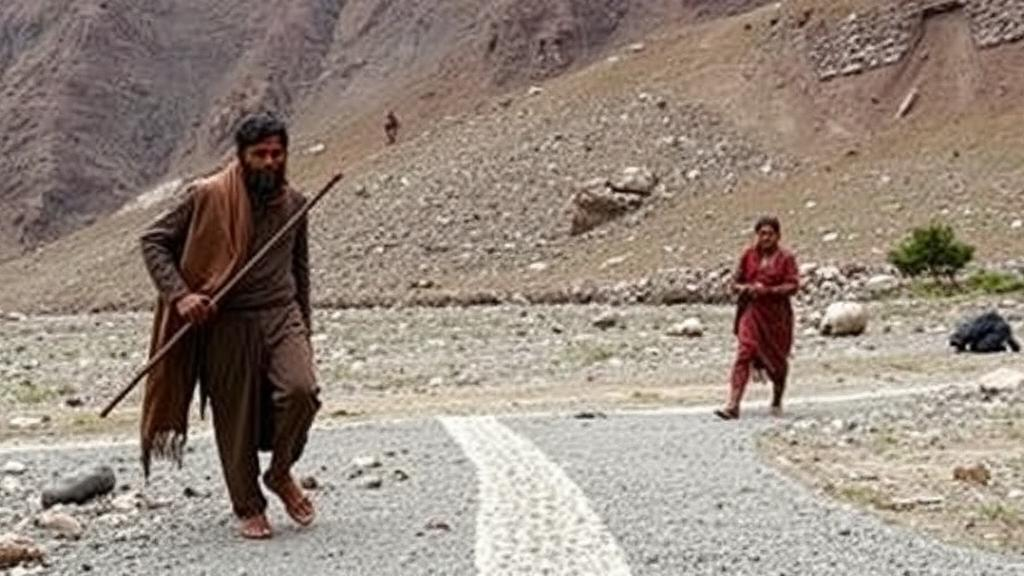
High in the Indian Himalaya, where the borders of India, Nepal, and Tibet converge, the Bhotiya people have for centuries lived a life defined by movement. They herded sheep and goats across dizzying altitude gradients, traded wool and salt across the passes into Tibet, and built a culture finely tuned to one of the most demanding environments on Earth. Today, that way of life is under profound pressure. A new systematic review published in SN Social Sciences by Chetna Negi and Richa Thapliyal of Graphic Era University in Dehradun brings together decades of scholarship on the Bhotiya community of Uttarakhand, offering the most comprehensive synthesis to date of what is known—and what remains poorly understood—about this border-dwelling tribe.
The scale of the review’s subject is considerable. India’s tribal communities number approximately 104 million people, or 8.6 percent of the national population, and Uttarakhand hosts several prominent groups, including the Jaunsari, Buksa, Tharu, and Raji. Among them, the Bhotiya stand out for their geographic dispersion: a population of 39,106 people spread across seven distinct river valleys in the border districts of Pithoragarh, Chamoli, and Uttarkashi. This fragmentation is not incidental. The valleys—the Johar, Darma, Byans, Chaudans, Niti, Mana, and the Bhagirathi basin associated with the Jaad Bhotiya—each host sub-groups with distinct dialects, customs, and histories, shaped by centuries of adaptation to different trade routes and ecological niches.
Methodologically, the study follows the PRISMA guidelines, the Preferred Reporting Items for Systematic Reviews and Meta-Analyses, a framework originally developed for medical research that has become the gold standard for transparent evidence synthesis across disciplines. Negi and Thapliyal drew on peer-reviewed articles, ethnographic accounts, and census data from national databases, compiling a corpus that spans colonial-era administrative reports from the 1830s through contemporary doctoral theses. No primary datasets were generated; instead, the authors conducted a thematic review of secondary sources, a design that allows them to trace how scholarly understanding of the Bhotiya has itself evolved over nearly two centuries.
That historical arc is one of the review’s most striking contributions. Early accounts, such as G.W. Traill’s 1832 statistical report on the Bhotiya mehals of Kumaon and E.T. Atkinson’s Himalayan Gazetteer, documented a community whose economic life revolved around trans-Himalayan trade. Bhotiya traders carried Indian goods over the passes to Tibet and returned with salt, wool, and borax, a commerce so strategically significant that British surveyors relied on Bhotiya intermediaries during clandestine expeditions to Tibet, including the famous ‘Pundit’ explorations connected to the Great Trigonometrical Survey. The 1962 closure of the Indo-Tibetan border severed this economic lifeline almost overnight, triggering what scholars have described as a cascade of livelihood collapse, sedentarization, and cultural dislocation.
The review pays particular attention to the fate of transhumant pastoralism, the seasonal movement of livestock between high-altitude summer pastures and winter villages. Work cited in the synthesis, including D.D. Dangwal’s studies of pastoralism in the Uttarakhand Himalaya, documents how colonial forest policies, post-independence conservation measures, and modern economic opportunities progressively eroded the mobility that defined Bhotiya life. Studies of the Jaad Bhotiya of the upper Bhagirathi basin record changing patterns of transhumance, with fewer households continuing the annual migration as education, employment, and state welfare draw younger generations toward permanent settlement in lower valleys and towns.
Yet the picture the review paints is not one of simple disappearance. Negi and Thapliyal emphasize that the Bhotiya continue to maintain several traditional practices even as modernization, out-migration, and shifting socio-economic dynamics transform their livelihoods and cultural fabric. Ethnobotanical research from the Dharchula region of Pithoragarh documents rich ethno-medicinal knowledge among Bhotiya communities, while studies of ritual communication in Chamoli District and of the vernacular architecture and cultural landscapes of the Johar Valley show living traditions that persist in modified forms. Handloom weaving, documented as both a challenge and an opportunity for the community, represents one avenue through which traditional skills are being repositioned within contemporary markets.
The review also engages with a question that has long complicated the study of Himalayan communities: identity and classification. The Bhotiya were granted Scheduled Tribe status in Uttarakhand through the Constitution (Scheduled Tribes) (Uttar Pradesh) Order of 1967, a designation that carries affirmative action benefits but also fixes in law categories that are fluid on the ground. Comparative scholarship cited in the review, including work on the Rang of far-western Nepal, examines how minority Himalayan populations navigate overlapping discourses of nation, scheduled tribe, janajati, and indigeneity. Genetic studies of Uttarakhand’s populations have likewise explored the region’s complex population structure, underscoring that the Bhotiya cannot be understood as a homogeneous bloc.
Language emerges as a central concern in the synthesis. Several Bhotiya sub-groups speak Tibeto-Burman languages, and the review cites descriptive linguistic work on Darma, an endangered language of the Darma Valley, as evidence of the stakes involved. As schooling, media, and migration shift daily communication toward Hindi and regional lingua francas, the intergenerational transmission of these languages weakens. For a community whose sub-groups are scattered across seven valleys, linguistic diversity is both a marker of cultural richness and a vulnerability, since each small speech community faces its own tipping point between maintenance and loss.
The policy implications of the review are framed around integration. Negi and Thapliyal argue that understanding the continuity and transformation of the Bhotiya requires a multidimensional framework that weaves together historical, social, cultural, and policy perspectives. Fragmented scholarship—historians writing on trade, anthropologists on kinship, botanists on medicinal plants, geographers on mobility—has produced valuable but disconnected insights. A synthesis that treats these dimensions together, the authors contend, is essential for designing interventions that support the community without freezing it in an idealized past, particularly as border-area development, tourism, and hydropower projects reshape the high valleys.
The study, which was supported by an Indian Council of Social Science Research doctoral fellowship and forms part of Negi’s doctoral work, arrives at a moment when high mountain communities worldwide face converging pressures from climate change, geopolitical tension, and economic transition. For the Bhotiya, whose identity was forged at the crossroads of empires and whose future is now being negotiated between tradition and modernity, the review offers something rare: a single, rigorous map of what two centuries of scholarship actually establish. It is a reminder that the fate of small indigenous communities in the Himalaya is not merely a local story, but a lens on how mountain societies everywhere adapt when the routes that once sustained them are closed, and new ones must be found.
Subject of Research: Systematic review of the historical and contemporary status of the Bhotiya tribal community in Uttarakhand, India
Article Title: Understanding the status of the Bhotiya community in Uttarakhand: a systematic review
Article References: Understanding the status of the Bhotiya community in Uttarakhand: a systematic review. (n.d.). https://doi.org/10.1007/s43545-026-01832-8
Image Credits: AI Generated
DOI: 10.1007/s43545-026-01832-8
Keywords: Bhotiya, Uttarakhand, systematic review, indigenous tribe, transhumance, pastoralism, Himalaya, Scheduled Tribes, ethnobotany, cultural transformation, India, border communities
Cite Scienmag News
Courtney Benton. (October 14, 2026). Himalayan Tribe at a Crossroads: Systematic Review Maps the Bhotiya of Uttarakhand. Scienmag. https://scienmag.com/himalayan-tribe-at-a-crossroads-systematic-review-maps-the-bhotiya-of-uttarakhand/
Courtney Benton. "Himalayan Tribe at a Crossroads: Systematic Review Maps the Bhotiya of Uttarakhand." Scienmag, 14 October 2026, https://scienmag.com/himalayan-tribe-at-a-crossroads-systematic-review-maps-the-bhotiya-of-uttarakhand/. Accessed 14 October 2026.
Courtney Benton. "Himalayan Tribe at a Crossroads: Systematic Review Maps the Bhotiya of Uttarakhand." Scienmag. October 14, 2026. https://scienmag.com/himalayan-tribe-at-a-crossroads-systematic-review-maps-the-bhotiya-of-uttarakhand/


