


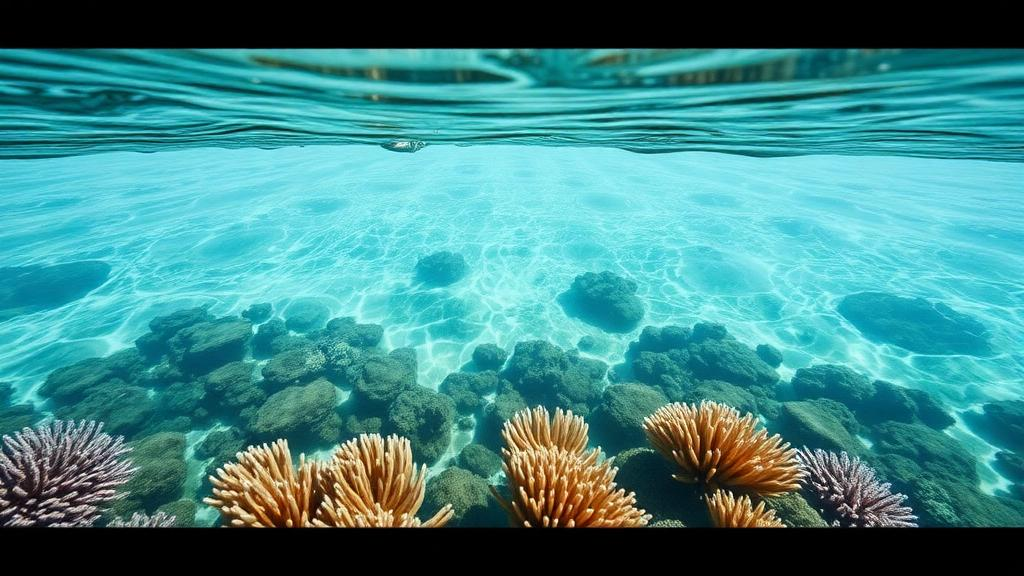
In the middle of one of the hottest seas on Earth, a small salt-dome island has quietly been keeping coral reefs alive while reefs across much of the southern Arabian/Persian Gulf have collapsed. Sir Bu Nair Island, a protected marine area lying roughly 70 kilometers offshore from the United Arab Emirates, retains extensive and well-developed coral communities, including the last known large stands of heat-sensitive Acropora table corals in the southern Gulf. Understanding why has become one of the most pressing questions in Gulf reef science, and a new 17-month observational study now offers the most complete physical explanation yet.
A team led by Geórgenes H. Cavalcante of New York University Abu Dhabi, publishing in the journal Ocean Science, deployed bottom-mounted acoustic Doppler current profilers and arrays of temperature loggers around the island from May 2021 to October 2022. Their measurements, complemented by satellite sea surface temperature records reaching back to 1985 and regional ocean model products spanning more than three decades, provide the first integrated picture of how water moves and heats around this isolated reef system. The answer, it turns out, is not a single mechanism but a hierarchy of interacting forces shaped dramatically by the island’s unusual underwater topography.
Sir Bu Nair is the surface expression of a Hormuz salt dome rising from the Arabian shelf, and its near-circular shape is ringed by remarkably steep bathymetry. Depths plunge to around 30 meters within just 3 to 5 kilometers of the shoreline. That steep gradient matters enormously for the water flow. Currents measured at both mooring sites were strongly anisotropic, meaning they moved in essentially straight lines back and forth along a single preferred direction rather than rotating freely. At the northwest site, flow aligned along a principal axis oriented roughly 29 degrees, a direction that captured more than 94 percent of the current variance. At the southern site, the axis was oriented east-west, with directional dominance weakening from about 85 percent near the seafloor to 67 percent near the surface.
The two flanks of the island behaved like entirely different oceanographic worlds. Upper-layer currents at the northwest mooring routinely reached 0.6 meters per second along the principal axis, with episodic peaks approaching 0.8 to 1.0 meters per second, while the southern site rarely exceeded 0.3 meters per second. Subtidal kinetic energy, a measure of the energy in currents stripped of tidal oscillations, was roughly nine times higher on the northwest flank. Even more striking, the mean current at the southern site was broadly aligned with the regional circulation derived from satellite-altimetry-based reanalysis products, whereas the northwest flow was strongly rotated relative to that regional field. The island’s bathymetry is clearly bending and channeling the basin-scale flow into locally forced pathways.
Tides emerged as the dominant engine of current variability, but with sharp spatial contrasts. Harmonic analysis showed that tidal constituents explained about 80 percent of the along-axis current variance at the northwest site, yet only about 35 percent of the cross-axis variance. At the southern site, tides accounted for just 39 percent of along-axis and 12 percent of cross-axis variance. The local tide regime is mixed with semidiurnal dominance, with the principal lunar M2 constituent producing a mean range of roughly 0.72 to 0.74 meters and constructive interference capable of pushing the astronomical range above 1.5 meters. Tidal current ellipses were predominantly rectilinear, and a quarter-diurnal overtide signal in the records pointed to nonlinear tidal harmonic generation around the island and its adjacent shoals rather than a free-standing seiche.
Wind, while secondary to tides, proved to be the key modulator of the residual circulation. The Gulf’s famous Shamal winds, northwesterly events whose name means north in Arabic, dominated the observed wind climate, with a bimodal directional pattern also including weaker southeasterly flow. Wind-current coupling was strongest at subtidal timescales of roughly 3 to 8 days, and current responses followed wind changes with remarkably short lags of zero to two hours. That immediacy, the authors note, is consistent with rapid barotropic adjustment through wind-driven setup and pressure gradients rather than the classical offshore Ekman response. At the northwest site, cross-axis currents correlated with wind velocity at up to 0.62, while at the southern site coupling occurred primarily along the flow axis.
The temperature story is where the findings become most consequential for corals. Summer water temperatures around the island exceeded 35 degrees Celsius, persisting above that threshold for up to 24 consecutive days at the southern mooring during mid-2021. Yet vertical temperature differences of 2 to 4 degrees Celsius, occasionally exceeding 4.8 degrees, repeatedly developed between near-surface and near-bottom waters during late spring and summer, only to collapse toward thermal homogeneity within two to three days. During a detailed case study from late May to mid-June 2021, surface waters around 32 to 33 degrees Celsius sat above bottom waters of 28 to 30 degrees before temperatures converged abruptly across all measured depths at both sites.
Spectral and variance-partitioning analyses revealed that no single driver controlled this thermal seesaw. The diurnal band dominated vertical temperature variability, explaining 67 percent of the variance at the northwest site and 54 percent at the southern site, with significant coherence linking temperature differences to cross-axis wind stress and along-axis currents. A synoptic band of 2 to 4 days accounted for another 36 to 39 percent, with sea level variations providing the largest unique contribution, a timescale that overlaps with Shamal wind cycles. The authors emphasize that without concurrent salinity data they cannot fully separate vertical mixing from horizontal advection, but the evidence points to lower-frequency preconditioning interacting with tidal and atmospheric forcing rather than any one process in isolation.
Regional context sharpened the picture of 2021’s exceptional heat. Satellite records from 1985 to 2025 showed that July-September sea surface temperatures in 2021 were anomalously warm across the entire southeastern Gulf, about 0.79 degrees Celsius above the long-term mean and at the 95th percentile, whereas 2022 was close to climatological conditions. Regional current speeds during 2021, however, remained within historical variability. The warming was an atmospheric event, not a circulation anomaly, which helps explain why the island’s corals faced genuine thermal stress that year despite their physical advantages.
Those advantages may now be quantifiable. The study period coincided with the first recorded bleaching event at Sir Bu Nair and losses of heat-sensitive Acropora, showing that even this refuge has limits. But under typical summer conditions, the authors suggest, episodic wind forcing helps disrupt vertical temperature gradients and exchange cooler subsurface waters with shallow reef habitats, potentially reducing cumulative heat stress, while prolonged weak-wind conditions favor heat retention in the shallow reef zone. That buffering mechanism may become increasingly fragile, given reported declines in summer Shamal frequency since the mid-1990s and increasingly recurrent bleaching across Gulf reefs. The pronounced spatial heterogeneity in currents between adjacent island flanks also carries implications for larval connectivity, since previous modeling has identified Sir Bu Nair as a potential larval source for degraded reefs along the southern Gulf coast. As climate change tightens its grip on the region, the fate of these reefs may hinge on the delicate interplay between tides, winds, and a salt dome’s steep underwater walls.
Subject of Research: Ocean circulation and vertical thermal structure around Sir Bu Nair Island in the Arabian/Persian Gulf and their implications for coral reef resilience
Article Title: Current dynamics, drivers, and vertical thermal structure around Sir Bu Nair Island (Arabian/Persian Gulf)
Article References: Cavalcante, G. H., Vieira, F., Bento, R., Bartholomew, A., & Burt, J. A. (2026). Current dynamics, drivers, and vertical thermal structure around Sir Bu Nair Island (Arabian/Persian Gulf). Ocean Science, 22(5), 3165-3183. https://doi.org/10.5194/os-22-3165-2026
Image Credits: AI Generated
Keywords: Sir Bu Nair Island, Arabian Gulf, coral reefs, ocean circulation, tides, wind forcing, thermal stratification, marine heatwaves, ADCP measurements, Shamal winds, coral bleaching, physical oceanography
Cite Scienmag News
Violet Maxwell. (October 14, 2026). Tides Rule the Currents That Shield a Gulf Island’s Last Great Coral Reefs. Scienmag. https://scienmag.com/tides-rule-the-currents-that-shield-a-gulf-islands-last-great-coral-reefs/
Violet Maxwell. "Tides Rule the Currents That Shield a Gulf Island’s Last Great Coral Reefs." Scienmag, 14 October 2026, https://scienmag.com/tides-rule-the-currents-that-shield-a-gulf-islands-last-great-coral-reefs/. Accessed 14 October 2026.
Violet Maxwell. "Tides Rule the Currents That Shield a Gulf Island’s Last Great Coral Reefs." Scienmag. October 14, 2026. https://scienmag.com/tides-rule-the-currents-that-shield-a-gulf-islands-last-great-coral-reefs/


