


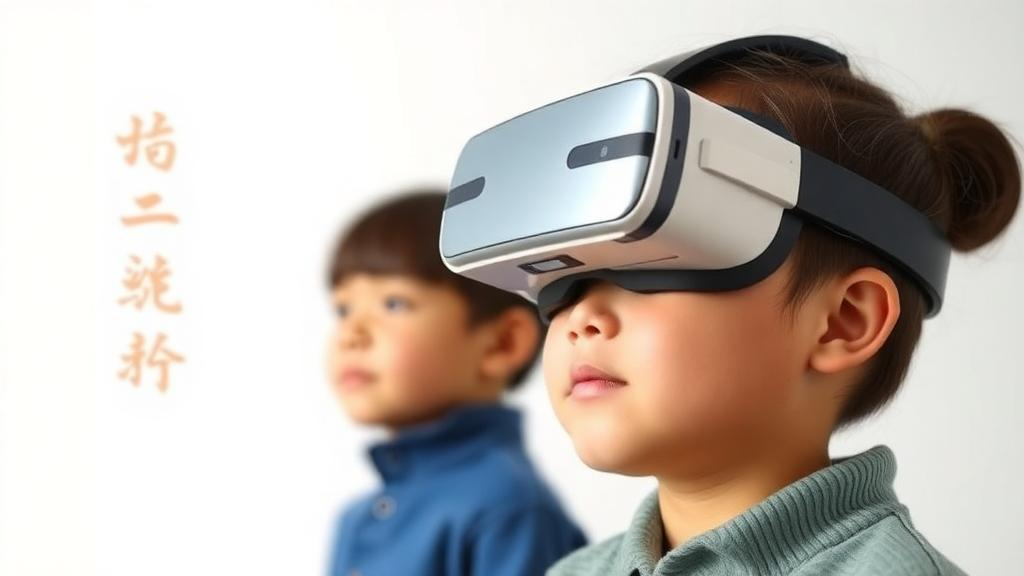
For more than a thousand years, Chinese schoolchildren have wrestled with Tang poetry, the compressed, image-rich verses composed during China’s golden age of classical literature. The poems are short enough to memorize, yet their layered imagery and cultural allusions have long frustrated even diligent eleven- and twelve-year-olds. A new quasi-experimental study published in Discover Education suggests that immersive virtual reality may offer a way through, transforming abstract verses into explorable three-dimensional scenes that students can inhabit rather than merely recite.
The research, conducted by Lin Cheng and colleagues at Universiti Putra Malaysia together with Riyan Hidayat of SEGi University, recruited 166 sixth-grade students aged 11 to 12 from two public primary schools in Guiyang, in China’s Guizhou Province. One group of 84 students learned six Tang poems through immersive VR instructional videos, while a control group of 82 students studied the same poems through traditional teacher-led lessons. Crucially, both groups followed identical learning objectives, schedules, and content, isolating the technology itself as the key difference between the classrooms.
The VR environment was not an off-the-shelf product but a carefully engineered instructional system built through the ADDIE model, the classic five-stage instructional design process of analysis, design, development, implementation, and evaluation. In the analysis phase, the team interviewed six experienced primary school Chinese teachers and reviewed 39 empirical studies, confirming that insufficient engagement, a lack of immersive scenarios, and a shortage of quality VR resources were the central obstacles to poetry teaching. The design stage produced a six-lesson program covering 48 core knowledge points, which experts rated with a content validity index of 0.97. The finished materials earned a mean expert rating of 4.85 out of 5.
Technically, the system ran on mobile phone-based head-mounted displays equipped with head-tracking and handheld controllers, allowing students to navigate panoramic poetic scenes from a first-person perspective. Rather than passively watching a video, learners freely explored virtual environments, inspected cultural elements from multiple angles, and engaged with embedded prompts and interactive recitation activities. Immersive visuals and 360-degree auditory experiences replaced the dry, abstract imagery that typically accompanies classical Chinese verses. Safety protocols were strict: continuous VR exposure was capped at 15 minutes followed by a five-minute rest, teachers monitored every session, and students could stop immediately if they experienced dizziness or visual discomfort. Headsets were sanitized before each use.
The study measured four outcomes: academic achievement, concentration, engagement, and classroom interaction. Achievement was assessed with a 12-item test combining multiple-choice, fill-in-the-blank, dictation, and short-answer questions scored against Bloom’s taxonomy, with internal consistency values of 0.81 and 0.82 for the pre- and post-tests. Concentration, engagement, and interaction were measured with validated Likert-scale questionnaires adapted from established instruments, all showing acceptable to strong reliability. To account for baseline differences between intact classes, the researchers used Analysis of Covariance, entering pre-test scores as a covariate, a statistically rigorous approach for a setting where random assignment of individual students was impractical.
The results were striking in places and nuanced in others. Students in the VR condition significantly outperformed their peers on the achievement post-test, with a small but reliable effect. Engagement showed the largest effect by far, with a substantial adjusted difference between groups, suggesting that the immersive experience moved students from passive memorization toward active emotional and behavioral involvement with the poems. Classroom interaction also improved significantly, though the effect was modest, likely because the intervention emphasized individual exploration over collaborative tasks. Concentration told a more complicated story: the VR group scored higher descriptively, but the standard statistical test found no significant main effect, and an assumption violation in the model means those results must be interpreted with caution.
The authors ground these findings in established theory. The Cognitive-Affective Model of Immersive Learning holds that presence, agency, embodiment, and cognitive engagement drive learning outcomes in VR, while Flow theory describes the state of complete absorption that immersive environments can induce. Motivation and engagement theory adds that heightened intrinsic motivation feeds directly into behavioral and emotional engagement, which in turn supports achievement. The study is careful to note that these frameworks served as conceptual scaffolding rather than directly measured constructs, and it acknowledges that some VR benefits in prior research may stem from novelty effects that fade with repeated exposure.
What makes this study notable is its target domain. Educational VR research has been overwhelmingly concentrated in STEM subjects, where virtual laboratories and geometric visualizations are natural fits. Tang poetry presents a harder problem: condensed classical language, dense historical symbolism, and imagery that demands imaginative reconstruction. By demonstrating measurable gains in achievement and engagement in a humanities context, the study extends the evidence base for immersive technology well beyond science classrooms and offers curriculum developers a concrete framework, structured around ADDIE, for integrating VR into language and literature instruction.
The researchers are candid about the limitations. The sample came from just two schools in one Chinese city, the six-week intervention was too brief to reveal long-term effects, and the interaction questionnaire captured students’ perceptions of teacher support rather than peer-to-peer exchange. The head-mounted displays also housed smartphones from different manufacturers, including Huawei and Xiaomi models, so hardware variation may have influenced perceived immersion. Formal inter-rater reliability for the short-answer scoring was not assessed, a limitation the authors themselves flag. They call for randomized and multi-site designs, longer intervention cycles, qualitative methods such as interviews and classroom observations, and comparative studies of semi-immersive versus fully immersive setups.
Even with those caveats, the implications ripple outward. As Chinese language learning surges globally and schools everywhere experiment with immersive technology, this study provides empirical evidence that VR can carry cultural and literary weight, not just scientific visualization. The authors recommend improved VR infrastructure, stronger teacher training, and closer alignment of VR resources with curriculum standards, along with collaborative tasks and gamified elements to strengthen the social dimension of future implementations. For now, the image of eleven-year-olds in Guiyang stepping inside a Tang dynasty landscape, reciting verses as they explore them, offers a vivid glimpse of how classical literature might survive its collision with the digital age, and perhaps be revitalized by it.
Subject of Research: The effect of immersive virtual reality instruction on primary school students' learning of Tang poetry
Article Title: Immersive virtual reality supports Tang poetry learning among primary school students
Article References: Immersive virtual reality supports Tang poetry learning among primary school students. (n.d.). https://doi.org/10.1007/s44217-026-02229-8
Image Credits: AI Generated
DOI: 10.1007/s44217-026-02229-8
Keywords: virtual reality, Tang poetry, primary education, Chinese language learning, engagement, classroom interaction, ADDIE model, quasi-experimental design, educational technology, immersive learning, humanities education, ANCOVA
Cite Scienmag News
Courtney Benton. (October 13, 2026). Virtual Reality Headsets Help Primary School Students Master Classical Chinese Poetry. Scienmag. https://scienmag.com/virtual-reality-headsets-help-primary-school-students-master-classical-chinese-poetry/
Courtney Benton. "Virtual Reality Headsets Help Primary School Students Master Classical Chinese Poetry." Scienmag, 13 October 2026, https://scienmag.com/virtual-reality-headsets-help-primary-school-students-master-classical-chinese-poetry/. Accessed 13 October 2026.
Courtney Benton. "Virtual Reality Headsets Help Primary School Students Master Classical Chinese Poetry." Scienmag. October 13, 2026. https://scienmag.com/virtual-reality-headsets-help-primary-school-students-master-classical-chinese-poetry/


