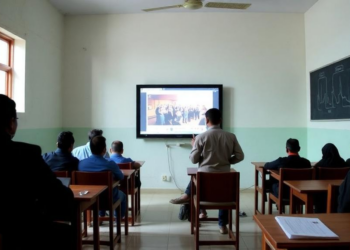
When South Africa’s Department of Basic Education placed Coding and Robotics on the timetable for children as young as five, it made a bold bet: that computational thinking, creativity, and digital confidence could be built from the very first years of schooling. A new exploratory qualitative study, published in Discover Education, offers one of the most intimate looks yet at how that bet is playing out on the ground. Focusing on the Umlazi District south of Durban in KwaZulu-Natal, researcher Wiseman Gcizelela Ngcobo followed five experienced Foundation Phase teachers across four pilot schools to understand what actually happens when the policy meets the classroom. The answer is a story of remarkable dedication colliding with systemic under-preparation, and its lessons reach far beyond one South African district.
The stakes of the early years are not incidental. Research on early childhood computational thinking consistently shows that first encounters with sequencing, pattern recognition, and symbolic representation shape later disciplinary learning and digital self-belief. In the Foundation Phase, which covers Grades R through 3, coding is not about writing lines of program code. It is about developmentally appropriate experiences: giving and following instructions, spotting and correcting errors, designing and making, and using programmable floor robots or unplugged activities to make abstract ideas tangible. When teachers are well prepared, these experiences blend naturally with the play, movement, story, and concrete manipulation that define effective early learning. When they are not, the subject risks becoming abstract, intimidating, and unevenly applied.
To make sense of what he observed, Ngcobo framed the study with the Technological Pedagogical Content Knowledge model, or TPACK, which treats effective technology integration as the product of a dynamic interplay between content knowledge, pedagogical knowledge, technological knowledge, and the realities of context. The framework is demanding by design. A teacher might be enthusiastic yet unable to explain sequencing accurately; another might grasp the concept but not know how to make it accessible to a Grade R learner through play; a third might understand both but lack the skills to operate a coding robot or a visual programming interface. In every case, it is the failure of integration across domains, not a single missing piece, that undermines teaching quality. Context matters too: the same curriculum can produce radically different classroom experiences depending on resources, support, and institutional conditions.
The methodology was deliberately close to the ground. Working within an interpretivist paradigm, the study combined semi-structured individual interviews, document analysis, and classroom observations to triangulate evidence from five purposively selected teachers in four pilot schools. Data were analysed thematically, with interview transcripts, observation notes, and curriculum documents coded and cross-checked throughout to strengthen trustworthiness. The small sample reflects a practical reality: the pilot programme had been delayed or halted in other selected schools, leaving five teachers as the accessible population. That constraint limits generalisability, but it also yields unusually rich detail about how one district’s implementation actually unfolded.
The findings on content knowledge are sobering. Teachers were eager and recognised the subject’s relevance, yet most lacked an integrated grasp of the curriculum. They were unsure not only of terminology but of what content was appropriate for Grades R to 3, how concepts should progress across grades, and how formal expectations connected to play-based practice. One participant described the concepts as unfamiliar and difficult to interpret because she was new to the subject; another said teaching it was challenging because she had never been professionally trained to teach it. In a phase where learners are emergent readers who need oral, visual, and tactile mediation, a teacher’s conceptual uncertainty translates directly into classroom confusion. Simplifying ideas like sequencing, patterning, and debugging without distorting them requires exactly the firm content grounding many participants did not yet have.
Compounding the problem was a striking scarcity of official documentation. During document analysis, the researcher found that most teachers lacked the basic subject documents needed for implementation, including the Curriculum and Assessment Policy Statement, annual teaching plans, assessments, and lesson plans; some had no subject files at all. One teacher explained that she had to ask other schools for the documents she was expected to teach from. Another reported repeated failed attempts to obtain them from the department, saying subject advisors were either unavailable or did not hold copies. One participant even visited schools in other provinces and read international policy documents to piece together a workable conception of the curriculum. That improvisation demonstrates commitment, but it also exposes a profound implementation gap: teachers were being asked to deliver a new subject while simultaneously hunting for its official content.
Pedagogy showed the same tension between intention and condition. Most teachers relied heavily on explanation, demonstration, and repetition, not because they dismissed hands-on learning, but because they lacked the manipulatives, programmable devices, and visual aids to do otherwise. One teacher described telling, explaining, and demonstrating as much as possible because learners needed to see and do, yet the school had few real objects to work with. Classroom observations made the cost vivid: in one Grade 3 lesson on the elements of a robot, the teacher read from notes and showed pictures while an unused robot set sat on the table. Across the four schools, only one had a fully resourced robotics lab; the other three had no robotic kits or textbooks. There were, however, signs of pedagogical movement, with some teachers blending explanation with practical activities in which learners built models, tested ideas, and revised attempts, a shift toward the guided, iterative problem-solving that robotics education research identifies as most effective.
Technological knowledge emerged as a third weak point. Most participants were comfortable with general classroom technologies such as computers and projectors but had limited familiarity with the tools that make Foundation Phase coding concrete: unplugged sequencing materials, programmable floor robots, coding mats, tangible coding blocks, and beginner visual environments like ScratchJr. Participants from under-resourced schools were especially candid about inequity, with one noting that advanced technology sits in schools like ex-Model C institutions while her own lacked the privilege of such resources. Professional development fared no better in their accounts: workshops were described as too few, too theoretical, and offering nothing about how to use the technology. Subject advisors, meanwhile, were reported as late, absent, or slow to follow through, leaving teachers to navigate a complex new subject largely alone. Notably, even the one well-equipped school saw underuse of its kits because teachers had not been trained to exploit them, a finding that punctures the assumption that hardware alone closes the gap.
Yet the learners’ response offers the study’s most hopeful thread. Four of the five teachers reported high enthusiasm, participation, and curiosity, with even usually quiet children becoming active during coding sessions. Teachers observed gains in logical reasoning, creativity, communication, and perseverance, and classroom observations confirmed deep engagement during practical activities. But assessment practices lagged behind. All five participants expressed uncertainty about what to assess and how to measure whether a learner truly understood a coding concept, often falling back on observation and participation. One warned that without clear guidelines, progression could rest on participation rather than actual understanding, raising concerns about the reliability and validity of assessment outcomes in a subject meant to build demonstrable skills.
The study’s conclusion reframes the implementation debate: the barrier is not teacher resistance but teacher under-preparation. Ngcobo recommends a coordinated, multi-layered response, including sustained practice-based professional development that starts from the curriculum itself and moves to age-appropriate tools, reliable access to official subject documentation, visible and instructional subject advisory support, and equitable resource distribution so that under-resourced schools are not left to implement the subject only symbolically. Universities, the study argues, should also redesign pre-service programmes so Foundation Phase teachers graduate with at least introductory competence in computational thinking and early-years robotics pedagogy. With the pilot phase informing a national rollout, the message from Umlazi is clear: young children are ready and eager to code, but the adults charged with teaching them need training, tools, and support that match the ambition of the policy.
Subject of Research: Teachers' experiences of teaching coding and robotics in the Foundation Phase of South African primary schools
Article Title: Exploring teachers’ experiences in teaching coding and robotics in the foundation phase (Grades R-3) in Umlazi, South Africa
Article References: Exploring teachers’ experiences in teaching coding and robotics in the foundation phase (Grades R-3) in Umlazi, South Africa. (n.d.). https://doi.org/10.1007/s44217-026-02292-1
Image Credits: AI Generated
DOI: 10.1007/s44217-026-02292-1
Keywords: coding and robotics, Foundation Phase, South Africa, TPACK, teacher preparedness, computational thinking, early childhood education, curriculum implementation, educational technology, professional development, Umlazi, digital literacy
Cite Scienmag News
Courtney Benton. (October 13, 2026). Robots in the Classroom: Why South Africa’s Youngest Coders Are Being Let Down by Teacher Training. Scienmag. https://scienmag.com/robots-in-the-classroom-why-south-africas-youngest-coders-are-being-let-down-by-teacher-training/
Courtney Benton. "Robots in the Classroom: Why South Africa’s Youngest Coders Are Being Let Down by Teacher Training." Scienmag, 13 October 2026, https://scienmag.com/robots-in-the-classroom-why-south-africas-youngest-coders-are-being-let-down-by-teacher-training/. Accessed 13 October 2026.
Courtney Benton. "Robots in the Classroom: Why South Africa’s Youngest Coders Are Being Let Down by Teacher Training." Scienmag. October 13, 2026. https://scienmag.com/robots-in-the-classroom-why-south-africas-youngest-coders-are-being-let-down-by-teacher-training/