


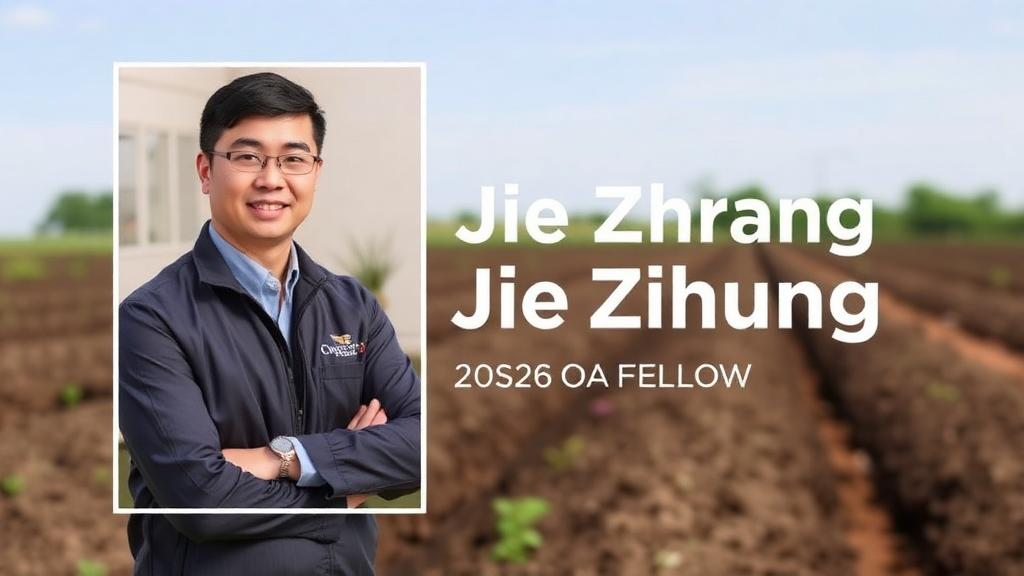
A University of Tennessee soil scientist has joined one of the most selective groups in his discipline. Jie Zhuang, a professor in the Department of Biosystems Engineering and Soil Science within the University of Tennessee Institute of Agriculture, is among nine members of the international cohort named 2026 Fellows of the Soil Science Society of America. The designation is the highest honor bestowed by the organization, and it is reserved for members who have achieved excellence in soil science while demonstrating outstanding service to the profession and to the society across the span of their careers.
The formal recognition will take place on November 3 during CANVAS 2026, an international meeting that brings together multiple scientific communities involved in crop, agronomic, environmental and soil science research. The meeting is expected to attract more than 4,000 scientists and innovators with a shared interest in global agricultural success, making it one of the largest gatherings of its kind. For Zhuang, the ceremony will cap a career that has spanned fundamental research into how water, contaminants and microorganisms move through soil, as well as applied work aimed at helping small farms operate more sustainably.
Fellowship in the Soil Science Society of America is not awarded for a single discovery. According to the society, recipients are recognized for significant contributions to research, education, industry, Extension and leadership, as well as their lasting impact on soil science and the broader scientific community. That breadth matters because soil science itself is an unusually integrative field. It sits at the intersection of physics, chemistry, biology and engineering, and its findings shape everything from crop productivity and water quality to carbon sequestration and disease transmission. A Fellow is expected to have moved the field forward on more than one of those fronts.
Zhuang’s research portfolio illustrates that integrative character. His published work ranges across the food-energy-water nexus, a framework that treats food production, energy generation and water resources as a tightly coupled system rather than as separate problems. The nexus approach has become increasingly influential in sustainability science because interventions in one domain often produce unintended consequences in the others. Irrigation, for example, links crop yields directly to energy use and aquifer depletion, and biofuel production can compete with food crops for both land and water. Studying these linkages requires the kind of cross-disciplinary modeling and experimentation that Zhuang’s group has pursued.
Another major thread of his research concerns the fate and transport of contaminants in soil and water systems. This line of inquiry addresses a remarkably wide array of agents, including viruses, bacteria, organic pollutants, heavy metals, engineered nanoparticles and nutrients. Each of these moves through porous media according to different physical and chemical rules. Viruses and bacteria, for instance, are transported by water flow but their retention in soil depends on factors such as pore size distribution, surface chemistry and electrostatic interactions. Heavy metals bind to soil particles through adsorption and precipitation reactions that are highly sensitive to pH and redox conditions. Engineered nanoparticles, an increasingly common class of environmental contaminants, present transport behavior that can differ sharply from that of dissolved chemicals, which is why their movement through soils has become a growing focus of environmental research.
Zhuang’s work also extends into soil hydrology modeling and pore-scale carbon-water interactions, areas that address some of the most fundamental questions in the discipline. Soil hydrology models predict how water enters, moves through and leaves the soil profile, and those predictions underpin flood forecasting, irrigation scheduling, groundwater recharge estimates and climate models. Pore-scale studies, by contrast, examine processes at the level of individual soil aggregates and the thin water films that coat mineral and organic surfaces. At that scale, the physical arrangement of pores determines where carbon compounds and water coexist, which in turn controls microbial access to organic matter and therefore the rate at which soil carbon is stabilized or released. Understanding these microscale interactions is considered essential for improving predictions of soil carbon dynamics under changing climate and land management conditions.
His research interests further include root water uptake and the physical foundations of phage-host interactions. Root water uptake is a central process in vadose zone hydrology, linking soil water availability to plant transpiration and crop productivity, and its modeling remains a challenge because roots alter the hydraulic properties of the soil around them as they grow. The study of phage-host interactions connects soil physics with microbiology. Bacteriophages, the viruses that infect bacteria, are now widely studied as modulators of microbial communities in soils and other environments, and the physical conditions governing how phages encounter and attach to their hosts are relevant both to understanding natural microbial ecology and to developing phage-based approaches for managing pathogens.
Zhuang’s most recent endeavors include studies of the food-energy-water nexus on small farms within the framework of the circular bioeconomy. The circular bioeconomy concept promotes the reuse and recycling of biological resources so that waste streams from one process become inputs for another, reducing reliance on finite resources and closing nutrient and energy loops. On small farms, this can involve practices such as converting agricultural residues and manure into energy or soil amendments, and it raises practical questions about economics, logistics and policy. Zhuang is among the editors of the recently published open access Handbook of Circular Bioeconomy, a guide intended for students and professionals that addresses future farming activities which could reshape urban-rural relationships. The handbook covers policy and engineering practices in global communities aimed at facilitating natural resource-based industries that address biosecurity, conservation and other global concerns.
Beyond his research, Zhuang has held a series of leadership and service roles at the University of Tennessee. He is currently a member of the UTIA Advisory Council. He served as faculty director of environmental and soil science graduate studies for his department from 2022 to 2026, and he has been the faculty lead of the UT Cluster Hiring Initiative for Resilient Agriculture and Forest Systems as well as the RAFS Community of Scholars in recent years. He has also received numerous faculty awards over the course of his career. In addition to his new SSSA honor, he is already a Fellow of the American Association for the Advancement of Science, one of the most widely recognized distinctions in the scientific community, and he is affiliated with the Institute for a Secure and Sustainable Environment at the University of Tennessee.
Zhuang received his B.S., M.S. and Ph.D. degrees in soil science from Shenyang Agricultural University in China, an academic path that took him through the full range of the discipline he now helps lead. His election as a 2026 Fellow of the Soil Science Society of America places him in a small group honored by the society in a given year and underscores the growing recognition that soil science, long a comparatively quiet corner of the agricultural sciences, is central to some of the most pressing questions of the era, from water security and contaminant control to carbon management and the design of resilient farming systems. The formal presentation at CANVAS 2026 will bring that recognition before an audience of thousands of researchers working on precisely those problems.
Subject of Research: Election of a University of Tennessee soil scientist as a 2026 Fellow of the Soil Science Society of America
Article Title: 2026 SSSA Fellows includes University of Tennessee soil scientist
Article References: 2026 SSSA Fellows includes University of Tennessee soil scientist. (n.d.). Original publication
Image Credits: AI Generated
DOI: Not provided
Keywords: Soil Science Society of America, Jie Zhuang, SSSA Fellows, University of Tennessee, soil science, food-energy-water nexus, contaminant transport, soil hydrology, circular bioeconomy, CANVAS 2026, agricultural research, scientific honors
Cite Scienmag News
Violet Maxwell. (October 13, 2026). University of Tennessee Soil Scientist Jie Zhuang Named 2026 SSSA Fellow. Scienmag. https://scienmag.com/university-of-tennessee-soil-scientist-jie-zhuang-named-2026-sssa-fellow/
Violet Maxwell. "University of Tennessee Soil Scientist Jie Zhuang Named 2026 SSSA Fellow." Scienmag, 13 October 2026, https://scienmag.com/university-of-tennessee-soil-scientist-jie-zhuang-named-2026-sssa-fellow/. Accessed 13 October 2026.
Violet Maxwell. "University of Tennessee Soil Scientist Jie Zhuang Named 2026 SSSA Fellow." Scienmag. October 13, 2026. https://scienmag.com/university-of-tennessee-soil-scientist-jie-zhuang-named-2026-sssa-fellow/


