


In many low- and middle-income countries, the professional development of teachers follows a familiar and often frustrating pattern: a centrally organised workshop, delivered to a large group of educators, compressed into a few days, and largely disconnected from the realities of the classrooms those teachers return to the following morning. In Pakistan, where education systems must serve vast and diverse populations with limited budgets, this one-size-fits-all approach has long struggled to reach every teacher, let alone address each teacher’s specific learning needs. A new peer-reviewed study published in ECNU Review of Education offers a detailed look at an alternative that was piloted across an NGO-based school system, and its central finding is strikingly simple: technology can help transform teacher learning, but only when it is woven into a human-centred system of mentoring, dialogue, and collaborative reflection.
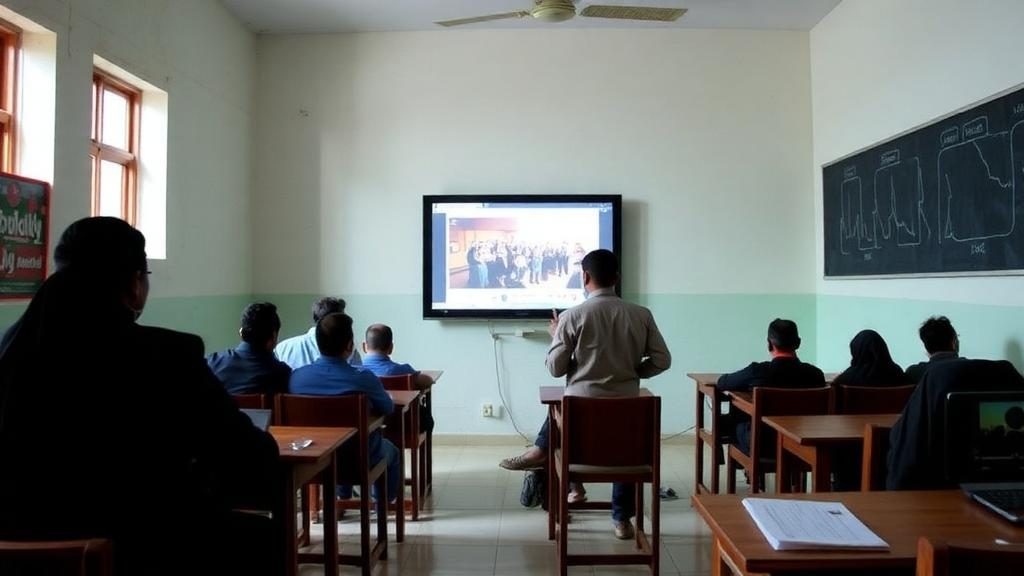
The study, titled ‘Design and Implementation of Personalized Teacher Professional Development: A Case of an NGO-Based School System in Pakistan’, examines a professional development model implemented across 25 NGO-based schools in two regions of the country. Rather than delivering identical training packages to all teachers regardless of their experience, subject area, or classroom context, the programme began by identifying what individual teachers actually needed to learn. On the basis of those identified needs, targeted audio-visual modules were developed, covering areas such as formative assessment, classroom questioning techniques, and differentiated instruction. Teachers then accessed these modules through audio-visual studios established within the schools themselves, a design choice that placed professional learning resources physically close to the point of practice.
The technical architecture of the model is worth examining because it departs from the mobile-first or fully online formats that dominate discussions of digital education. Instead of relying on personal devices and internet streaming, the programme created shared, school-based AV studios where teachers could watch and work with audio-visual learning resources. This design acknowledged the infrastructure realities of resource-constrained settings: connectivity can be intermittent, electricity supply can be unreliable, and not every teacher owns a suitable device. By concentrating the technology in a dedicated school space, the model gave teachers a reliable venue for self-paced learning while also creating a natural site for peer collaboration. Teachers could revisit materials as often as they needed, a flexibility that conventional workshops, by their very nature, cannot offer.
Crucially, the digital resources were never intended to stand alone. The programme combined self-paced engagement with audio-visual content against a backdrop of practice, reflection, peer feedback, and mentoring. School-level facilitators, including school leaders and programme implementation personnel, played an active role in helping teachers connect what they encountered in the modules with their everyday classroom routines. This pairing of asynchronous digital content with synchronous human support reflects a growing consensus in the professional development literature: sustained, practice-embedded learning tends to outperform isolated training events, and the presence of a knowledgeable other can make the difference between passive consumption of content and genuine change in instructional behaviour.
To understand how the model worked in practice, the researchers adopted a case study design, interviewing key school-level stakeholders including programme developers, implementers, school leaders, and teachers. Programme documents were also examined in order to reconstruct the processes of design and implementation and to capture participants’ experiences of the model. This methodological choice matters. Case studies cannot establish causal effects, and the authors are explicit on this point: the study does not claim to demonstrate that the programme improved teaching quality in any measurable, causal sense. What it does provide is rich evidence of how a personalised, technology-supported approach to professional development can actually be designed and implemented under resource constraints, and of the conditions required to keep such professional learning alive over time.
The findings from the interviews paint a encouraging picture of teacher engagement. Teachers reported using more interactive instructional strategies in their classrooms, adjusting their questioning practices, and changing the pacing of their lessons. They described returning independently to the audio-visual materials to revisit concepts, and they spoke of becoming more reflective about their own teaching. These are precisely the kinds of behavioural shifts that professional development programmes aspire to produce but often fail to document. Equally significant was the role attributed to the implementers, who helped teachers interpret the digital content and translate it into classroom-appropriate actions. Without that interpretive layer, the study suggests, the modules risked remaining abstract resources rather than becoming catalysts for changed practice.
The challenges teachers encountered were neither trivial nor surprising. Internet connectivity was inconsistent, electricity supply was unreliable, access to equipment was uneven, and some teachers faced long travel to reach schools equipped with AV studios. These obstacles are endemic to technology-based interventions in developing contexts, and the study does not minimise them. Yet the most important insight to emerge from teachers’ experiences was not about infrastructure at all. It was that the technology became meaningful only when it was combined with dialogic professional learning, that is, with interaction among colleagues and with mentors. The technology itself was not the transformative element. Its integration with professional dialogue, mentoring, and collaborative reflection was what strengthened teachers’ engagement and sustained their learning.
This conclusion carries a caution that extends well beyond Pakistan. Enthusiasm for digital solutions in education frequently outruns the evidence, and funders and policymakers are often tempted to equate the provision of devices and content with the achievement of professional growth. The study pushes back against that equation directly, arguing that technology alone is unlikely to transform teacher professional development. Its potential, the authors contend, is far greater when it is embedded within a human-centred system of professional support. The practical implication is a question of balance: digital resources can extend reach, enable self-pacing, and allow repeated access to content, but they require sustained human support to be interpreted, contextualised, and converted into durable changes in teaching.
The wider relevance of the findings lies in what the study offers to other education systems searching for alternatives to one-off, standardised teacher training. The authors are careful not to suggest that the Pakistani model can simply be transplanted elsewhere. Instead, they argue that its underlying principles are what merit adaptation: identifying teachers’ learning needs before designing provision, providing flexible access to professional learning resources, supporting structured reflection, and maintaining local mentoring relationships. These principles, they suggest, could be adapted to different institutional and resource contexts, whether in other developing education systems or in settings where conventional training has similarly failed to engage teachers meaningfully. The emphasis on principles over procedures is a deliberate methodological stance, recognising that the specific configuration of studios, modules, and facilitators emerged from a particular set of local conditions.
The study closes with a sober assessment of what expansion would require. Education systems in developing contexts, the authors conclude, are fully capable of generating contextually grounded approaches to teacher development rather than importing models designed elsewhere. But successful scaling is not automatic. It demands careful planning, reliable infrastructure, continued mentoring, institutional commitment, and sustained investment in both people and technology. In an era when artificial intelligence platforms and mobile learning apps promise to personalise education at scale, this case study from 25 Pakistani schools offers a grounded counterpoint: personalisation in professional learning is less about the sophistication of the technology than about the quality of the human relationships and institutional structures that surround it. For policymakers, programme designers, and researchers interested in teacher development under resource constraints, the message is clear. Build the studios, yes, but build the mentoring around them, because it is the combination, not the hardware, that changes how teachers teach.
Subject of Research: Personalised, technology-supported teacher professional development in resource-constrained Pakistani schools
Article Title: A study from Pakistan offers contextual insights into Personalized Teacher Professional Development
Article References: A study from Pakistan offers contextual insights into Personalized Teacher Professional Development. (n.d.). Original publication
Image Credits: AI Generated
DOI: Not provided
Keywords: teacher professional development, Pakistan, audio-visual studios, personalised learning, mentoring, ECNU Review of Education, case study, education technology, resource-constrained education, NGO schools, formative assessment, teacher training
Cite Scienmag News
Courtney Benton. (October 13, 2026). Audio-Visual Studios in Pakistani Schools Point to a New Model of Teacher Training. Scienmag. https://scienmag.com/audio-visual-studios-in-pakistani-schools-point-to-a-new-model-of-teacher-training/
Courtney Benton. "Audio-Visual Studios in Pakistani Schools Point to a New Model of Teacher Training." Scienmag, 13 October 2026, https://scienmag.com/audio-visual-studios-in-pakistani-schools-point-to-a-new-model-of-teacher-training/. Accessed 13 October 2026.
Courtney Benton. "Audio-Visual Studios in Pakistani Schools Point to a New Model of Teacher Training." Scienmag. October 13, 2026. https://scienmag.com/audio-visual-studios-in-pakistani-schools-point-to-a-new-model-of-teacher-training/


