


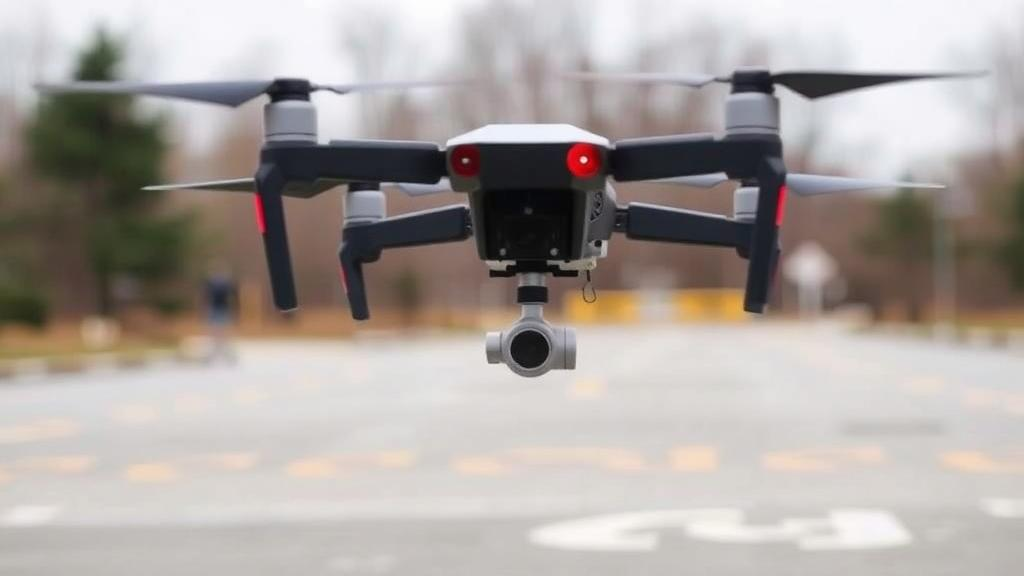
Imagine a drone flying toward a landing marker, camera locked on target, when a pole suddenly appears in its path. The drone swerves to avoid it — and in doing so, the target slides out of the camera’s field of view. The flight controller, blind to its goal, either stalls, wanders, or worse, collides. This deceptively simple failure mode has haunted researchers working on image-based visual servoing (IBVS), a control strategy that steers unmanned aerial vehicles using what the onboard camera sees rather than GPS coordinates. A new study published in the International Journal of Aeronautical and Space Sciences by Carlos A. Toro-Arcila of the Universidad Autónoma de Coahuila in Mexico proposes an elegant mathematical solution that could make vision-guided drones dramatically safer and more adaptable.
The heart of the contribution is what Toro-Arcila calls an analytical safety boundary, denoted mathematically as δ_safe. Rather than relying on a fixed, hand-tuned safety margin around obstacles — the approach taken by most traditional reactive avoidance schemes — the new method computes this boundary on the fly, coupling the physical size of the drone and the obstacle with the optical limits of the onboard camera. The result is a safety distance that automatically adapts when the hardware changes or when environmental conditions shift. Swap in a camera with a different field of view, or encounter an obstacle of a different size, and the framework recalculates its safety envelope without any manual retuning by an engineer.
This adaptability matters because field-of-view constraints are not a minor detail in visual servoing; they are the defining constraint of the entire control problem. In IBVS, the controller drives the vehicle by minimizing the error between the current image of a target and a desired reference image. If the target leaves the image plane, the error signal becomes meaningless and the control loop effectively breaks. The new framework addresses this by deriving its safety boundary directly from the camera’s optical geometry, ensuring that any avoidance maneuver the system executes remains compatible with keeping the target visible. The paper demonstrates this robustness through parametric analyses across three distinct optical configurations — cameras with 45-degree, 69-degree, and 110-degree fields of view — showing that the UAV circumvents obstacles without scenario-specific recalibration in any of them.
Another stubborn problem the study tackles is what the author terms the “Target-as-Obstacle” paradox. In cluttered environments, the very object a drone is trying to approach can be classified by its perception system as an obstacle, creating a logical contradiction: the avoidance layer pushes the vehicle away from the goal the navigation layer is trying to reach. Conventional systems often resolve this conflict with hard-switching mechanisms that abruptly toggle between avoidance and navigation modes, producing flight instabilities or unnecessary lateral deviations that can shake the target out of view. Toro-Arcila’s solution is a localized 3D perception pipeline that resolves the paradox at runtime without requiring a dense global map of the environment, a significant advantage for lightweight drones with limited onboard computing.
The mathematical machinery behind the avoidance maneuver is equally noteworthy. The framework uses a continuously differentiable activation function to project secondary navigation commands into the obstacle’s null-space — a concept borrowed from redundant manipulator control, where motions that would violate a constraint are mathematically filtered out of the command signal. By structurally decoupling the collision avoidance constraint from the navigation objective, the safety layer never fights the navigation controller; instead, it reshapes the command space so that both objectives can coexist. This modularity means the safety layer can be bolted onto existing low-level UAV autopilots and works with both image-based visual servoing and coordinate-based pose control, making it practical for integration into a wide range of existing platforms.
Safety claims in robotics are only as good as the theory backing them, and the study grounds its architecture in formal control-theoretic guarantees. The formulation is supported by Lyapunov stability analysis and positive invariant set analysis, providing theoretical safety bounds for collision avoidance at the kinematic level. In plain terms, Lyapunov analysis demonstrates that the system’s error dynamics converge rather than diverge, while invariant set arguments show that once the drone enters a provably safe region of its state space, it cannot leave it. These are the kinds of guarantees that distinguish an engineering curiosity from a certifiable flight-critical system, and they are notably absent from many heuristic obstacle avoidance methods in the literature.
The paper also addresses a subtle but critical phase of flight: terminal docking, the final moments when a drone approaches its target to land or perch. During this phase, many actuators exhibit deadbands — small regions around the zero command where the motors produce no response — which can cause jittery, imprecise motion precisely when precision matters most. Toro-Arcila introduces an adaptive gain scheduling technique that adjusts the controller’s responsiveness to mitigate these deadband effects, smoothing the terminal approach. It is the kind of unglamorous detail that separates simulation demos from systems that can actually touch down reliably on a physical platform.
To benchmark the approach, the author ran comparative simulations against a classical artificial potential field (APF) baseline, one of the oldest and most widely used reactive avoidance methods. APF schemes steer robots away from obstacles using repulsive forces and toward goals using attractive forces, but they are notorious for requiring careful parameter tuning per scenario and for trapping vehicles in local minima. The comparative results, alongside the parametric sweeps across camera configurations and obstacle dimensions, show that the proposed framework maintains reliable avoidance behavior under optical scaling and coupled spatial trajectories — conditions under which a statically tuned APF would typically need to be re-parameterized or would fail outright. The simulation work was conducted in the CoppeliaSim robotics framework, and supplementary video material accompanies the publication.
The broader context makes the work timely. Drones are being deployed at scale in precision agriculture, search and rescue, forest ecology monitoring, surveillance, and the emerging low-altitude economy, where vehicles must operate autonomously in cluttered, GPS-denied, or visually complex environments. Vision-based control is attractive in these settings because cameras are lightweight, inexpensive, and passive, but the field has long struggled to reconcile the competing demands of target tracking and obstacle avoidance. Related research efforts — from control barrier functions and model predictive control to reinforcement learning-based planners — attack pieces of the problem, but often at the cost of heavy computation, dense mapping requirements, or scenario-specific training. The analytical, lightweight nature of the new approach positions it as a complementary safety layer rather than a replacement for these heavier planning stacks.
There are, of course, limits to what the current study demonstrates. The validation is simulation-based, the source code and simulation framework are not yet publicly available due to ongoing intellectual property protection procedures, and the safety guarantees hold at the kinematic level, meaning dynamic effects such as wind gusts, actuator saturation, and aggressive maneuvers remain outside the formal bounds. The author notes that numerical data are available upon reasonable request, and access to the code may be granted for legitimate academic purposes. Still, the core idea — deriving a provable safety boundary from the interplay of camera optics and physical geometry, and enforcing it through null-space projection rather than brittle mode switching — offers a compelling template for the next generation of vision-guided aerial robots. If the approach survives the transition from simulation to hardware, drones that can chase a target through cluttered spaces without ever losing sight of it may become the norm rather than the exception.
Subject of Research: Reactive obstacle avoidance for image-based visual servoing control of unmanned aerial vehicles
Article Title: Reactive Obstacle Avoidance in UAV Visual Servoing: An Analytical Safety Boundary Approach Under FOV Constraints
Article References: Toro-Arcila, C. A. (2026). Reactive Obstacle Avoidance in UAV Visual Servoing: An Analytical Safety Boundary Approach Under FOV Constraints. International Journal of Aeronautical and Space Sciences. https://doi.org/10.1007/s42405-026-01310-8
Image Credits: AI Generated
DOI: 10.1007/s42405-026-01310-8
Keywords: UAV, visual servoing, obstacle avoidance, IBVS, field of view, null-space projection, Lyapunov stability, drone control, artificial potential field, hierarchical control, autonomous navigation, safety boundary
Cite Scienmag News
Grant Pearson. (October 13, 2026). New Safety Math Helps Drones Dodge Obstacles Without Losing Sight of Their Target. Scienmag. https://scienmag.com/new-safety-math-helps-drones-dodge-obstacles-without-losing-sight-of-their-target/
Grant Pearson. "New Safety Math Helps Drones Dodge Obstacles Without Losing Sight of Their Target." Scienmag, 13 October 2026, https://scienmag.com/new-safety-math-helps-drones-dodge-obstacles-without-losing-sight-of-their-target/. Accessed 13 October 2026.
Grant Pearson. "New Safety Math Helps Drones Dodge Obstacles Without Losing Sight of Their Target." Scienmag. October 13, 2026. https://scienmag.com/new-safety-math-helps-drones-dodge-obstacles-without-losing-sight-of-their-target/


