


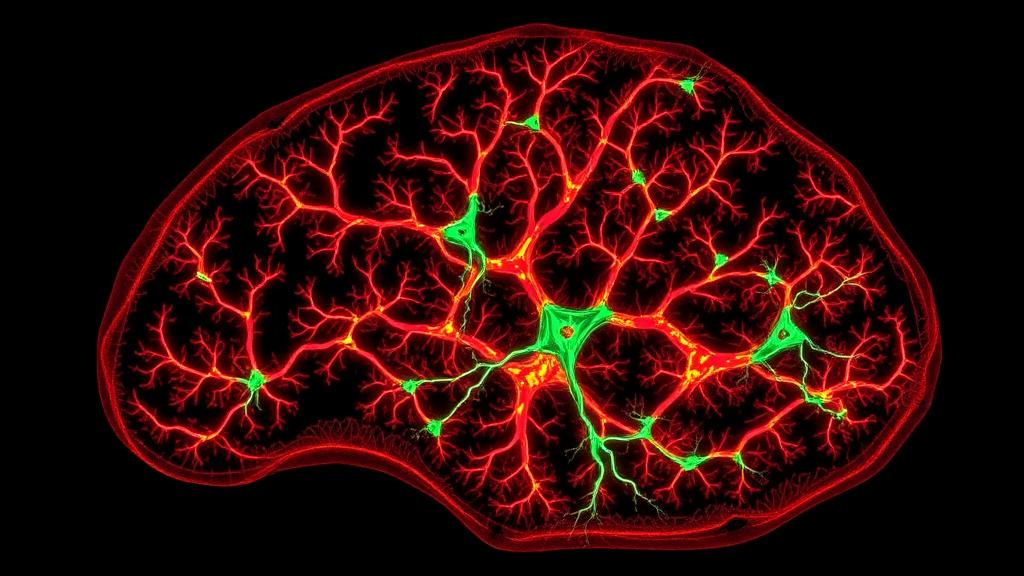
One of the most robust genetic signals in psychiatry points to a single immune gene. Elevated expression of complement component 4A, part of an ancient branch of the immune system best known for tagging pathogens and cellular debris for destruction, is strongly associated with schizophrenia risk. For years, the dominant explanation has centered on synapses: C4 helps prune excessive synaptic connections during development, and too much of it might mean too aggressive a pruning program in the adolescent brain. A new computational and experimental study published in PLOS Computational Biology suggests that this picture is incomplete. When a tiny fraction of neurons in the mouse prefrontal cortex produces extra C4, the effects ripple far beyond those cells, reshaping gene expression, lipid metabolism, and stress responses across the surrounding cortical tissue.
The research team, led by Marta Sánchez-Carbonell and Alberto Cruz-Martín, set out to answer a deceptively simple question: is C4 elevation in a small local population of neurons enough to change the biology of an entire cortical microenvironment? The question matters because genetic studies measure C4 risk across whole populations, yet the gene is not uniformly expressed. If only scattered neurons carry elevated C4 activity, and if those cells act entirely on their own, then the risk signal should remain confined. If instead those cells broadcast their state to their neighbors, the consequences for circuit development could be far more widespread than the synapse-pruning model implies.
To create the sparse elevation, the researchers used in utero electroporation, a technique in which DNA is delivered into neural progenitors in embryonic mice so that a small, spatially defined set of cortical neurons later expresses a transgene. In this case, roughly two percent of prefrontal cortical neurons ended up overexpressing mouse C4, marked by a fluorescent reporter. The rest of the tissue was genetically untouched. The team then microdissected the prefrontal cortex and performed bulk RNA sequencing, a method that captures the combined messenger RNA output of every cell in the sample rather than isolating the manipulated cells.
The result was striking precisely because it should not have been dramatic. Even though the vast majority of sequenced tissue came from untransfected cells, the C4-overexpressing samples showed broad transcriptional remodeling. Coordinated changes appeared in cholesterol biosynthesis programs, in axon- and synapse-associated gene networks, in vascular and extracellular matrix pathways, and in immune- and stress-related responses. A manipulation touching two percent of neurons had left a measurable signature across the whole microdissected region, implying that the altered cells were influencing their neighbors rather than acting in isolation.
To probe how this sparse signal could produce such a broad response, the researchers turned to computational dissection. They compared their differentially expressed genes with a schizophrenia-related synaptic proteomic dataset. The global correspondence was limited, meaning the C4-overexpression signature is not simply a replica of the proteomic changes reported in the disorder. Yet at the level of individual genes and specific molecular pathways, selective overlaps emerged, hinting that some of the programs engaged by focal C4 elevation may intersect with molecular pathways implicated in schizophrenia even if the full picture differs.
The team then projected the directional signatures of their differentially expressed genes onto a cortical single-cell transcriptomic reference, a computational strategy that asks which cell types most plausibly account for a bulk signal. The projections revealed clear cell-type-associated structure. Prominent axes pointed toward astrocytes, the star-shaped glial cells that support neurons and regulate metabolic supply, and toward vascular-associated programs. Distinct correlation domains emerged for lipid and metabolic genes, for vascular and endothelial programs intertwined with interferon-associated signaling, and for immune and stress responses. In other words, the bulk signal was not noise; it carried the fingerprints of specific non-neuronal compartments responding to the manipulation.
Spatial validation strengthened the case. Using multiplex fluorescent in situ hybridization, the researchers examined Hmgcr, the gene encoding HMG-CoA reductase, the rate-limiting enzyme of the cholesterol biosynthesis pathway and the molecular target of statin drugs. Hmgcr expression was increased in GFP-negative cells, meaning the upregulation occurred in the untransfected neighbors of the C4-overexpressing neurons, not merely in the manipulated cells themselves. This is a direct spatial demonstration of a non-cell-autonomous effect: cells that never received the transgene changed their metabolic gene expression because of what their neighbors were doing.
Imaging of lipid droplets added a second, visually compelling layer of evidence. Lipid droplets, intracellular fat stores marked by the protein PLIN2, accumulated in increased numbers in a perinuclear pattern, clustered around the DAPI-stained nuclei, within the local field containing the C4-overexpressing neurons. Lipid droplets are dynamic organelles that buffer cells against lipotoxic stress and supply membrane material, and their accumulation is a classic readout of altered lipid homeostasis. The finding ties the transcriptomic cholesterol-biosynthesis signal to an observable cellular phenotype in the tissue, connecting gene expression data to structure.
Taken together, the study supports a model in which sparse neuronal C4 elevation acts as a focal perturbation with network-wide consequences. The complement signal originating in a small neuronal population appears to engage neighboring cells, particularly astrocytes and vascular-associated compartments, prompting lipid-homeostatic remodeling, stress responses, and shifts in extracellular matrix and immune programs. The authors describe this as a non-cell-autonomous component of C4 biology: the gene’s effects are not confined to the neurons that express it but propagate through the local cortical microenvironment, altering the metabolic and inflammatory context in which circuits develop.
The implications extend beyond complement biology. If a two-percent neuronal perturbation can remodel the transcriptomic and lipid landscape of surrounding tissue, then genetic risk variants need not act solely through the cells in which they are expressed. Focal immune-gene dysregulation could, in principle, recruit glial and vascular responses that change the vulnerability of developing cortical circuits in ways that synapse-pruning measurements alone would miss. The work also highlights the value of combining sparse experimental manipulations with bulk sequencing, single-cell reference projection, and spatial validation, an integrated pipeline that can detect signals that any single method would overlook. As the authors note, these findings expand the interpretation of C4 risk biology and suggest that lipid homeostasis, stress signaling, and cell-type-specific transcriptional programs deserve a central place in future models of how complement genes shape the brain in health and disease.
Subject of Research: Non-cell-autonomous effects of sparse neuronal C4 overexpression on the cortical transcriptomic and lipid microenvironment in mice
Article Title: Sparse neuronal C4 elevation induces network-wide transcriptomic and lipid-droplet remodeling in the cortical microenvironment
Article References: Sánchez-Carbonell, M., Bolshakova, S., Ávila-Pagán, J. E., Sabir, Y. A., Griffin-Derr, C., Stich, D. G., Cieslewicz, S. V., Carmen Sifuentes, S. E., Phadke, R. A., Brack, A., Hasche-Kluender, A., Caley, P., Dias, C., & Cruz-Martín, A. (2026). Sparse neuronal C4 elevation induces network-wide transcriptomic and lipid-droplet remodeling in the cortical microenvironment. PLOS Computational Biology, 22(10), e1014871. https://doi.org/10.1371/journal.pcbi.1014871
Image Credits: AI Generated
DOI: 10.1371/journal.pcbi.1014871
Keywords: C4 complement, schizophrenia, prefrontal cortex, in utero electroporation, RNA sequencing, cholesterol biosynthesis, lipid droplets, astrocytes, non-cell-autonomous, synaptic pruning, single-cell transcriptomics, cortical circuits
Cite Scienmag News
Juliet Wilcox. (October 13, 2026). A Few Neurons Overexpressing C4 Remodel the Whole Cortical Neighborhood. Scienmag. https://scienmag.com/a-few-neurons-overexpressing-c4-remodel-the-whole-cortical-neighborhood/
Juliet Wilcox. "A Few Neurons Overexpressing C4 Remodel the Whole Cortical Neighborhood." Scienmag, 13 October 2026, https://scienmag.com/a-few-neurons-overexpressing-c4-remodel-the-whole-cortical-neighborhood/. Accessed 13 October 2026.
Juliet Wilcox. "A Few Neurons Overexpressing C4 Remodel the Whole Cortical Neighborhood." Scienmag. October 13, 2026. https://scienmag.com/a-few-neurons-overexpressing-c4-remodel-the-whole-cortical-neighborhood/


