


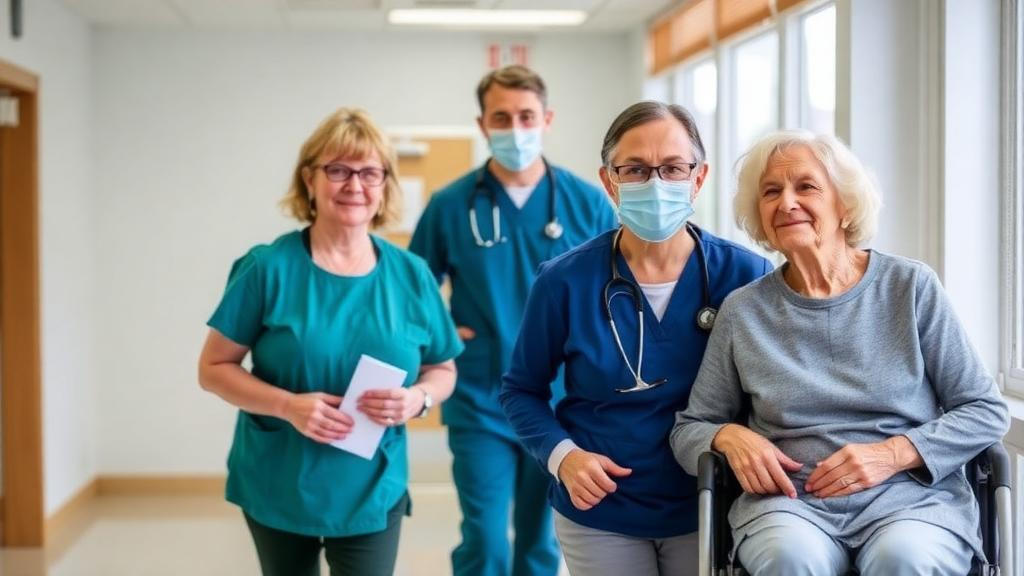
When an elderly nursing home resident becomes acutely ill in the middle of the night, one of the most consequential decisions in their final years is made within minutes: should they be sent to a hospital emergency department, or can they be cared for safely where they live? A new nationwide study from Norway suggests that the answer depends, in part, on something that has received surprisingly little quantitative attention — the experience level of the nursing home staff standing at the bedside. The research, published in BMC Health Services Research, analyzed data from more than 76,000 nursing home residents across 851 facilities and found that residents were less likely to be transferred to emergency care when the staff caring for them had more years of professional experience behind them.
The study, led by Arne Bastian Wiik of the Centre for Care Research West at the Western Norway University of Applied Sciences, together with colleagues in Bergen and at the University of Manitoba in Canada, tackled a long-standing controversy in geriatric care. Transfers from nursing homes to emergency care facilities are frequently questioned by clinicians and ethicists alike, because many residents are terminally ill and nursing homes are staffed with qualified personnel who can, in principle, deliver palliative and acute care on site. Yet emergency transfers remain common, disruptive, and in some cases arguably avoidable. Understanding what drives the decision to send a resident out of the facility has therefore become a central question for health services researchers.
What makes the Norwegian study methodologically distinctive is its scale and its statistical machinery. The researchers assembled a retrospective, register-based longitudinal cohort covering every nursing home resident aged 65 and older who entered long-term care in Norway between 2017 and 2022 — 76,140 people in total. They linked individual-level records from Statistics Norway, the Norwegian Registry for Primary Health Care, the Control and Payment of Health Reimbursements database, and the Norwegian Patient Registry, creating an unusually complete picture of both the residents and the workforce around them. Staff characteristics at 851 nursing homes between 2016 and 2022 were anchored to each resident’s date of admission, allowing the team to track how workplace conditions shaped outcomes over time.
The statistical approach was equally careful. Because many nursing home residents die without ever being transferred, the researchers could not simply measure who experienced a transfer; death competes with transfer as an outcome and, if ignored, would distort the estimates. To handle this, the team employed a semi-Markov irreversible illness-death model, a framework that explicitly accounts for the competing risk of mortality. The analyses were stratified by resident sex, and the models adjusted for resident age, comorbidity, the number of residents in the facility, and the proximity of next of kin — factors that could plausibly influence both clinical decisions and family preferences about where care should be delivered.
The headline finding concerns staff experience. For every additional decade of average time since graduation among a nursing home’s staff, the estimated hazard of a resident’s first acute transfer to an emergency care facility fell by roughly five to six percent. The hazard ratio was 0.95 for male residents and 0.94 for female residents, and both estimates were statistically significant, with confidence intervals excluding the null value of 1.0. In plain terms, in facilities where the workforce had accumulated more years of professional practice, residents were measurably less likely to be sent out for emergency care — a pattern consistent with the idea that experienced clinicians are better equipped to assess, stabilize, and manage acute deterioration on site.
The study also detected a second, more subtle signal involving staff turnover. Female residents faced a higher estimated risk of transfer in facilities with higher yearly staff turnover, with each additional 10 percentage points of annual turnover associated with a hazard ratio of 1.01 — a small but statistically significant effect. The sex-specific nature of this association is intriguing and the authors themselves flag that the mechanisms behind accumulated staff knowledge and acute care decision-making deserve further investigation. Notably, staff sick leave showed no statistically significant association with transfer risk for either sex, suggesting that it is the stability and depth of the workforce, rather than short-term absences, that matters most.
The raw numbers underlying the analysis underscore how consequential this stage of life is. Of the 76,140 residents studied, 46 percent — 34,899 individuals — underwent at least one emergency transfer to an emergency care facility, while 66 percent — 50,548 people — died before the end of follow-up on December 31, 2022. Nearly two-thirds of the cohort died during the observation window, a stark reminder that nursing home populations are among the frailest in any health system and that decisions about emergency transfer are, for many residents, decisions about the circumstances of their final days.
Why would staff experience translate into fewer transfers? The authors point toward accumulated knowledge as the likely mechanism, though the register-based design cannot observe clinical reasoning directly. Experienced nurses and physicians have typically encountered thousands of episodes of acute deterioration in frail elderly patients. They may be more confident distinguishing reversible conditions that warrant hospital care from expected trajectories of decline that are better managed with on-site palliative interventions. They may also communicate more effectively with out-of-hours emergency services, negotiate alternatives to transport, and implement treatment plans — such as subcutaneous fluids, oxygen, or symptom control — that keep residents comfortable in familiar surroundings. Conversely, a workforce with high turnover may lack the institutional memory and resident-specific knowledge that make such on-site management feasible.
The implications extend well beyond Norway. Many countries face aging populations, chronic nursing shortages, and rising rates of potentially burdensome end-of-life hospitalizations. The Norwegian findings give administrators and policymakers a concrete, quantifiable reason to prioritize staff retention: keeping experienced workers in nursing homes is not merely a matter of continuity or job satisfaction, but appears to be associated with measurable differences in how residents experience acute illness. If a decade of additional average staff experience corresponds to a five to six percent reduction in first-transfer risk, then workforce stability becomes a legitimate clinical intervention, one that could be evaluated alongside medical protocols and staffing ratios in quality improvement programs.
The study does have boundaries that readers should keep in mind. It is observational, so the association between staff experience and transfer risk does not prove causation; facilities with more experienced staff may differ in unmeasured ways, from leadership culture to physician coverage. The effect sizes, while statistically robust, are modest on a per-decade basis, and the turnover finding for female residents is small in magnitude. Still, the sheer scale of the cohort, the nationwide coverage, the competing-risk modeling, and the linkage of multiple national registries give the result unusual credibility for this field. The authors conclude that accumulated knowledge among nursing home staff and the outcomes of acute care decisions should be investigated further, and that the study underscores the need for nursing home administrators and policymakers to prioritize staff retention — a prescription that, if followed, could reshape both workforce policy and the end-of-life experience of hundreds of thousands of older adults.
Subject of Research: Association between nursing home staff characteristics and residents' emergency care transfers in Norway
Article Title: Staff characteristics associated with nursing home residents’ initial transfer to emergency care facilities– a nationwide cohort study in Norway
Article References: Wiik, A. B., Førland, O., Doupe, M. B., & Hufthammer, K. O. (2026). Staff characteristics associated with nursing home residents’ initial transfer to emergency care facilities– a nationwide cohort study in Norway. BMC Health Services Research. https://doi.org/10.1186/s12913-026-15748-9
Image Credits: AI Generated
DOI: 10.1186/s12913-026-15748-9
Keywords: nursing homes, emergency care transfers, staff experience, staff turnover, competing risk analysis, cohort study, geriatric care, health services research, Norway, staff retention, palliative care, register-based research
Cite Scienmag News
Ophelia Keating. (October 13, 2026). Experienced Nursing Home Staff Linked to Fewer Emergency Transfers of Residents. Scienmag. https://scienmag.com/experienced-nursing-home-staff-linked-to-fewer-emergency-transfers-of-residents/
Ophelia Keating. "Experienced Nursing Home Staff Linked to Fewer Emergency Transfers of Residents." Scienmag, 13 October 2026, https://scienmag.com/experienced-nursing-home-staff-linked-to-fewer-emergency-transfers-of-residents/. Accessed 13 October 2026.
Ophelia Keating. "Experienced Nursing Home Staff Linked to Fewer Emergency Transfers of Residents." Scienmag. October 13, 2026. https://scienmag.com/experienced-nursing-home-staff-linked-to-fewer-emergency-transfers-of-residents/


