


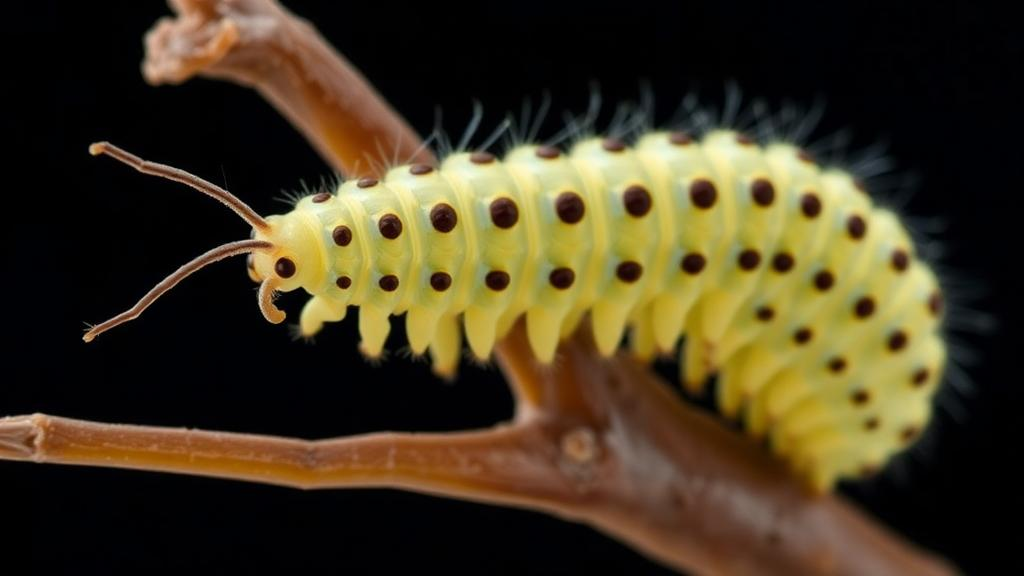
The silkworm, Bombyx mori, is one of the most familiar insects on Earth, yet the genetic machinery that paints its larval skin with characteristic dark markings has remained only partly understood. A new study published in PLOS Genetics now identifies a surprising player in this process: the estrogen-related receptor, a nuclear receptor famous in vertebrates for controlling metabolism without any known natural ligand. The research, led by Jinxin Wu and colleagues, demonstrates that in insects this receptor depends on a conserved structural feature called the AF-2 domain to partner with a coactivator protein, and that this partnership directly governs the melanin chemistry underlying larval epidermal patterns.
Nuclear receptors are transcription factors that sense small molecules and switch genes on or off in response. Estrogen-related receptors, or ERRs, are unusual members of this family. Although they are structurally close relatives of the estrogen receptor, decades of work in vertebrates have failed to identify a natural hormone that binds them. Instead, vertebrate ERRs are considered orphan receptors that rely on their activation function-2 region, a short helical segment at the C-terminal end of the ligand-binding domain, to recruit coactivator proteins and drive transcription. Whether insect ERRs, which operate in metabolic contexts very different from those of vertebrates, also depend on coactivator recruitment through this domain has been an open question.
To address it, the team turned to the silkworm, a premier genetic model among lepidopterans, and used CRISPR/Cas9 gene editing to precisely disrupt the AF-2 domain of the silkworm ERR, known as BmERR. This strategy allowed the researchers to ask a targeted question: if the receptor can no longer engage coactivators through its AF-2 surface, what happens to the animal? The answer was written plainly on the larvae themselves. Mutants in which the AF-2 domain was knocked out lost their normal epidermal markings, the dark patterns that normally decorate the caterpillar’s cuticle.
The molecular explanation traces back to melanin metabolism, the biochemical pathway that converts the amino acid tyrosine into dark pigments. Gene expression analysis showed that disruption of the BmERR AF-2 domain suppressed a suite of melanin pathway genes, including BmTH, which encodes tyrosine hydroxylase, the rate-limiting enzyme of the pathway; BmDDC, which encodes dopa decarboxylase; BmAA-NAT, involved in converting dopamine derivatives toward pigment or cuticular sclerotization products; and Bmebony and Bmtan, both linked to pigment processing. With these genes dialed down, intermediates of the pathway accumulated: the researchers measured a build-up of tyrosine and dopa in the mutants, confirming that flux through the melanin pathway had stalled at specific points.
The consequences of this metabolic bottleneck were visible and specific. Larvae carrying the AF-2 disruption displayed aberrant melanin metabolism and a loss of the epidermal markings that give silkworm strains their distinctive appearance. The finding establishes BmERR as an upstream regulator of pigmentation rather than a structural component of the pigment cells themselves, and it ties the activity of a single nuclear receptor domain to a whole metabolic cascade that shapes an externally visible trait.
The story has a second, equally instructive half. When the researchers overexpressed BmERR, the effect ran in the opposite direction: melanin metabolism genes were enhanced and the epidermal markings intensified. This dose-dependent relationship, loss of function erasing patterns and gain of function deepening them, is strong evidence that BmERR is a genuine regulatory driver of the pathway, not merely a passive participant. It also suggests that natural variation in ERR activity could contribute to the remarkable diversity of larval color patterns seen across moths and butterflies.
Having established that BmERR matters, the team searched for the mechanism, and here the vertebrate parallel re-emerged. The researchers identified BmPPRC1, the silkworm homolog of PRC1, a well-characterized coactivator of vertebrate ERRs, and found that its expression pattern in the epidermis closely matched that of BmERR. Immunofluorescence imaging placed the BmPPRC1 protein in the nucleus, where its signal overlapped extensively with that of BmERR, consistent with the two proteins occupying the same nuclear compartments at the same developmental time and place.
The functional test followed. Biochemical interaction assays showed that BmPPRC1 physically binds to the AF-2 domain of BmERR, the very region that had been deleted in the CRISPR mutants. In silkworm embryonic cells, removing this domain weakened the receptor’s ability to regulate the melanin metabolism genes, reproducing at the cellular level what the gene-edited larvae displayed at the organismal level. Together, these experiments close the loop: the AF-2 domain recruits BmPPRC1, and this coactivator interaction is required for BmERR to activate the pigment pathway genes that generate larval markings.
The evolutionary implications are considerable. Vertebrate ERRs use their AF-2 surfaces to dock coactivators and regulate metabolism, and the new work shows that an insect ERR employs the same structural logic, with a conserved coactivator family member, to regulate metabolism in a developmental context. In other words, the mode of action of this receptor appears deeply conserved across hundreds of millions of years of evolution, even as the biological outputs, from cellular energy balance in mammals to cuticle patterning in a caterpillar, have diversified. The study thereby refines the metabolic regulatory network of insects and provides a molecular bridge between orphan receptor biology in vertebrates and pigment pattern formation in lepidopterans.
Beyond its evolutionary message, the work opens practical avenues. Larval epidermal markings are easy-to-score, visually striking traits, and the authors suggest that the modulability of mottle formation through the BmERR-BmPPRC1 axis offers a new perspective for studying, and potentially manipulating, insect color patterns. Because the same melanin pathway contributes to cuticle hardening and immune-related darkening in insects, understanding how a nuclear receptor and its coactivator tune the pathway’s genes could inform broader questions in entomology, from pest biology to the genetics of commercially important silkworm strains. For now, the study stands as a clear demonstration that a ligand-independent receptor, acting through an ancient coactivator-binding surface, sculpts one of the most visible features of an insect’s body.
Subject of Research: AF-2 domain-dependent interaction between estrogen-related receptor and PPRC1 in regulating larval epidermal melanin markings of the silkworm
Article Title: The AF-2 domain of estrogen-related receptor interacts with PPRC1 to modulate larval epidermal marking in Bombyx mori
Article References: Wu, J., Liu, D., Xu, H., Zeng, L., Lin, P., Zhao, P., & Shen, G. (2026). The AF-2 domain of estrogen-related receptor interacts with PPRC1 to modulate larval epidermal marking in Bombyx mori. PLOS Genetics, 22(10), e1012339. https://doi.org/10.1371/journal.pgen.1012339
Image Credits: AI Generated
DOI: 10.1371/journal.pgen.1012339
Keywords: estrogen-related receptor, Bombyx mori, silkworm, AF-2 domain, PPRC1, melanin metabolism, epidermal markings, CRISPR/Cas9, nuclear receptor, coactivator, insect pigmentation, PLOS Genetics
Cite Scienmag News
Drew Townsend. (October 12, 2026). Silkworm Study Reveals Ancient Receptor Mechanism Behind Insect Skin Patterns. Scienmag. https://scienmag.com/silkworm-study-reveals-ancient-receptor-mechanism-behind-insect-skin-patterns/
Drew Townsend. "Silkworm Study Reveals Ancient Receptor Mechanism Behind Insect Skin Patterns." Scienmag, 12 October 2026, https://scienmag.com/silkworm-study-reveals-ancient-receptor-mechanism-behind-insect-skin-patterns/. Accessed 12 October 2026.
Drew Townsend. "Silkworm Study Reveals Ancient Receptor Mechanism Behind Insect Skin Patterns." Scienmag. October 12, 2026. https://scienmag.com/silkworm-study-reveals-ancient-receptor-mechanism-behind-insect-skin-patterns/


