


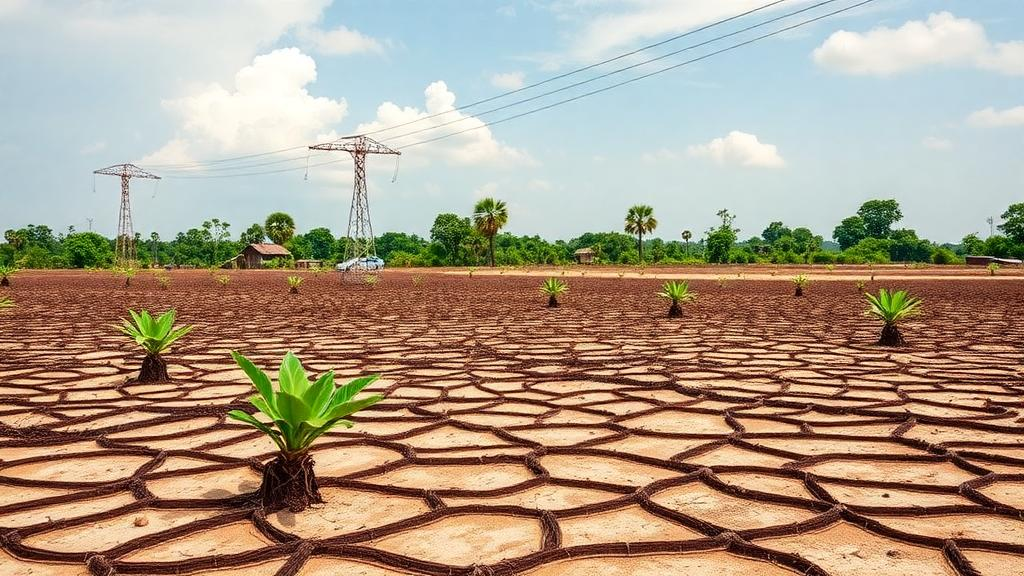
In the semi-arid reaches of northern and north-central Togo, where millions of smallholder farmers depend on rain-fed sorghum, millet and maize, the question of whether the climate is drying is not academic. It determines planting dates, seed choices, and whether a harvest will feed a family through the lean season. A new study published in Theoretical and Applied Climatology has now delivered the most detailed long-term picture yet of hydroclimatic change in this vulnerable corner of West Africa, and its central finding is deceptively subtle: rainfall has not significantly declined, yet the region is drying anyway.
The research, led by Malaguièhèwa Grâce Pekeyi of the Federal University of Technology Minna in Nigeria, together with Appollonia Aimiosino Okhimamhe, Tayo Iyanda Yahaya and Isaiah Sule, analysed 45 years of climate data spanning 1981 to 2025 across three agroecological zones of northern and north-central Togo. The team combined records from three synoptic weather stations with two independent gridded datasets: NASA POWER reanalysis data and the CHIRPS satellite-based precipitation archive. This multi-source approach matters in a region where ground-based weather networks are sparse and patchy, a limitation the authors document explicitly in their appendix on missing station data.
Methodologically, the study is a tour de force of classical climate diagnostics. The researchers applied the Hamed-Rao modified Mann-Kendall test, a non-parametric trend test corrected for autocorrelation, alongside Sen’s slope estimator to quantify the magnitude of change. To detect abrupt shifts in climate records, they deployed three independent change-point tests: the Pettitt test, the Buishand test and the Standard Normal Homogeneity Test. All analyses were run at annual, seasonal and monthly timescales, giving the team a finely resolved view of when and where the climate system has shifted.
The headline result is striking for what it does not show. No statistically significant precipitation trends were detected at any station, at any timescale. In a region often assumed to be sliding steadily into drought, total rainfall has remained remarkably stable over the 45-year window. This finding aligns with a broader pattern across the Sahel and Sudanian zones of West Africa, where the catastrophic rainfall declines of the 1970s and 1980s have partially recovered, even as rainfall variability and extreme events have intensified.
But temperature tells a different story. All stations showed significant warming of between +0.27 and +0.34 degrees Celsius per decade, a rate consistent with regional and global warming trends. In a rain-fed agricultural system, this warming is far from benign. Higher temperatures increase atmospheric evaporative demand, meaning that even unchanged rainfall delivers progressively less effective moisture to soils and crops. It is precisely this mechanism that the study’s drought indices were designed to capture.
The researchers computed three complementary drought metrics: the Standardised Precipitation Index (SPI), which reflects rainfall anomalies alone; the Standardised Precipitation-Evapotranspiration Index (SPEI), which subtracts the moisture demand imposed by temperature; and the Willmott-Feddema Moisture Index, a ratio-based measure of climatic water balance. The comparison proved revealing. While SPI and SPEI tracked each other closely in the decades before 2000, they diverged significantly after that point, with the divergence strongest at Sokodé, the station in the wettest of the three zones. Because SPEI accounts for warming-driven evapotranspiration while SPI does not, this post-2000 split is a statistical fingerprint of temperature stress emerging on top of stable rainfall.
Perhaps the most technically intriguing result concerns what that divergence does and does not mean. The team tested an independent Penman-Monteith formulation of potential evapotranspiration, the physically rigorous standard that accounts for radiation, wind and humidity as well as temperature. Intriguingly, Penman-Monteith PET itself showed no comparable warming-driven increase, yet the SPI-SPEI divergence persisted even under this alternative formulation. The authors interpret this carefully: the divergence reflects a broader shift in the surface energy and moisture balance rather than temperature alone, a conclusion that guards against the common criticism that SPEI simply exaggerates warming effects when computed with temperature-based evapotranspiration estimates.
Change-point analysis added a further layer of nuance. All three tests pointed to a common shift year at exactly 2003, a remarkable coincidence across independent statistical methods. Yet the authors report that this change point was not statistically clear-cut, meaning the evidence for an abrupt regime shift falls short of conventional significance thresholds. The honest reading is that the early 2000s marked a gradual transition rather than a sharp break, with the moisture balance drifting into a new regime over several years rather than snapping at a single moment.
The Willmott-Feddema Moisture Index delivered the study’s most sobering spatial message. All stations recorded predominantly negative MI values across the study period, indicating a persistent climatic moisture deficit: on average, atmospheric demand for water exceeds supply across the entire region. Yet when the team mapped trends across the gridded datasets, they found predominantly positive, wetting trends, with significant drying confined to fewer than 8 percent of grid cells. The region, in other words, is simultaneously water-limited on average and not systematically getting drier in space, a paradox that underscores why single-metric drought assessments so often mislead.
For Togo, the practical implications are immediate. The country’s northern regions have faced acute drinking water shortages, prompting government responses as recently as late 2025, and the study’s authors explicitly frame their work as relevant to early-warning systems and water-resource management. Because the SPI-SPEI divergence shows that rainfall-only drought indices now systematically understate moisture stress, the researchers argue that temperature-sensitive indices should anchor drought monitoring in the region. For the rain-fed cereal systems that dominate northern Togo’s agriculture, where previous work has linked rainfall variability directly to yield outcomes, the message is that the enemy is no longer declining rainfall but rising evaporative demand, a quieter and harder-to-see threat that demands equally vigilant measurement.
Subject of Research: Hydroclimatic variability and drought characterisation in northern and north-central Togo from 1981 to 2025
Article Title: Hydroclimatic variability and drought characterisation in Northern and North-Central Togo, 1981–2025
Article References: Pekeyi, M. G., Okhimamhe, A. A., Yahaya, T. I., & Sule, I. (2026). Hydroclimatic variability and drought characterisation in Northern and North-Central Togo, 1981–2025. Theoretical and Applied Climatology, 157(11), Article 701. https://doi.org/10.1007/s00704-026-06621-0
Image Credits: AI Generated
DOI: 10.1007/s00704-026-06621-0
Keywords: drought, Togo, West Africa, climate change, Standardised Precipitation Index, SPEI, evapotranspiration, rain-fed agriculture, CHIRPS, NASA POWER, trend analysis, water resources
Cite Scienmag News
Alan Morgan. (October 11, 2026). Warming Skies, Silent Drought: New Study Maps Four Decades of Moisture Loss in Togo. Scienmag. https://scienmag.com/warming-skies-silent-drought-new-study-maps-four-decades-of-moisture-loss-in-togo/
Alan Morgan. "Warming Skies, Silent Drought: New Study Maps Four Decades of Moisture Loss in Togo." Scienmag, 11 October 2026, https://scienmag.com/warming-skies-silent-drought-new-study-maps-four-decades-of-moisture-loss-in-togo/. Accessed 11 October 2026.
Alan Morgan. "Warming Skies, Silent Drought: New Study Maps Four Decades of Moisture Loss in Togo." Scienmag. October 11, 2026. https://scienmag.com/warming-skies-silent-drought-new-study-maps-four-decades-of-moisture-loss-in-togo/


