


In the industrial heartland of Shandong Province, the soils beneath one of China’s most heavily industrialized cities are telling a story that scientists have now decoded with unusual precision. A new study of Zibo City, published in the journal Environmental Geochemistry and Health, has mapped where eight toxic metals and metalloids lurk in the city’s soils, traced each one back to its origin, and calculated how much health risk they actually pose to the people living above them. The findings offer a template for how industrial cities worldwide might finally get a clear answer to a deceptively simple question: which pollution sources matter most for human health, and which chemicals should regulators target first?
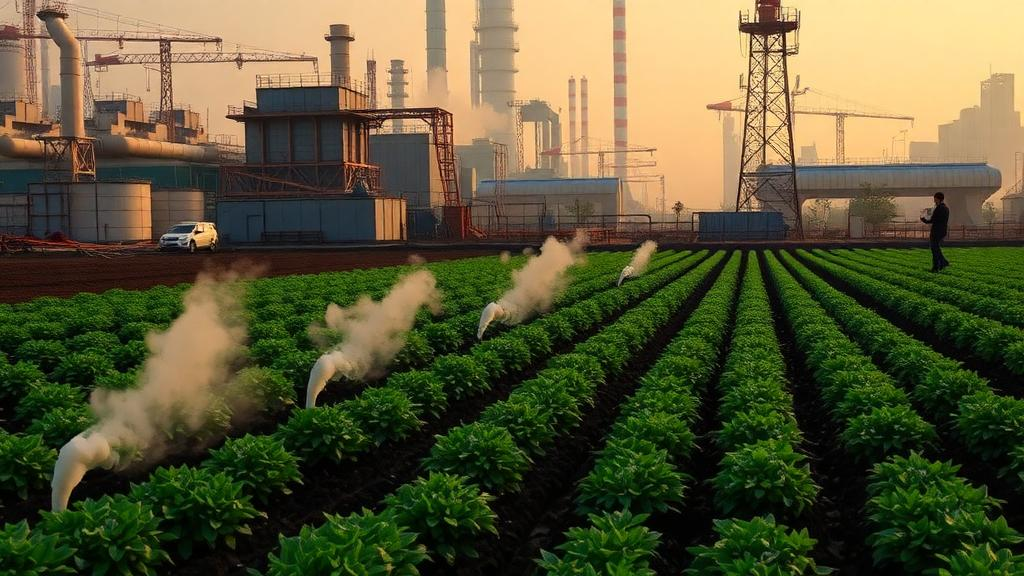
Zibo is, in many ways, a worst-case laboratory for soil contamination. The city has spent decades as a hub of petrochemicals, ceramics, metallurgy and pharmaceutical manufacturing, and its dense network of factories, highways and farmland means that industrial emissions, traffic exhaust and agricultural chemicals all compete to leave their fingerprints on the ground. A team of researchers from the Zibo Center for Disease Control and Prevention and Shandong University of Technology set out to determine whether that legacy has pushed the city’s soils past safe thresholds, and if so, who or what is to blame.
The researchers collected soil samples across the city and measured concentrations of eight potentially toxic elements: chromium, nickel, copper, zinc, arsenic, cadmium, lead and mercury. The overall picture was less alarming than the city’s industrial reputation might suggest, but not reassuring. Only a small fraction of samples exceeded China’s national soil screening thresholds, with 2.33 percent of samples exceeding limits for copper, 1.16 percent for zinc and 0.75 percent for cadmium. Copper, zinc and mercury showed moderate pollution across the study area, and 1.50 percent of sampling sites were classified as heavily polluted. The heavily polluted zones were not scattered randomly; they clustered in the central region of the city, exactly where industrial activity and urban density are greatest.
One of the study’s more striking findings concerned the soil-vegetable system, the pathway by which contaminants in garden and farm soils can move into the food supply. Using the Influence Index of Comprehensive Quality, a metric designed to evaluate contamination across linked soil and crop systems rather than soil alone, the team found that plots in the Zhangdian, Boshan and Zichuan districts were classified as heavily contaminated. That distinction matters because a soil that appears only moderately polluted on its own can still deliver a significant dose of metals to residents when vegetables grown in it accumulate cadmium, lead or arsenic over a growing season. The index approach acknowledges that people do not eat soil; they eat what the soil produces.
With the contamination map in hand, the researchers turned to the harder question of attribution. Distinguishing between metals that arrived through factory smokestacks, vehicle exhaust, fertilizer application or the slow weathering of the underlying bedrock is one of the central challenges of environmental geochemistry, because each source leaves overlapping chemical signatures. The team applied a statistical technique known as absolute principal component scores combined with multiple linear regression, or APCS-MLR, which sifts through the correlations among elements and assigns each one a quantitative contribution from identifiable source categories.
The results drew clean lines through the chemical noise. Zinc, cadmium and lead in Zibo’s soils were mainly associated with industrial emissions and traffic, a signature consistent with combustion processes, metal smelting and the historical use of leaded fuels. Chromium and nickel, by contrast, traced back to natural parent material, meaning these two elements largely reflect the geochemistry of the rocks and sediments from which the soils formed rather than human activity. Arsenic and mercury were linked to agricultural activities and atmospheric deposition, pointing to inputs from pesticides, fertilizers and the settling of airborne particles emitted by regional industry. Copper showed a mixed profile, drawing from multiple sources simultaneously, which makes it one of the trickier elements to manage through any single-source intervention.
Identifying sources is only half the battle; the real question for public health is how much harm those sources actually cause. Traditional health risk assessments treat soil contamination as a single pooled exposure, which can obscure the fact that a source contributing little metal mass might still dominate risk if the metals it delivers are highly toxic. To get around this, the researchers paired their source apportionment with a Monte Carlo simulation, a computational method that runs thousands of randomized exposure scenarios using realistic ranges for variables such as how much soil people inadvertently ingest, how long they live in the area and how their bodies absorb each element. Instead of producing a single risk number based on average assumptions, the simulation produces a probability distribution that captures the uncertainty inherent in human behavior and physiology.
The probabilistic assessment concluded that soil heavy metal(loid)s in Zibo currently pose a tolerable risk to local residents, a result that will reassure some readers but comes with important caveats. Arsenic and nickel emerged as the main contributors to health risk, meaning that even at concentrations within regulatory limits, these two elements account for the largest share of the calculated hazard. The source-oriented analysis then delivered the study’s most actionable insight: agricultural activities and atmospheric deposition, rather than industrial point sources alone, were identified as the priority pollution sources for health risk, and arsenic should be the target element for prioritized soil management. In other words, the pathway that matters most for protecting public health in Zibo may run through farm inputs and airborne particles settling onto soils, not solely through the smokestacks that dominate public perception.
The methodological combination used here, linking APCS-MLR source apportionment to Monte Carlo risk simulation, reflects a broader shift in environmental health science toward source-specific risk assessment. Regulators armed with this kind of analysis can allocate remediation budgets where they will produce the greatest reduction in actual human exposure, rather than where total metal concentrations happen to be highest. For Zibo, the study’s authors suggest their findings provide technical support and a scientific reference for investigating soil heavy metal(loid) pollution and safeguarding public health in industrial cities. For the many other fast-industrializing cities in China and beyond that share Zibo’s profile of dense manufacturing, active agriculture and legacy contamination, the message is that the most dangerous pollution source is not always the most visible one, and that arsenic, a metalloid often overshadowed by cadmium and lead in public discourse, deserves a place at the top of the monitoring agenda.
The research was supported by the National Natural Science Foundation of China and regional health science programs in Shandong and Zibo, and it arrives at a moment when China has been tightening its national soil pollution prevention framework. As cities like Zibo continue to balance industrial output with environmental recovery, studies that can say precisely which sources to control and which elements to watch will increasingly determine whether the ground beneath industrial communities becomes safer for the generations that live on it.
Subject of Research: Source apportionment and health risk assessment of heavy metal(loid) contamination in soils of an industrial Chinese city
Article Title: Source apportionment and source-oriented health risk assessment of heavy metal(loid)s in soils of Zibo City, a typical industrial City in China: insights from APCS-MLR and Monte Carlo simulation
Article References: Chang, T., Peng, C., Wang, T., Zhu, S., He, Y., & Wang, C. (2026). Source apportionment and source-oriented health risk assessment of heavy metal(loid)s in soils of Zibo City, a typical industrial City in China: insights from APCS-MLR and Monte Carlo simulation. Environmental Geochemistry and Health, 48(16), Article 631. https://doi.org/10.1007/s10653-026-03527-8
Image Credits: AI Generated
DOI: 10.1007/s10653-026-03527-8
Keywords: soil contamination, heavy metals, arsenic, source apportionment, APCS-MLR, Monte Carlo simulation, health risk assessment, industrial pollution, Zibo City, China, atmospheric deposition, soil-vegetable system
Cite Scienmag News
Russell Cooper. (October 11, 2026). Industrial Emissions and Farming Drive Soil Metal Pollution in Chinese City, Study Finds. Scienmag. https://scienmag.com/industrial-emissions-and-farming-drive-soil-metal-pollution-in-chinese-city-study-finds/
Russell Cooper. "Industrial Emissions and Farming Drive Soil Metal Pollution in Chinese City, Study Finds." Scienmag, 11 October 2026, https://scienmag.com/industrial-emissions-and-farming-drive-soil-metal-pollution-in-chinese-city-study-finds/. Accessed 11 October 2026.
Russell Cooper. "Industrial Emissions and Farming Drive Soil Metal Pollution in Chinese City, Study Finds." Scienmag. October 11, 2026. https://scienmag.com/industrial-emissions-and-farming-drive-soil-metal-pollution-in-chinese-city-study-finds/


