


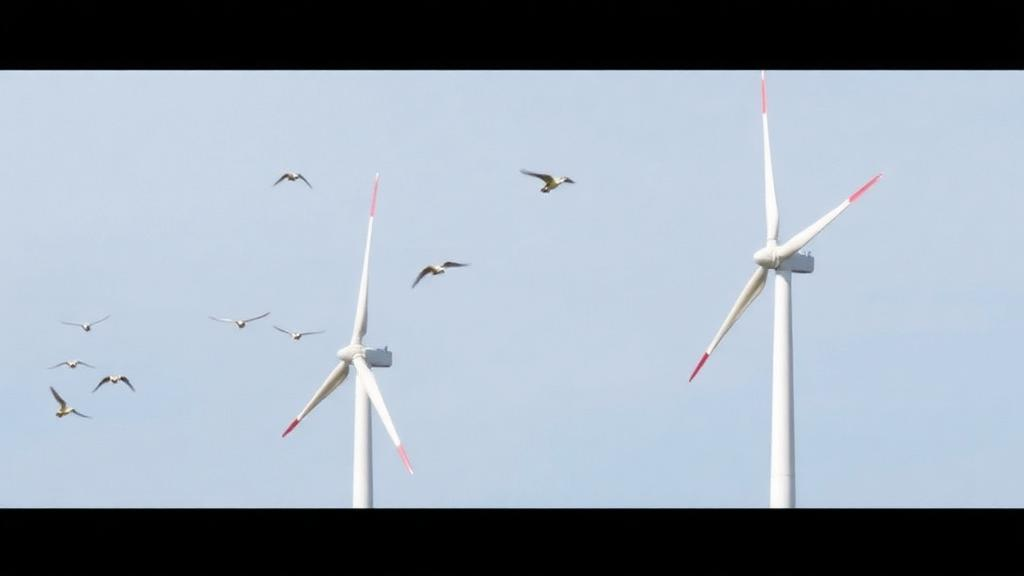
Wind power has become one of the fastest-growing sources of clean electricity in Latin America, and few places illustrate that expansion better than the Isthmus of Tehuantepec in southern Mexico, where powerful winds funnel between the Gulf of Mexico and the Pacific Ocean. But the same turbines that generate renewable energy also kill birds, and a new long-term study offers the most detailed picture yet of exactly which species are dying, where, and why. Drawing on fifteen years of carcass searches at eight wind farms, researchers have shown that the toll falls far more heavily on resident, native, and ground-foraging birds than on the migratory species that have long dominated public concern about wind energy.
The study, published in the journal Environmental Management by Miguel A. San Martín-Cruz, Sergio A. Cabrera-Cruz, and Rafael Villegas-Patraca, compiled records of 1,527 bird carcasses representing 123 species collected during systematic searches beneath turbines across the region. That scale of monitoring is rare anywhere in the tropics, and it allowed the team to move beyond simple fatality counts to examine taxonomic patterns, seasonal and spatial trends, and the ecological traits that make some birds far more likely to collide with turbine blades than others.
One of the most striking findings concerns pigeons and doves. This single family accounted for nearly 40 percent of all fatalities recorded over the study period, and one species in particular stood out: the White-winged Dove, which alone concentrated 17 percent of the carcasses registered. That a common, abundant resident species should dominate the death toll challenges a widespread assumption, both among the public and within parts of the conservation community, that wind farms in migration corridors pose their greatest threat to long-distance migrants such as raptors and songbirds passing through the Isthmus of Tehuantepec on journeys between North and South America.
Indeed, when the researchers classified the victims by residency status, resident species accounted for 78 percent of the fatalities, and more than half of all recorded deaths came from just six species. Resident birds and temporary residents, species that move locally within the region rather than undertaking continental migrations, showed higher fatality rates than migratory species in the analysis. The pattern suggests that birds living year-round around wind farms, flying daily between roosting, feeding, and watering sites, may encounter turbines far more frequently than migrants that pass through the area during limited seasonal windows.
The team also examined the victims through the lens of trophic guilds, grouping species by what they eat and how they forage. Granivores, omnivores, insectivores, and scavengers showed the highest collision rates in the analysis. This ecological signature points toward birds that forage on or near the ground, moving through the open landscapes created around turbine bases, rather than species that spend their lives high in the air or deep in forest canopies. The finding carries practical weight because it implies that the way wind farms reshape local habitat, opening ground-level foraging opportunities amid a matrix of tall moving structures, may itself be part of the collision problem.
To understand the spatial dimension of the mortality, the researchers built environmental models relating fatality counts to the position and characteristics of individual turbines. The results were consistent: bird fatalities increased at turbines located further north within the facilities and at turbines with greater height, while turbines situated closer to the periphery of a wind farm also tended to show higher collision counts. These spatial gradients offer a tangible lever for mitigation, because operators and planners can use them to identify the highest-risk positions within existing and future wind farms and to prioritize monitoring and curtailment efforts accordingly.
The significance of the work extends beyond the Isthmus of Tehuantepec, which is recognized internationally as a critical bottleneck for migrating raptors and other soaring birds and has been the focus of earlier research by the same group on raptor migration and nocturnal bird movements across the region. Latin America’s wind sector is expanding rapidly, yet post-construction fatality monitoring remains far less standardized there than in North America or Europe, and previous reviews have noted how sparse and uneven the region’s data are. A fifteen-year dataset from eight operating wind farms therefore represents an unusually solid foundation for ecological risk assessment in the tropics.
The study also highlights the practical challenges of measuring wildlife mortality at wind facilities. Carcass searches are subject to detection biases: scavengers remove carcasses before searchers find them, some birds fall outside searchable areas, and small or cryptic species are harder to spot than large ones. Earlier work by the research team documented carcass persistence and scavenger removal at a tropical wind farm in the region, underscoring how such biases can distort fatality estimates. The authors are explicit that future research should address these detection biases directly, integrate finer-resolution vegetation data into the models, and evaluate cumulative impacts across additional wind farms to improve ecological risk assessments.
For conservation planning, the implications are twofold. First, mitigation aimed only at protecting migratory species, such as shutting down turbines during peak migration windows, would address only part of the mortality documented in this study, since the majority of victims were residents killed throughout the year. Second, the concentration of fatalities among a small number of species and among turbines with identifiable spatial characteristics means that targeted interventions, from adjusting the placement and height of new turbines to managing ground-level habitat in ways that discourages high-risk foraging near rotor zones, could plausibly reduce collisions without shutting down clean energy generation.
The research arrives at a moment when the tension between renewable energy expansion and biodiversity protection is intensifying worldwide. Scientists have described wind energy as a genuine ecological challenge precisely because its impacts, while small relative to other sources of human-caused bird mortality such as cats, buildings, and power lines, are concentrated in specific places and fall unevenly on specific species. Studies like this one, grounded in long-term field monitoring rather than extrapolation, are what allow regulators, developers, and conservationists to see where the risk actually lies. In southern Mexico, the answer turns out to be the quiet, year-round lives of doves and other resident birds, not the spectacular migrations that once defined the region’s wind energy debate.
Subject of Research: Ecological and spatial drivers of bird collisions with wind turbines in southern Mexico
Article Title: Ecological and Spatial Drivers of Bird Collisions with Wind Turbines in Southern Mexico
Article References: San Martín-Cruz, M. A., Cabrera-Cruz, S. A., & Villegas-Patraca, R. (2026). Ecological and Spatial Drivers of Bird Collisions with Wind Turbines in Southern Mexico. Environmental Management, 76(10), Article 340. https://doi.org/10.1007/s00267-026-02636-5
Image Credits: AI Generated
DOI: 10.1007/s00267-026-02636-5
Keywords: wind energy, bird mortality, wind turbines, Isthmus of Tehuantepec, Mexico, carcass searches, White-winged Dove, resident species, bird migration, trophic guilds, environmental management, conservation
Cite Scienmag News
Faith Mcneil. (October 11, 2026). Fifteen Years of Data Reveal Which Birds Die at Wind Turbines in Southern Mexico. Scienmag. https://scienmag.com/fifteen-years-of-data-reveal-which-birds-die-at-wind-turbines-in-southern-mexico/
Faith Mcneil. "Fifteen Years of Data Reveal Which Birds Die at Wind Turbines in Southern Mexico." Scienmag, 11 October 2026, https://scienmag.com/fifteen-years-of-data-reveal-which-birds-die-at-wind-turbines-in-southern-mexico/. Accessed 11 October 2026.
Faith Mcneil. "Fifteen Years of Data Reveal Which Birds Die at Wind Turbines in Southern Mexico." Scienmag. October 11, 2026. https://scienmag.com/fifteen-years-of-data-reveal-which-birds-die-at-wind-turbines-in-southern-mexico/


