


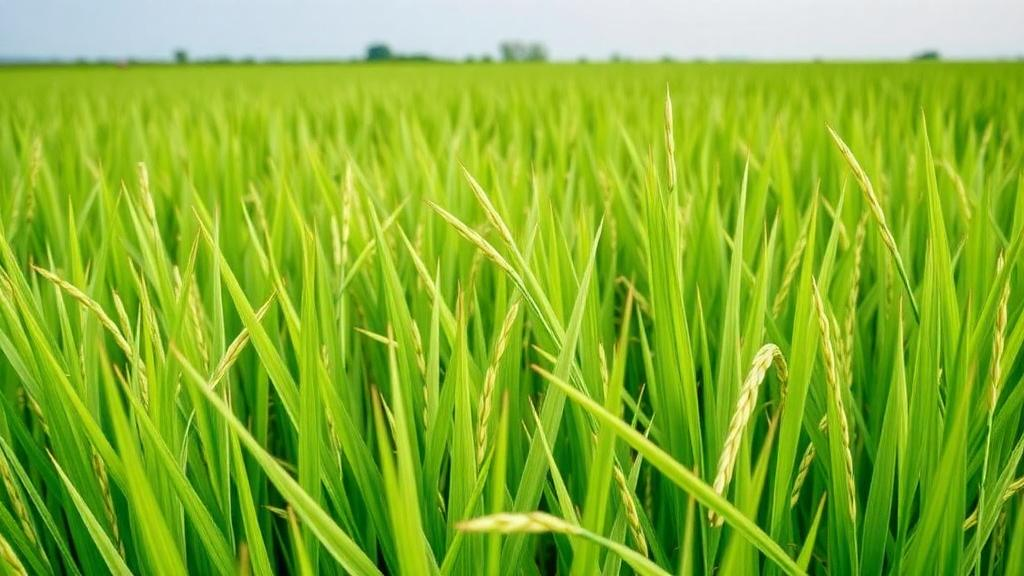
Direct-seeded rice was supposed to make farmers’ lives easier. Instead of the back-breaking, water-hungry ritual of transplanting seedlings into flooded paddies, growers simply drill seed into dry soil, saving labour, water, and precious days at the start of the season. But the method comes with a hidden cost: the rice and the weeds start life together, with no standing water to drown the invaders and no head start for the crop. In a two-year field study conducted at the ICAR-Directorate of Weed Research in Jabalpur, India, researchers have now mapped out precisely how three post-emergence herbicide programmes perform when tank-mixed with foliar nano-fertilizers, and the results offer a nuanced picture of what actually drives yield in this increasingly popular production system.
The stakes are enormous. Rice feeds more than half the world’s population and supplies roughly 27 percent of global energy intake, grown across about 164.2 million hectares with a projected production of 543.6 million tonnes. India alone dedicates around 51.27 million hectares to the crop, producing 150.18 million tonnes annually. Yet in direct-seeded systems, uncontrolled weeds can wipe out the entire harvest. The critical period of weed competition extends up to 41 days after sowing, and maintaining weed-free conditions through 70 days is considered optimal. Left unchecked, mixed infestations of grasses, broad-leaved weeds, and sedges can reduce yields by as much as 100 percent, which is why post-emergence herbicides, applied after the dominant weed flora has emerged, are the backbone of weed management in these fields.
The research team, led by V.K. Choudhary and colleagues, designed an unusually systematic comparison. Three herbicide programmes, bispyribac sodium at 25 grams of active ingredient per hectare, cyhalofop plus penoxsulam at 135 grams, and triafamone plus ethoxysulfuron at 66.5 grams, were each tested alone, with nano urea, with nano DAP, and with the two nano-fertilizers combined, alongside an unweeded control. All sprays went on at 25 days after sowing, when rice was at the four-to-five leaf stage and weeds at three to four leaves, using a knapsack sprayer calibrated to deliver 375 litres per hectare. Nano urea and nano DAP, both produced by IFFCO, were applied at 4 millilitres per litre of water, or 2 millilitres each when combined. The experiment ran through the kharif seasons of 2023 and 2024, receiving 1288.5 and 1340.0 millimetres of rainfall respectively, on a clayey vertisol with low available nitrogen but high phosphorus and potassium.
The weed flora itself told a story. Grasses dominated, with jungle rice (Echinochloa colona) accounting for 22.93 and 25.44 percent of the weed population in the two years, followed by hairy crabgrass and viper grass. Broad-leaved weeds such as sessile joyweed and the sedge Cyperus iria filled out the mix. Against this grass-heavy lineup, cyhalofop plus penoxsulam was the clear winner. The unweeded control plots harboured nearly 180 grassy weeds per square metre in 2023 and about 170 in 2024, with dry biomass exceeding 113 grams per square metre. The best cyhalofop-based treatment slashed that to as few as 3.67 weeds per square metre and barely 1.3 grams of biomass, and two of the cyhalofop treatments eliminated broad-leaved weeds and sedges entirely in both years.
Weed-control efficiency, calculated against the unweeded reference, reached approximately 99 percent for the top cyhalofop treatment in both seasons. But the more intriguing finding concerned the nano-fertilizers. Adding nano urea to cyhalofop plus penoxsulam produced the lowest numerical weed density and biomass of any treatment, yet the effect on weeds themselves was modest and variable. As the authors emphasize, nano-fertilizers are nutrient sources, not herbicides; any benefit to weed competition flows indirectly, through a better-nourished, more competitive crop rather than through direct weed mortality. Triafamone plus ethoxysulfuron, by contrast, struggled against the grass-dominated flora, leaving densities above 96 weeds per square metre even in treated plots.
Crop performance followed the weed suppression. The cyhalofop plus nano urea treatment produced the highest leaf area, at 379.86 and 432.16 square centimetres per plant across the two years, the highest leaf area index at 3.80 and 4.32, and the greatest plant dry matter accumulation at roughly 51 and 58 grams per plant. Its roots were equally impressive: 162 and 184 roots per plant, root lengths above 12 centimetres, and root dry weights of 0.70 and 0.80 grams. At harvest, the same treatment stood tallest at over 105 and 120 centimetres and produced the most effective tillers, 80 and 91 per metre of row. The unweeded control, starved of light, water, and nutrients, recorded the lowest values for every one of these traits.
The yield numbers crystallized the story. Grain yield peaked at 4.75 tonnes per hectare in 2023 and 5.20 tonnes in 2024 under the cyhalofop plus nano urea combination, a numerical increase of 7.2 and 7.7 percent over the herbicide alone. Panicle weight, grains per panicle, and test weight all reached their maxima under the same treatment, with nearly 193 grains per panicle in the second season. Yet here is the critical caveat: the four cyhalofop-based treatments were statistically indistinguishable from one another for grain yield. The herbicide was doing the heavy lifting; nano urea added a numerical bonus that did not reach statistical significance. The researchers are careful to frame this as an additional agronomic advantage rather than evidence of a synergistic herbicide-nano-fertilizer interaction, a distinction that matters enormously for how farmers and agronomists interpret the results.
One of the study’s most counterintuitive findings involves remote sensing. Normalized difference vegetation index readings, taken with a GreenSeeker handheld sensor at 60 days after sowing, were highest in the unweeded control plots, at 0.72 and 0.75, and lowest in the best-performing weed-controlled treatments. The reason is simple but consequential: the sensor measures all green vegetation in its field of view and cannot distinguish rice foliage from weed foliage. Regression analysis confirmed the trap, showing strong negative relationships between NDVI and both leaf area index and effective tiller number, each with a coefficient of determination of 0.91. In heavily weeded fields, a lush green canopy signal may actually spell disaster for the crop, a warning for anyone using satellite or drone-based vegetation indices to assess rice health without accounting for weed cover.
Correlation analysis reinforced the causal chain from weed suppression to yield. Leaf area index, plant biomass, effective tiller number, and yield attributes were positively associated with grain and straw yields, while total weed density and weed biomass were negatively associated with nearly every crop variable. The pattern held across both seasons, suggesting that the yield advantage of the best treatments stemmed from maintaining a larger, more productive rice canopy once competition was removed. The findings align with a growing body of evidence on nano-fertilizers in South Asian rice systems, including recent work showing that well-timed foliar nano urea can maintain yields while improving nitrogen-use efficiency, and parallel results in wheat where nano urea combined with effective herbicide management improved yield attributes.
The practical message is twofold. First, cyhalofop plus penoxsulam at 135 grams per hectare was the most consistently effective option against the grass-dominated weed flora typical of direct-seeded rice in central India, delivering near-complete weed control and the strongest crop recovery. Second, foliar nano urea at 4 millilitres per litre is best understood as a supplementary nutrient-management tool layered on top of effective weed control, not a substitute for it, and not a guaranteed yield booster. The authors caution that the experiment was conducted at a single location with one cultivar, Sahbhagi, under a specific soil-fertility and weed-flora regime, and that validation across contrasting locations, soils, weed communities, and varieties will be needed before the integrated approach can be broadly recommended. For a cropping system that saves water and labour but lives or dies by its weed management, that distinction between herbicide-driven control and fertilizer-driven vigour is exactly the kind of precision agronomy the future of rice farming will demand.
Subject of Research: Integration of foliar nano urea and nano DAP with post-emergence herbicide programmes for weed management and yield in direct-seeded rice
Article Title: Assessment of herbicide-nano-fertilizer compatibility and its impact on weed dynamics and yield performance in direct-seeded rice
Article References: Choudhary, V., Sahu, M., Singh, V., Verma, B., & Mishra, J. (2026). Assessment of herbicide-nano-fertilizer compatibility and its impact on weed dynamics and yield performance in direct-seeded rice. Journal of Agriculture and Food Research, Article 103363. https://doi.org/10.1016/j.jafr.2026.103363
Image Credits: AI Generated
DOI: Not provided
Keywords: direct-seeded rice, nano urea, nano DAP, post-emergence herbicides, cyhalofop, penoxsulam, weed control efficiency, Echinochloa colona, NDVI, grain yield, weed competition, foliar fertilization
Cite Scienmag News
Alan Morgan. (October 11, 2026). Nano Urea Boosts Weed-Killing Herbicide in Direct-Seeded Rice, Two-Year Trial Finds. Scienmag. https://scienmag.com/nano-urea-boosts-weed-killing-herbicide-in-direct-seeded-rice-two-year-trial-finds/
Alan Morgan. "Nano Urea Boosts Weed-Killing Herbicide in Direct-Seeded Rice, Two-Year Trial Finds." Scienmag, 11 October 2026, https://scienmag.com/nano-urea-boosts-weed-killing-herbicide-in-direct-seeded-rice-two-year-trial-finds/. Accessed 11 October 2026.
Alan Morgan. "Nano Urea Boosts Weed-Killing Herbicide in Direct-Seeded Rice, Two-Year Trial Finds." Scienmag. October 11, 2026. https://scienmag.com/nano-urea-boosts-weed-killing-herbicide-in-direct-seeded-rice-two-year-trial-finds/


