


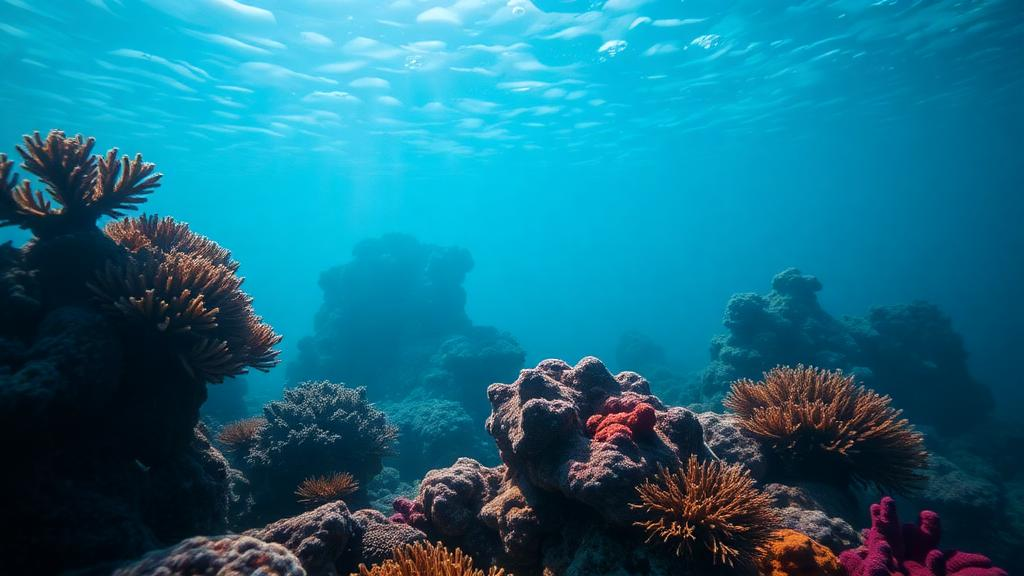
Beneath the surface of the Florida Keys, two populations of the great star coral, Montastraea cavernosa, look so similar that even experienced divers cannot tell them apart. Yet their genomes tell a different story. These are cryptic genetic lineages, MC4 and MC7, two branches of the same nominal species that interbreed so rarely that their genomes have drifted apart while their appearance has stayed essentially identical. MC4 dominates the nearshore shallows, where water runs warm and variable and carries nutrients washing off the land. MC7 clusters on offshore reefs, bathed in the cooler, more stable waters influenced by the Florida Current. For restoration scientists, this hidden diversity poses an awkward question: if two genetically distinct corals occupy different habitats, does each lineage carry a unique biochemical toolkit suited to its home reef, or do both simply respond to whatever environment they find themselves in?
A new study published in the journal Metabolomics set out to answer that question with one of the most direct experimental designs available to ecologists: a reciprocal transplant. Researchers from the University of Texas at Austin, Mote Marine Laboratory, and partner institutions collected fragments of both lineages from two shallow reef sites in the Lower Florida Keys, Carly’s Patch and Haslun’s Heads, split each fragment into genetically identical clones, and swapped half of them between the sites. Over ten weeks in the summer of 2023, the team tracked how each clone grew and how its entire suite of small molecules, its metabolome, shifted in response to its new surroundings. The design allowed a direct comparison of genetically identical coral tissue experiencing two different environments simultaneously.
The genetic groundwork came first. The team collected 160 tissue samples using needleless syringes to isolate single polyps, extracted DNA with a phenol-chloroform protocol, and prepared 2bRAD sequencing libraries run on an Illumina NovaSeq 6000. After quality filtering with CUTADAPT and mapping reads to the M. cavernosa reference genome with bowtie2, the researchers computed genetic distances with ANGSD, filtered out clones and technical replicates, and combined their samples with previously published datasets to reach 392 individuals. From 7,346 single nucleotide polymorphisms, they assigned lineage membership using admixture analysis, excluding any individual with more than 25 percent assignment to a second lineage. That left 60 colonies, 15 of each lineage from each site, for the transplant itself.
Each selected colony contributed roughly ten square centimeters of tissue, which was fragmented, glued to bolts, weighed by buoyant weight, and mounted on PVC rigs covered with plastic mesh to deter fish that nibble on coral. Two HOBO temperature loggers accompanied each rig, recording water temperature every five minutes. The experiment ran from May 23 to July 28, 2023, a window that turned out to be far from ordinary. The Florida Keys experienced an unprecedented marine heat wave that summer, with sea surface temperatures near Key West reaching 31.5 degrees Celsius and a regional mass bleaching event sweeping the reef tract. The transplant thus became an accidental stress test, measuring how both lineages respond to environmental change under some of the hottest conditions the region has recorded.
The temperature loggers revealed a consistent and statistically significant difference between the two sites. Carly’s Patch, the nearshore location, ran warmer than Haslun’s Heads throughout the deployment, by roughly one degree Celsius on average. That modest gap proved biologically meaningful. When the researchers measured growth by comparing final buoyant weights to initial ones, correcting for the fact that larger fragments grow faster, they found that corals transplanted to Haslun’s Heads grew significantly more than their genetically identical clones left at Carly’s Patch. A linear mixed-effects model showed that final site was the only significant predictor of growth, with lineage and origin site falling short of significance and none of the interactions among them mattering. Three of the four lineage-by-site comparisons reached statistical significance individually, and the fourth showed the same directional trend.
The metabolomic analysis told a parallel story with more resolution. The team extracted metabolites from preserved coral tissue and analyzed them by ultra high-performance liquid chromatography coupled to heated electrospray ionization tandem mass spectrometry on a Q Exactive orbitrap instrument. Processing the raw data with MZMine, building feature-based molecular networks on the GNPS platform, and predicting molecular formulas and structures with SIRIUS yielded 9,806 unique metabolite features, of which 2,191 passed abundance filtering for statistical analysis. Permutational multivariate analysis of variance delivered the study’s central surprise: final habitat explained 24 percent of the variation in metabolomic profiles, while lineage explained only 9 percent. Both were highly significant, but the environment the coral currently occupied outweighed its genetic identity by a wide margin.
Volcano plots of differentially abundant features sharpened the picture. Comparing lineages revealed 203 significantly different metabolite features, a genuine biochemical signature of cryptic genetic divergence. But comparing final sites revealed 195 differentially abundant features, and heatmaps showed that corals clustered by the site where they ended up rather than by the lineage they belonged to, a pattern that held when the analysis focused on putative carbohydrates and on amino acids and peptides. Only two features differed between corals that stayed home and those that were switched, suggesting that what mattered was where a fragment lived, not whether it had moved. Principal coordinate analysis confirmed the pattern: one axis separated the lineages, but a second axis, explaining more variance, separated the final sites cleanly.
The authors had predicted the opposite outcome. Because prior work had shown environmental specialization in M. cavernosa lineages and suggested that metabolomic profiles can predict coral genotypes, they expected lineage assignment to dominate the chemical phenotype and native-habitat corals to outperform transplants. Instead, both lineages responded to the new environment in similar ways, growing faster and shifting their metabolomes in parallel when placed in the cooler offshore site. The findings contradict studies of the mustard hill coral, Porites astreoides, which showed strong local acclimatization and reduced fitness after transplantation, and they diverge from an Indo-Pacific transplant study where survival tracked coral morphology rather than site. They do, however, echo a recent Great Barrier Reef study of Acropora millepora in which all corals outplanted to one location outperformed those at another, regardless of origin.
The researchers are careful about interpretation. Metabolomic profiles integrate an organism’s recent physiological and environmental history, but differences in metabolite abundance do not translate directly into differences in health, survival, or fitness, and the functional roles of most metabolites in this species remain unknown. Because the experiment coincided with an acute thermal stress event and the two sites differed in temperature, the site effects should be read as responses to conditions during a heat wave rather than as evidence of stable habitat specialization. The extractions were performed on intact tissue, so the team cannot say whether the observed plasticity comes from the coral host, its algal symbionts, or its microbiome, and they call for microbiome gene-expression work and longer, multi-season transplants to disentangle these contributions.
Even with those caveats, the practical implications for reef restoration are striking. Restoration programs increasingly cultivate diverse coral genotypes in nurseries and outplant them to degraded reefs, and cryptic lineages complicate decisions about which strains belong where. This study suggests that, at least in the short term under thermal stress, the habitat a coral is outplanted to may matter more than its cryptic lineage affiliation. A cooler site produced faster growth and a distinct chemical phenotype in both lineages alike, hinting that sites near the cooling influence of the Florida Current could function as refugia similar to the mangrove habitats recently proposed for Caribbean corals. If future longer-term experiments confirm that lineage-by-habitat interactions remain weak, restoration practitioners could prioritize matching corals to favorable environmental contexts rather than investing heavily in lineage-specific sourcing, a simplification that could make rebuilding devastated reef tracts faster, cheaper, and more effective as ocean temperatures continue to climb.
Subject of Research: Environmental and genetic drivers of metabolomic variation in cryptic lineages of the great star coral Montastraea cavernosa
Article Title: Environmental drivers of metabolomic profiles within and between cryptic lineages of Montastraea cavernosa, the great star coral
Article References: Environmental drivers of metabolomic profiles within and between cryptic lineages of Montastraea cavernosa, the great star coral. (n.d.). https://doi.org/10.1007/s11306-026-02545-y
Image Credits: AI Generated
DOI: 10.1007/s11306-026-02545-y
Keywords: coral reefs, Montastraea cavernosa, cryptic lineages, metabolomics, reciprocal transplant, Florida Keys, marine heat wave, phenotypic plasticity, reef restoration, genotype-environment interaction, mass spectrometry, coral bleaching
Cite Scienmag News
Juliet Wilcox. (October 11, 2026). Habitat, Not Hidden Genes, Drives Coral Chemistry Under Heat Stress. Scienmag. https://scienmag.com/habitat-not-hidden-genes-drives-coral-chemistry-under-heat-stress/
Juliet Wilcox. "Habitat, Not Hidden Genes, Drives Coral Chemistry Under Heat Stress." Scienmag, 11 October 2026, https://scienmag.com/habitat-not-hidden-genes-drives-coral-chemistry-under-heat-stress/. Accessed 11 October 2026.
Juliet Wilcox. "Habitat, Not Hidden Genes, Drives Coral Chemistry Under Heat Stress." Scienmag. October 11, 2026. https://scienmag.com/habitat-not-hidden-genes-drives-coral-chemistry-under-heat-stress/


