


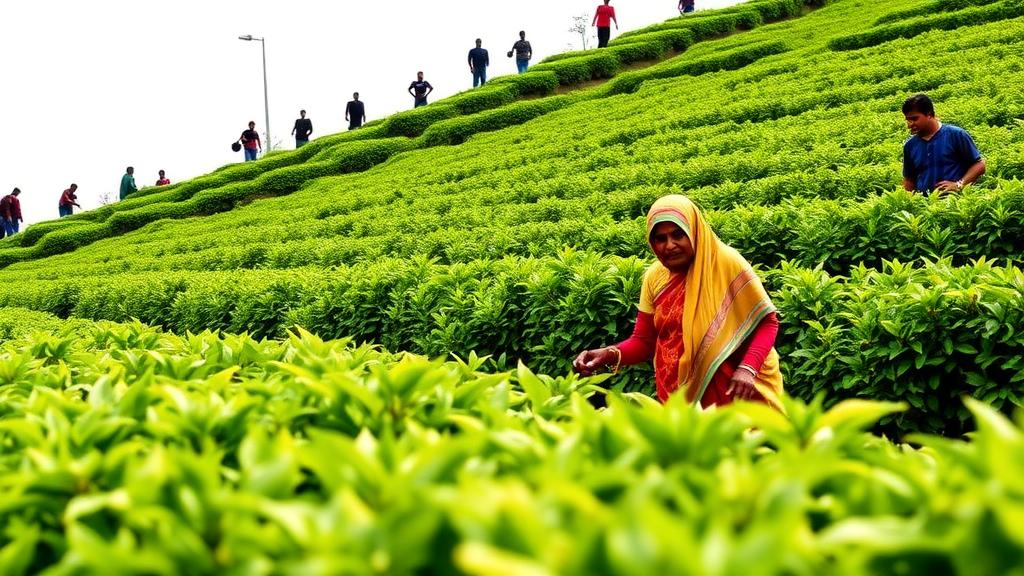
In the rolling tea estates of the Dooars region of West Bengal, the women who pluck the leaves that fill the world’s teacups are, according to new research, being systematically shortchanged of the very benefits that Indian law was designed to guarantee them. A study published in SN Social Sciences by geographers Manami Datta and Gopa Samanta of the University of Burdwan examines how entitlements meant to protect plantation workers are distributed along gendered lines, and it finds that the burdens of missing infrastructure and withheld provisions fall disproportionately on female workers. Drawing on secondary data as of 2014, supplemented by field narratives and direct observation gathered during 2021 and 2022, the research paints a picture of a labour force whose legal protections exist largely on paper.
The historical roots of this situation reach back to the colonial era, when the British established tea plantations across the Dooars, the foothill belt of the eastern Himalayas in the district of Jalpaiguri and beyond. Labourers recruited to work these estates, many brought from distant regions such as Chotanagpur, were exploited in ways the authors describe as beyond description. Wages were meagre, mobility was restricted, and workers were bound to the gardens through systems of debt and dependency. Historical scholarship on recruitment for the Assam tea gardens has documented how consent was often manufactured or coerced, and the Dooars plantations followed closely parallel patterns. The plantation was not merely a workplace but a total environment, controlling where workers lived, what they ate, and how they accessed healthcare and education.
After India gained independence in 1947, the state moved to address these colonial-era hardships through legislation. The Plantations Labour Act of 1951 remains the central legal instrument governing conditions on tea estates, and it contains a range of labour-friendly provisions: requirements for housing, drinking water, medical facilities, crèches for the children of women workers, educational arrangements, and canteens. On paper, the Act transforms the plantation into a site of welfare provision, obliging employers to supply services that the state itself does not directly deliver in these remote enclaves. The new study, however, demonstrates that despite these provisions, many companies prioritise profits over delivering the benefits to workers, leaving the statutory promise unfulfilled across large parts of the Dooars.
The analytical approach of the study combines two strands of evidence. The researchers used available secondary data as of 2014, including a synopsis of surveys of tea gardens conducted by the regional labour offices under the jurisdiction of the Joint Labour Commissioner of the North Bengal Zone, a report that was purchased directly from the Office of the Joint Labour Commissioner in Siliguri for the purposes of the research. This documentary base was then supplemented with selective narratives and observations from fieldwork carried out in 2021 and 2022, during which the authors engaged with workers across tea gardens in the region. The combination allows the study to connect the statistical picture of provision gaps with the lived experience of the people those gaps affect, and the authors note that ethical guidelines were followed throughout, with participants fully informed and anonymity maintained wherever narratives were used.
One of the starkest findings concerns healthcare. The study reports that the lack of facilities, especially among female workers, makes it difficult for them to access medical care. Plantation medical infrastructure in the Dooars is generally thin, with gardens often relying on a single dispensary or a visiting practitioner to serve entire working communities. For women, whose occupational realities include long hours of physically demanding plucking, exposure to pesticides, and the physiological strains of repeated pregnancies alongside chronic undernutrition, the absence of accessible and gender-sensitive healthcare compounds existing vulnerabilities. When the nearest functioning facility is distant, understaffed, or poorly equipped, the cost of seeking care, in time, money, and lost wages, falls most heavily on those with the least capacity to bear it.
Childcare provision emerges as a second critical fault line. The Plantations Labour Act requires estates to maintain crèches so that women can work while their young children are cared for nearby. The study emphasises the particular absence of crèche facilities for temporary female workers, a category that has grown as tea companies have increasingly shifted parts of their workforce onto casual and temporary contracts. Because these workers lack permanent status, they are frequently excluded from the entitlements that attach to permanent employment, even though they perform the same tasks on the same slopes. The consequence is a two-tier labour force in which the most precarious workers, who are disproportionately women, are also the least protected. A mother without access to a crèche must either bring her child to the field, where sun, insects, and hazards pose risks, or leave the child at home in conditions she cannot supervise, and either choice imposes a real cost on both mother and child.
Water and sanitation form a third dimension of the gendered entitlement gap, and here the study connects the Dooars to a broader body of scholarship on gender and water in South Asia. Research on water fetching has shown that women and girls carry the overwhelming share of the labour of hauling water in rural areas of the global South, and scholars have described the emotional and physical suffering embedded in this unequal division. In the tea gardens, where housing colonies were built by colonial managers and have often deteriorated without adequate maintenance, unreliable water supply and poor sanitation translate directly into hours of additional unpaid work for women, alongside health risks. The study situates these everyday hardships within a framework of structural violence, in which the absence of infrastructure is not accidental but reflects deeper patterns of who is deemed entitled to resources and services.
The concept of entitlement is central to the authors’ argument. Following the influential work of scholars such as Bina Agarwal on gender and governance, the study treats entitlement not simply as a legal category but as a social relationship: what a person can actually claim, and whether the institutions around them recognise and honour that claim. On the Dooars tea estates, the legal entitlements of women workers are mediated by management practices, by the gendered organisation of the workforce itself, and by the historical construction of the plantation as a paternalistic domain. Women form the backbone of the plucking labour force, the iconic two-leaves-and-a-bud work that generates the estate’s revenue, yet the study, echoing the authors’ earlier work questioning this very narrative, shows that their access to benefits lags behind their contribution. Trade unions, which historically played a role in securing plantation rights, have also been critiqued in the literature for their male-dominated leadership and for prioritising wage issues over the gendered welfare provisions that most affect women.
The wider context of the Indian tea industry sharpens the significance of these findings. The industry has faced prolonged crises of profitability, with many gardens in West Bengal and Assam experiencing closures, abandonment, and wage arrears. Scholars of plantation labour have documented how the promise of minimum wages remains unfulfilled for tea workers, with the same commitments repeated at each election cycle without delivery. In such an environment, the welfare provisions of the Plantations Labour Act become the first casualties of cost-cutting, and because women’s entitlements, crèches, maternal healthcare, sanitation, are often treated as peripheral to the core wage bargain, they are eroded fastest. The study’s finding of a general shortage of infrastructure and worker provisions, with a relatively higher impact on the lives of female workers, thus reflects an intersection of economic precarity and gender inequality that is structural rather than incidental.
What emerges from the Dooars research is a call to rethink how plantation welfare is monitored and enforced. The authors argue for equal access to services as a matter of principle, insisting that temporary and permanent workers alike should be able to claim the provisions the law establishes, and that the gendered distribution of infrastructure deficits must be made visible in policy. The study, conducted as part of a doctoral research programme at the University of Burdwan under the supervision of its Research Advisory Committee, and published in September 2026, arrives at a moment when the global tea supply chain is under increasing scrutiny for labour conditions. Its central message is deceptively simple: the distance between the letter of the Plantations Labour Act and the daily reality of a woman plucking tea in the Dooars is a measure of how far legal entitlement still is from lived entitlement, and closing that distance requires treating women workers not as an afterthought of plantation welfare but as its centre.
Subject of Research: Gendered access to statutory labour benefits among tea garden workers in the Dooars region of West Bengal, India
Article Title: Gendered entitlement and access to benefits: the tea garden labour force in Dooars, India
Article References: Datta, M., & Samanta, G. (2026). Gendered entitlement and access to benefits: the tea garden labour force in Dooars, India. SN Social Sciences, 6(9), Article 429. https://doi.org/10.1007/s43545-026-01731-y
Image Credits: AI Generated
DOI: 10.1007/s43545-026-01731-y
Keywords: tea gardens, Dooars, West Bengal, Plantations Labour Act 1951, gender inequality, women workers, temporary labour, healthcare access, crèche facilities, water and sanitation, plantation labour, entitlements
Cite Scienmag News
Courtney Benton. (October 10, 2026). Tea Garden Women in India Still Denied Benefits Promised by Law, Study Finds. Scienmag. https://scienmag.com/tea-garden-women-in-india-still-denied-benefits-promised-by-law-study-finds/
Courtney Benton. "Tea Garden Women in India Still Denied Benefits Promised by Law, Study Finds." Scienmag, 10 October 2026, https://scienmag.com/tea-garden-women-in-india-still-denied-benefits-promised-by-law-study-finds/. Accessed 10 October 2026.
Courtney Benton. "Tea Garden Women in India Still Denied Benefits Promised by Law, Study Finds." Scienmag. October 10, 2026. https://scienmag.com/tea-garden-women-in-india-still-denied-benefits-promised-by-law-study-finds/


