


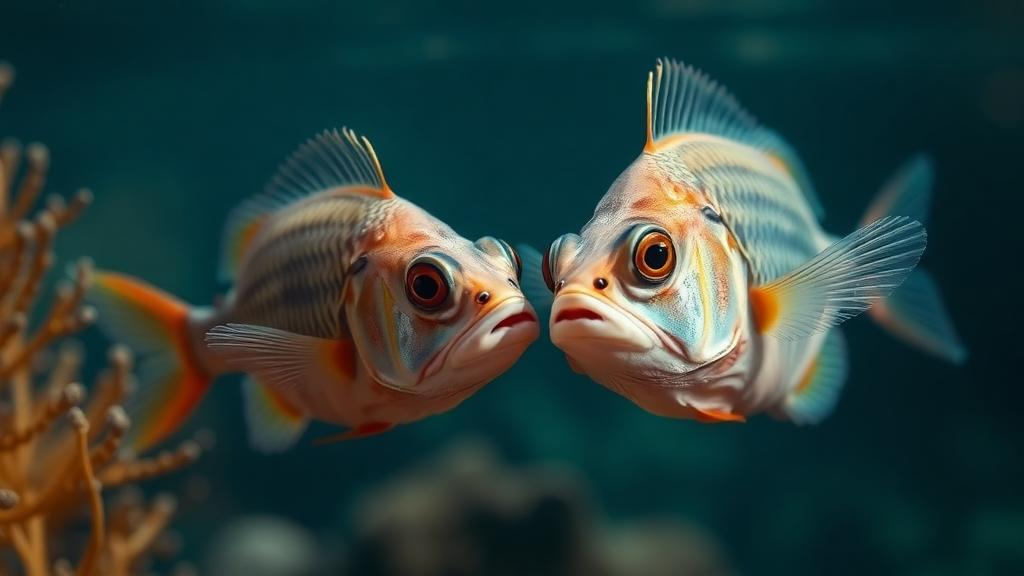
In one of the most vivid demonstrations yet of how social brains operate, researchers at the University of California San Diego have captured the moment a fish’s nervous system registers the escape of a neighbor and converts that observation into its own life-saving reaction. Working with the translucent glassfish Danionella cerebrum, a species so small and transparent that its brain activity can be watched through an optical microscope, the team identified a neural signature of social action detection in an ancient visual midbrain circuit that is also found across fish, birds and primates. The findings, published in Nature, reveal how information about danger travels through a group without every individual having to see the threat itself.
Social behavior is one of the most widespread strategies in the natural world. From enormous bird flocks wheeling across the sky to dense fish schools shimmering in open water, animals of nearly every type benefit from living in groups, coordinating their actions by sharing information among individuals. That sharing becomes a matter of survival the instant a predator attacks, because news of a threat must spread rapidly through the group for members to escape effectively. What has remained mysterious is precisely how this information is passed between individuals at the level of the brain. The new study, led by Jo-Hsien Yu, a recent graduate of UC San Diego’s Biological Sciences PhD Program, in the laboratory of Assistant Professor of Neurobiology Matthew Lovett-Barron, set out to answer that question at cellular resolution.
The species at the heart of the work, Danionella cerebrum, is an extraordinary experimental animal. Its body measures roughly twelve millimeters long, less than the width of a human pinky finger, and it is almost entirely transparent. That transparency allows researchers to non-invasively measure the activity of thousands of neurons across the fish’s brain using optical microscopes, without implants or surgery that would disturb natural behavior. The Lovett-Barron lab had previously shown that glassfish rely on their sense of vision to school and to interact by copying their neighbors’ actions. The new study pushed that line of inquiry further, asking how groups of glassfish respond when danger suddenly appears in the form of a rapidly approaching visual object simulating a predator attack.
The behavioral results were striking. Groups of fish proved more effective at escaping danger than individual fish, and they leveraged vision to rapidly scatter away from one another. Crucially, when a predator approached the group, fish that were farthest from the danger were still able to escape, provided they could see their neighbors closer to the threat fleeing the visible danger. In other words, the alarm propagated through the school as a chain of observed reactions. Each fish in the group sees its neighbors move, and moves in response, an interaction that produces schooling in the first place. As Lovett-Barron explained, the ability to pay attention to each other helps these fish detect danger as well. The same social attention that binds the group together doubles as an early-warning system.
A critical question followed: would fish escape from danger if they only saw their neighbors escape, without ever directly experiencing the threat? To answer it, postdoctoral fellow Geoff Meyerhof turned to video game software, designing schools of virtual Danionella fish whose realistic appearance, posture and movements were convincing enough to attract real fish to swim alongside them on a video screen. This virtual reality setup allowed the researchers to control precisely what the real fish saw. When the virtual fish suddenly executed an escape maneuver, the real fish scattered away from the screen as if a genuine threat were present, even though nothing had approached them directly. The escape response, it turned out, could be triggered entirely by social information.
With behavior established, the team moved to the brain. Using optical microscopy, they recorded the activity of thousands of neurons across the brains of glassfish as the fish viewed the actions of their virtual companions. Visual neurons in the midbrain proved highly responsive to the actions of social partners, and were strongly driven when the fish observed their virtual partners escaping. This midbrain circuit, the researchers report, is an ancient one, present across fish, birds and primates, suggesting that the neural machinery for detecting the actions of others is deeply conserved in vertebrate evolution. The discovery provides a concrete neural mechanism for a phenomenon that has long been observed behaviorally but poorly understood mechanistically.
One result came as a surprise. The escape-responsive neurons also fired when virtual fish suddenly vanished from the screen. A disappearing fish may seem like an unnatural event in the laboratory, but observing it was clearly behaviorally meaningful: glassfish retreated from virtual schools that either escaped or abruptly disappeared. Intriguingly, this reaction only appeared when the virtual fish moved with the glassfish’s natural burst-and-glide swimming pattern. When virtual schools moved with smooth, non-biological motion, the glassfish were indifferent to their actions. The brain, in other words, is not simply reacting to any change on screen; it is tuned to identify social partners by the characteristic movement pattern of its own species, and it is exquisitely sensitive to the sudden disappearance of those partners from their expected positions.
The explanation for this sensitivity likely lies in the fish’s natural habitat. Danionella cerebrum are naturally found in murky waters, where visibility is limited and an individual may not be able to see much farther than its closest social partners. The researchers compare this to human vision in dense fog, where fast-moving objects can seem to vanish from view. In such an environment, a neighbor’s sudden disappearance is a powerful clue that something has happened, possibly something dangerous, even if the danger itself remains invisible. The ability of the glassfish’s brain to detect the disappearance of social partners can therefore serve as an effective strategy for inferring the presence of danger from social information alone. Rather than needing to spot every predator, each fish has become highly attentive to the actions of its nearest neighbors, letting the group collectively sense threats that no single individual could perceive.
For Lovett-Barron, the finding underscores a recurring theme in neuroscience: nervous systems have evolved to function within the constraints of an organism’s natural environment. For these fish, much of their natural visual experience consists of observing one another, and their brains are correspondingly highly sensitive to perceiving the actions of those social partners. He emphasizes that much can be learned by studying the brains and behavior of many different species, both to discover how brains solve the unique challenges of particular environments and to identify foundational properties shared across the animal kingdom. Schooling fish and flocking birds display social behaviors very different from those of humans, yet we share a common feature: our brains evolved to pay attention to each other and to one another’s actions.
The study opens a window onto one of the most fundamental questions in neuroscience and collective behavior: how individual brains combine into group intelligence. By showing that a conserved midbrain circuit detects the actions of social partners and that this detection is sufficient to trigger escape, the UC San Diego team has traced a complete pathway from a neighbor’s movement, through sensory neurons tuned to species-typical motion, to a coordinated survival response. The work also demonstrates the power of transparent model organisms paired with virtual reality, allowing scientists to watch, neuron by neuron, as a brain interprets the behavior of others. As researchers continue to explore how animals from fish to primates perceive and respond to social cues, the humble glassfish offers a clear lesson: in a world where danger is often invisible, watching your companions may be the sharpest sense of all.
Subject of Research: Neural detection of social escape actions in schooling glassfish
Article Title: Social brains allow animal groups to escape danger
Article References: Social brains allow animal groups to escape danger. (n.d.). Original publication
Image Credits: AI Generated
DOI: Not provided
Keywords: glassfish, Danionella cerebrum, schooling behavior, social detection, midbrain, virtual reality, escape behavior, collective behavior, neuroscience, predator avoidance, UC San Diego, Nature
Cite Scienmag News
Cassandra Pierce. (October 10, 2026). Fish Watch Their Neighbors’ Brains at Work to Escape Danger Together. Scienmag. https://scienmag.com/fish-watch-their-neighbors-brains-at-work-to-escape-danger-together/
Cassandra Pierce. "Fish Watch Their Neighbors’ Brains at Work to Escape Danger Together." Scienmag, 10 October 2026, https://scienmag.com/fish-watch-their-neighbors-brains-at-work-to-escape-danger-together/. Accessed 10 October 2026.
Cassandra Pierce. "Fish Watch Their Neighbors’ Brains at Work to Escape Danger Together." Scienmag. October 10, 2026. https://scienmag.com/fish-watch-their-neighbors-brains-at-work-to-escape-danger-together/


