


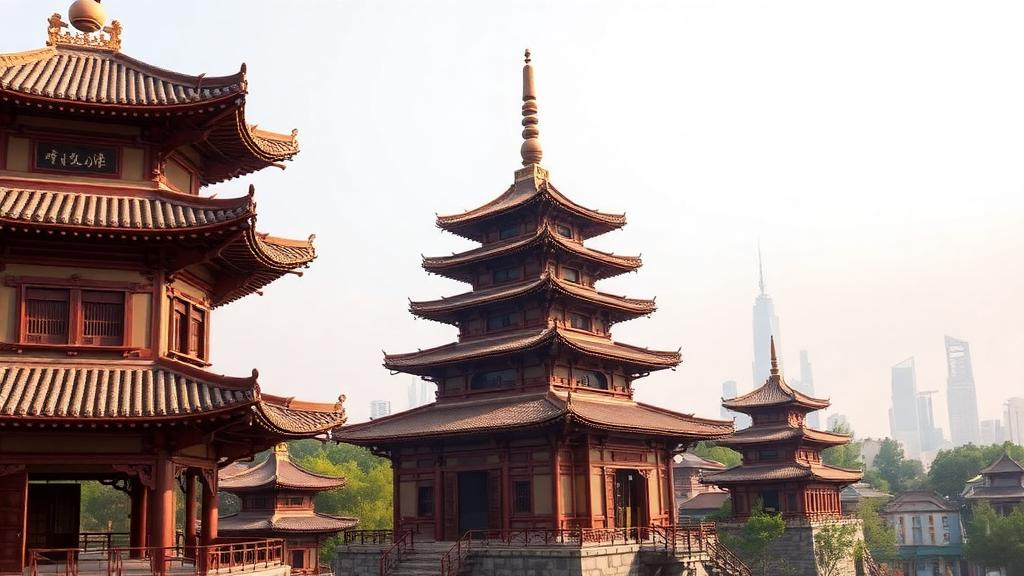
For roughly a thousand years, two dark-brick pagodas in Leshan, in China’s Sichuan Province, have stood through monsoons, earthquakes, and the slow abrasion of time. Conservationists have long blamed weathering on rain, frost, and pollution. A new study published in npj Heritage Science suggests a less visible culprit has been at work all along: living communities of microbes that colonize the brick surfaces and quietly transform nitrogen compounds into acids capable of dissolving the mineral fabric of the monuments themselves.
The research team, led by Shanduo Chen and Ji-Dong Gu of the Guangdong Technion–Israel Institute of Technology together with heritage scientists from the Leshan Institute of Cultural Heritage Protection, examined the Sanjiang and Lingbao pagodas using a combination of structural, chemical, and molecular tools. Both structures date back approximately a millennium and are built from dark-fired bricks characteristic of the region. While microbial biodeterioration of stone monuments such as marble and sandstone buildings has been studied extensively, brick architecture has received far less attention, leaving conservators without a clear picture of what, exactly, is eating these materials.
The first line of evidence came from scanning electron microscopy paired with energy-dispersive X-ray spectroscopy. Under the electron microscope, the ancient bricks revealed highly porous microstructures quite unlike fresh reference bricks collected from local sources. The elemental analysis showed that the aged surfaces were enriched in carbon, calcium, iron, and sulfur relative to the fresh material. Elevated carbon is consistent with dense organic biofilm coverage, while the enrichment of calcium, iron, and sulfur points to chemical alteration of the brick matrix, potentially involving the precipitation of secondary mineral phases and the accumulation of sulfur-bearing compounds over centuries of exposure.
To identify the organisms responsible, the researchers applied high-throughput sequencing to the microbial DNA extracted from the brick surfaces. The results showed diverse communities dominated by cyanobacteria, the photosynthetic bacteria that often pioneer colonization of exposed surfaces, along with actinobacteria and a suite of stress-tolerant taxa capable of surviving desiccation, intense sunlight, and nutrient scarcity. This composition paints a picture of a hardy, self-sustaining ecosystem: cyanobacteria fix carbon and pump energy into the biofilm, while the accompanying bacteria exploit the organic matter and the mineral nutrients released as the brick slowly weathers beneath them.
The most striking discovery emerged when the team analyzed the nitrogen-cycle reactions occurring within these biofilms. Sequencing data identified Nitrospira as a dominant nitrifying lineage, together with trace amounts of Nitrosomonadaceae. These organisms are chemolithoautotrophs that gain energy by oxidizing ammonia, in the form of ammonium or ammonia, first to nitrite and then to nitrate. In other words, the pagoda surfaces host an active nitrification pathway, converting nitrogen deposited by rain, dust, bird droppings, and atmospheric pollution into oxidized nitrogen species right on the brick itself.
Why does that matter for preservation? Nitrification is an acid-generating process. The oxidation of ammonium to nitrite and nitrate releases protons, which can locally acidify the biofilm–brick interface. For silicate and carbonate-bearing ceramic materials, even modest acidification accelerates the dissolution of binding phases and cements within the brick matrix. Over decades and centuries, the authors propose, this microbially driven acid production could contribute to the microstructural weakening and elemental alteration observed under the electron microscope, loosening grains and enlarging the pore network that lets water and further microbes penetrate deeper into the fabric.
Functional predictions based on the sequencing data added a second layer of insight. Samples from the Sanjiang pagoda showed enrichment of genes associated with carbohydrate degradation, fermentation, and redox-associated metabolic pathways, suggesting that its biofilms are dominated by consumers breaking down organic material and shuttling electrons through anaerobic and microaerophilic processes. Samples from the Lingbao pagoda, by contrast, displayed higher levels of biosynthesis pathways, indicating communities investing more energy in building cellular machinery. These site-specific metabolic differences likely reflect variations in moisture, shading, pollution exposure, and brick chemistry between the two structures, and they imply that conservation strategies may need to be tailored site by site rather than applied uniformly.
The study reframes how heritage managers should think about brick monuments. If microbial nitrification-induced acidification is indeed a plausible contributor to deterioration, then simply cleaning visible growths off the surface may not be enough, and could even be counterproductive if it disturbs the brick crust without removing the underlying biological driver. More effective approaches might target the nitrogen source itself, for instance by reducing ammonium deposition from nearby agricultural or traffic emissions, or by developing biocides and protective coatings that suppress nitrifying bacteria specifically while leaving the brick surface intact. Monitoring programs could also incorporate molecular assays for Nitrospira and related taxa as early-warning indicators of active biodeterioration.
There are broader implications beyond Sichuan. Brick is one of the most widespread construction materials in world heritage, from the pagodas and city walls of East Asia to the Roman ruins of Europe and the colonial architecture of the Americas. If nitrogen-cycling biofilms are shown to play a similar role in other climates, microbial acidification could join salt crystallization and freeze–thaw cycling as a standard factor in monument condition assessments. The authors caution that their findings identify nitrification potential rather than measured acid damage, and that linking the metabolic data directly to observed decay rates will require further work, including in situ microsensor measurements of pH and long-term monitoring of brick loss.
Even so, the message from Leshan is clear: the enemies of ancient architecture are not always wind and water. Sometimes they are microscopic chemists, living in slimy films a fraction of a millimeter thick, quietly converting atmospheric nitrogen into acid one reaction at a time. Understanding and managing these invisible communities may prove essential if the region’s thousand-year-old dark-brick pagodas are to survive their next millennium.
Subject of Research: Microbial biodeterioration and nitrogen-cycling biofilms on ancient dark-brick pagodas in Southwest China
Article Title: Microbial biofilm and deterioration of a thousand-years-old dark-brick pagodas with nitrogen-cycling potentials in Southwest China
Article References: Chen, S., Ding, X., Zhang, Y., Hu, P., Qian, Y., Meng, S., Hu, F., & Gu, J.-D. (2026). Microbial biofilm and deterioration of a thousand-years-old dark-brick pagodas with nitrogen-cycling potentials in Southwest China. npj Heritage Science. https://doi.org/10.1038/s40494-026-03035-z
Image Credits: AI Generated
DOI: 10.1038/s40494-026-03035-z
Keywords: microbial biofilm, biodeterioration, nitrification, Nitrospira, cultural heritage, brick pagodas, Leshan, Sichuan, cyanobacteria, acidification, heritage science, nitrogen cycle
Cite Scienmag News
Morgan Morrow. (October 10, 2026). Ancient Chinese Pagodas Are Being Eaten Away by Acid-Producing Microbial Biofilms. Scienmag. https://scienmag.com/ancient-chinese-pagodas-are-being-eaten-away-by-acid-producing-microbial-biofilms/
Morgan Morrow. "Ancient Chinese Pagodas Are Being Eaten Away by Acid-Producing Microbial Biofilms." Scienmag, 10 October 2026, https://scienmag.com/ancient-chinese-pagodas-are-being-eaten-away-by-acid-producing-microbial-biofilms/. Accessed 10 October 2026.
Morgan Morrow. "Ancient Chinese Pagodas Are Being Eaten Away by Acid-Producing Microbial Biofilms." Scienmag. October 10, 2026. https://scienmag.com/ancient-chinese-pagodas-are-being-eaten-away-by-acid-producing-microbial-biofilms/


