


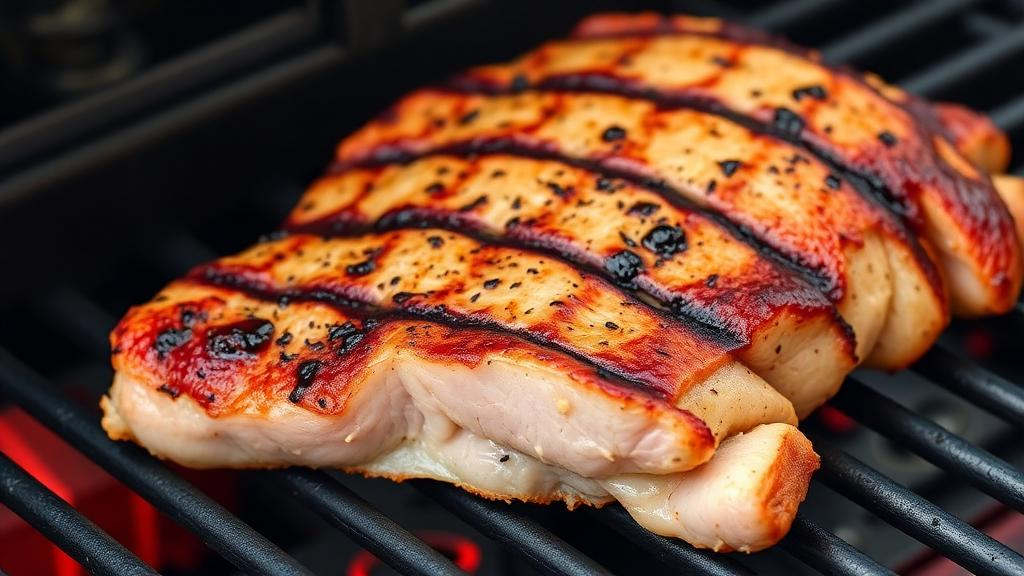
Charcoal grilling delivers the smoky, caramelized flavors that make barbecued pork irresistible, but it also supercharges the formation of advanced glycation end-products, or AGEs, a diverse family of compounds produced when reducing sugars react non-enzymatically with amino groups in proteins under intense heat. Two of the most abundant and chemically stable AGE markers, Nε-carboxymethyl-lysine (CML) and Nε-carboxyethyl-lysine (CEL), accumulate rapidly when meat surfaces are exposed to direct flame contact and the high temperatures of a glowing charcoal bed. Because absorbed dietary AGEs and their signaling through the receptor for AGEs (RAGE) have been linked to chronic oxidative stress and low-grade inflammation, researchers have long sought practical ways to suppress these compounds in food without ruining the eating experience. A new study published in Current Research in Food Science now reports that a simple twist—spraying fruit powder formulations onto pork before grilling—can cut total AGE formation by up to 86 percent, and that how the protective ingredients are applied matters even more than which fruit is used.
The research team, led by Mei-Ling Li and Kuo-Chiang Hsu of China Medical University in Taiwan, chose pork for good reason: pork accounts for 32.8 percent of total meat intake in Taiwan, and charcoal-grilled pork is a staple of both household kitchens and street-food stalls. The investigators freeze-dried eight fresh fruits—guava, strawberry, lemon, kumquat, papaya, tankan orange, passion fruit, and banana—purchased from a local market in Taichung, milling the dried material into powders that could be standardized and dosed precisely. Four powders, guava, strawberry, lemon, and kumquat, were selected for meat experiments after screening showed they consistently outperformed the others in antioxidant capacity relative to their sugar content. The team then grilled pork loin and pork belly over a charcoal bed held at 500 ± 20 °C, monitored by infrared thermometry, until the geometric center of the meat reached 72 °C, the endpoint verified by thermocouple.
A key innovation of the study was treating the application method itself as a controllable processing variable rather than a fixed detail. The researchers compared three approaches: marinating, in which meat is immersed in a fruit powder solution for two hours at 4 °C; spraying, in which a calibrated atomizer delivers a mass-matched amount directly onto the surface; and mixing, in which ground patties are blended with an equivalent dry-matter loading of powder plus salt. Using a two-way analysis of variance to decompose the sources of variation in AGE inhibition, they found that in lean pork loin the application method accounted for a striking 62 percent of the total variance, compared with only 13 percent for fruit type and 17 percent for the interaction between the two. In other words, the way the protective formulation reached the meat mattered far more than the identity of the fruit itself.
The picture changed dramatically in the fattier pork belly, where the method contribution fell to 35 percent and the interaction term rose to 30 percent. Here the team uncovered a paradox that illustrates why sugar chemistry cannot be ignored: marinating pork belly with strawberry powder produced a negative inhibition rate of −142.5 percent, meaning AGE formation was dramatically promoted rather than suppressed. The likely culprit is the prolonged immersion, which allowed the strawberry powder’s high fructose and glucose loads—18.8 and 16.2 grams per 100 grams of dry powder, respectively—to penetrate the fat-rich intramuscular space and overwhelm the protective polyphenols delivered alongside them. Because fructose is eight to ten times more reactive than glucose in Maillard chemistry, sugar-rich fruit ingredients can actively backfire if they are given time and access to diffuse into the meat. Spraying, by contrast, kept inhibition above 60 percent for both kumquat (70.5 percent) and strawberry (60.9 percent) in belly, precisely because it confined the formulation to the surface without extended exposure.
These findings led the researchers to propose a new formulation-screening criterion: the antioxidant-to-reducing-sugar ratio, calculated as total phenolic or flavonoid content divided by the combined glucose and fructose burden. Guava, despite posting the highest ferric reducing antioxidant power (104.88 mg FeSO4 equivalents per gram) and the highest total phenolic content, carried the heaviest sugar load at 55.2 grams per 100 grams, yielding a phenolic-to-sugar ratio of just 0.35. Kumquat, with the highest flavonoid content (29.87 mg quercetin equivalents per gram) and comparatively low glucose, achieved the most favorable ratios. Correlation analysis reinforced the point: the phenolic-to-sugar ratios positively predicted AGE inhibition in belly-marinating conditions (r = 0.61 to 0.73), while FRAP alone actually showed a significant negative correlation with inhibition in loin-spraying conditions (r = −0.69). Conventional antioxidant metrics, the authors conclude, can be actively misleading when applied to fruit powder treatments in meat.
To translate the laboratory findings into something a home cook or food manufacturer could actually use, the team formulated two sprayable barbecue sauces: one containing soy sauce and one soy sauce-free, each fortified with the selected fruit powders, adjusted to pH 4.2–4.4, and hot-filled into 150-milliliter fine-mist spray bottles. The soy sauce choice proved consequential. The soy sauce-containing blank itself elevated total AGEs in pork belly by 58.2 percent over the untreated control, rising from 2.02 to 3.19 micrograms per gram, because the fermentation-derived free amino acids and reducing sugars in soy sauce serve as extra Maillard substrates during grilling. The soy sauce-free base, by contrast, actually reduced total AGEs by 27.4 percent in loin and 14.2 percent in belly on its own, providing a cleaner background against which the fruit polyphenols could work.
The final performance numbers were remarkable. In the soy sauce-free system, strawberry powder achieved the highest inhibition in pork loin, cutting total AGEs from 2.59 to 0.44 micrograms per gram—an 83.1 percent reduction versus the untreated control—with CML falling 98.2 percent, from 1.64 to 0.03 micrograms per gram. Kumquat powder delivered the best results in belly, reducing total AGEs from 2.02 to 0.28 micrograms per gram, an 86.2 percent reduction, with CML down 97.7 percent. The preferential suppression of CML over CEL suggests the sprays more efficiently blocked the oxidative glycation routes that produce CML than the methylglyoxal-associated pathways that feed CEL. Guava, despite its stellar antioxidant credentials, managed only 6.1 percent inhibition in the soy sauce-containing belly formulation, once again demonstrating that a high reducing-sugar load can negate antioxidant benefits even in a spray format.
Crucially, the optimized formulations passed the practical tests that determine whether a laboratory success can become a kitchen reality. Both strawberry and kumquat sprays significantly reduced lipid oxidation, cutting TBARS values by 53.0 and 32.3 percent respectively in loin, with all treated samples far below the 2.0 mg malondialdehyde per kilogram threshold associated with rancidity. A consumer panel of fifty tasters rated both sauces well above the neutral point on a nine-point hedonic scale, with strawberry earning an overall liking score of 6.33 and kumquat 6.14, and lemon was dropped from further development after panelists flagged pronounced bitterness from citrus limonoids. During accelerated storage at 45 °C for 90 days, both sauces retained more than 80 percent of their initial flavonoid content and kept AGE inhibition rates between roughly 51 and 84 percent depending on matrix and powder, while triangle tests found the flavor indistinguishable from the day-zero reference throughout the entire storage period.
To explain why the sprays work, the researchers combined untargeted metabolomics with computational and biochemical probes. Twenty-eight polyphenols identified in the kumquat and strawberry powders were docked against four glycation-susceptible hotspots on porcine myosin, using an AlphaFold-predicted protein structure; 27 of the 28 bound more strongly than glucose, and all 28 outcompeted the reactive carbonyl intermediates methylglyoxal and glyoxal, with top performers including hesperidin, neohesperidin, and procyanidin B2. Methylglyoxal-trapping assays then revealed a clear structure–activity relationship: dihydromyricetin, with three free hydroxyl groups on its B-ring, trapped 85.2 percent of methylglyoxal, while fully methoxylated nobiletin trapped a negligible 2.1 percent despite moderate docking affinity. The authors propose a three-pathway model in which polyphenols competitively occupy glycation sites on myosin, directly trap reactive dicarbonyl intermediates, and suppress lipid oxidation that would otherwise generate secondary reactive carbonyls. While the docking and trapping data do not constitute direct proof inside the grilled-meat matrix, they offer a coherent molecular framework for a deceptively simple message: when it comes to healthier grilling, a fine mist of the right fruit powder, applied at the right moment, may matter as much as what is in the bottle.
Subject of Research: Reducing advanced glycation end-product formation in charcoal-grilled pork using spray-applied fruit powder formulations
Article Title: Fruit powder spray formulations reduce advanced glycation end-product formation in charcoal-grilled pork: effects of application method and polyphenol–sugar balance
Article References: Li, M.-L., Huang, S.-M., Wu, P.-Y., Huang, C.-W., Hung, W.-L., & Hsu, K.-C. (2026). Fruit powder spray formulations reduce advanced glycation end-product formation in charcoal-grilled pork: effects of application method and polyphenol–sugar balance. Current Research in Food Science, 13, Article 101592. https://doi.org/10.1016/j.crfs.2026.101592
Image Credits: AI Generated
DOI: 10.1016/j.crfs.2026.101592
Keywords: advanced glycation end-products, charcoal grilling, fruit powder, polyphenols, Maillard reaction, pork, food chemistry, spray application, CML, CEL, methylglyoxal, barbecue sauce
Cite Scienmag News
Daisy Hatcher. (October 10, 2026). Fruit Powder Sprays Slash Harmful Compounds in Charcoal-Grilled Pork by Up to 86 Percent. Scienmag. https://scienmag.com/fruit-powder-sprays-slash-harmful-compounds-in-charcoal-grilled-pork-by-up-to-86-percent/
Daisy Hatcher. "Fruit Powder Sprays Slash Harmful Compounds in Charcoal-Grilled Pork by Up to 86 Percent." Scienmag, 10 October 2026, https://scienmag.com/fruit-powder-sprays-slash-harmful-compounds-in-charcoal-grilled-pork-by-up-to-86-percent/. Accessed 10 October 2026.
Daisy Hatcher. "Fruit Powder Sprays Slash Harmful Compounds in Charcoal-Grilled Pork by Up to 86 Percent." Scienmag. October 10, 2026. https://scienmag.com/fruit-powder-sprays-slash-harmful-compounds-in-charcoal-grilled-pork-by-up-to-86-percent/


