


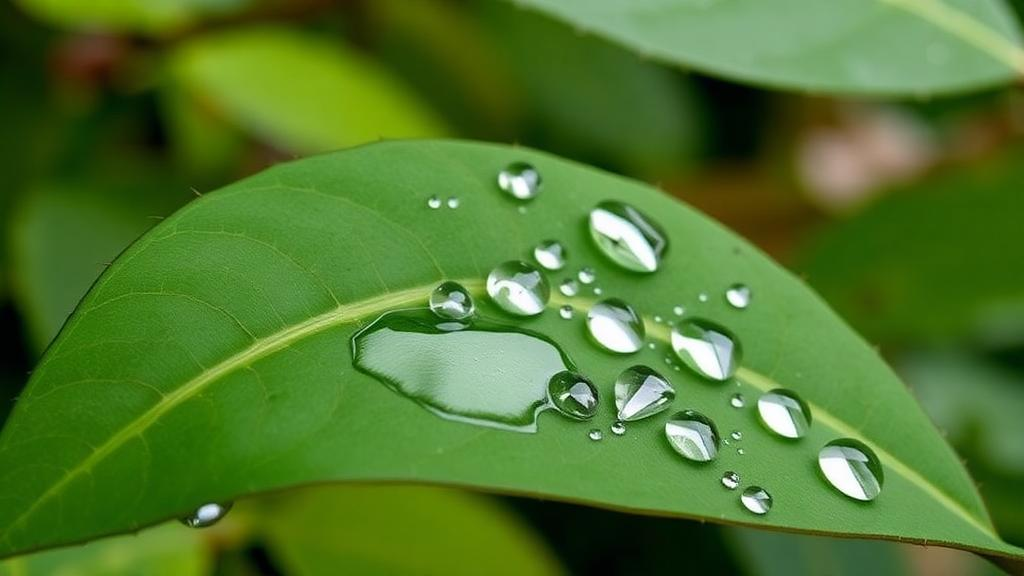
How well a leaf sheds water sounds like the kind of quantity that should have a single, fixed answer. Place a droplet on a leaf surface, measure the angle at which it sits or the tilt at which it slides off, and you have a number. Yet a new study of thirty evergreen plant species in a humid urban environment suggests that the number you get depends heavily on where and when you take the measurement, a finding with wide implications for how ecologists, hydrologists, and urban planners interpret one of the plant world’s most consequential surface properties.
The research, published in BMC Plant Biology by Tian-liang Cheng, Ao-cheng He, and colleagues at Zhejiang Agriculture and Forestry University, examined leaf water repellency, often abbreviated LWR, under both field and laboratory conditions during summer and winter. Leaf water repellency describes the interfacial interactions between plant leaf surfaces and water, governing whether rain forms a film, beads up, or lingers on foliage. It influences processes ranging from canopy rainfall interception to the persistence of pathogens and pollutants on plant surfaces. Despite its ecological importance, the authors note that whether the measurement environment itself affects how LWR is characterized has remained poorly understood.
The team’s experimental design was deliberately straightforward in concept but demanding in execution. They selected thirty evergreen species growing in a humid urban setting and measured two complementary quantities on the upper, or adaxial, surface of leaves: the contact angle and the retention angle. The contact angle, CA, captures the static morphology of a water droplet resting on the leaf, essentially how round or flattened the bead appears at its edge. The retention angle, RA, measures a dynamic property, the tilt a leaf must reach before the droplet begins to slide. Together these metrics describe both how water sits on a leaf and how easily it departs, and the relationship between the two has long been an open question in the literature.
Measurements were taken under field conditions and again in the laboratory, in both summer and winter, allowing the researchers to disentangle the effects of measurement environment and sampling season. Because leaves on the same species can vary, and because species differ systematically, the team used mixed-effects models to analyze the data, a statistical framework that can separate the signal of the factors of interest from the noise introduced by species identity and repeated observations. They evaluated models using standard criteria including the Akaike Information Criterion and the Bayesian Information Criterion, tools that help identify which model structure is best supported by the data without overfitting.
The results were striking and, in places, asymmetric. Measurement environment significantly affected the retention angle: field-measured values were 11.7 degrees higher than laboratory measurements. In other words, when measured outdoors, on leaves in their living context, droplets clung to leaf surfaces more stubbornly than the same leaves’ laboratory readings implied. By contrast, the static contact angle showed no significant difference between the two environments. This divergence matters because it suggests that the dynamic behavior of droplets, the property most directly tied to whether water runs off, is the more fragile, context-dependent of the two metrics, and the one most likely to be mischaracterized when leaves are brought indoors.
Season produced even larger effects. Relative to summer, both metrics fell substantially in winter, with the contact angle decreasing by 14.1 degrees and the retention angle by 21.4 degrees. The direction of the shift indicates that leaves were less water repellent in winter than in summer across the sampled species. For evergreens, which keep their leaves through the cold season, this seasonal softening of repellency could alter how canopies intercept fog, dew, and winter precipitation, and it raises questions about whether summer-based laboratory measurements systematically overstate the repellency these plants exhibit for much of the year.
The study also addressed a theoretical uncertainty that has hindered progress in the field: how droplet static morphology relates to the critical dynamics of water on leaf surfaces. In their observations, the contact angle and retention angle were positively correlated, meaning leaves that held droplets in rounder, more beaded configurations also required steeper tilts before those droplets slid away. Notably, the correlation was stronger in winter than in summer. By integrating their own observations with data from previous studies, the researchers uncovered a broader pattern, a concave-down parabolic relationship between contact angle and retention angle. Such a relationship implies that the simple intuition of a straight-line link between how a droplet looks and how it moves breaks down across the full range of leaf surface properties, with the dynamic metric rising with the static one but bending over at the extremes.
The practical upshot is methodological as much as ecological. If field and laboratory settings yield different retention angles, and if season shifts both metrics by double-digit degrees, then published values of leaf water repellency are not directly comparable unless the sampling season and measurement environment are standardized or at least transparently reported. The authors conclude that the characterization of leaf water repellency depends on both the measurement metric used and the environmental conditions under which it is measured, and they argue that standardized sample preparation and measurement conditions are therefore important for reliable assessment of LWR and for understanding vegetation-mediated water interactions.
Why would the environment leave its fingerprint on the retention angle but not the contact angle? The full mechanistic explanation awaits further work, but the distinction itself is informative. The contact angle reflects fine-scale surface chemistry and texture at the droplet’s edge, properties that travel with the leaf into the laboratory. The retention angle, however, depends on the droplet’s behavior across the entire contact area as it is dragged toward the downhill edge, including the pinning of the droplet on surface irregularities and the weight of water it carries. Environmental history, including exposure to the particulate matter and humidity of an urban atmosphere, could plausibly deposit particles or alter waxes on the leaf surface in ways that affect how droplets pin and slide, and such effects might be partially lost or modified during handling and transport to the lab.
The seasonal contrast likely has its roots in the biology of the leaf surface itself. The waxes and microstructures that make a surface repellent are not static; they are produced, eroded, and reorganized over the life of a leaf. In a humid urban environment, summer growth may coincide with the freshest, most intact wax layers, while winter brings aging surfaces, exposure to cold, and deposition of atmospheric particles such as PM2.5 and PM10, categories of fine particulate pollution that the study’s authors considered in their framing of the work. Whatever the precise mix of causes, the measured declines of 14.1 and 21.4 degrees from summer to winter demonstrate that a leaf’s relationship with water is not a fixed trait but a state that changes with the calendar.
For the broader research community, the study is a caution against treating laboratory convenience as neutrality. Databases of leaf traits feed into models of rainfall interception, urban cooling, and plant water use, and those models inherit whatever biases exist in the underlying measurements. A model calibrated on summer laboratory contact angles may quietly overestimate how well an evergreen canopy repels water in January, and one calibrated on laboratory retention angles may underestimate how tenaciously droplets cling to leaves in their native setting. The remedy the authors propose, standardized sample preparation and measurement conditions, sounds mundane, but the size of the effects they document suggests it is anything but trivial.
There is also a constructive message embedded in the parabolic relationship between contact angle and retention angle. If the two metrics trace a consistent curved relationship when data from many studies are pooled, then measurements of one can, within limits, inform expectations about the other, provided researchers know where on the curve a given species sits. That kind of cross-metric bridge has been sought for years, because retention angle measurements are more demanding than static contact angle measurements, and a reliable mapping would let ecologists extract dynamic information from simpler static data. The confirmation that the correlation strengthens in winter adds nuance, suggesting the reliability of such inferences is itself season-dependent.
The work, conducted by researchers at the College of Forestry and Biotechnology and the Tianmushan Forest Ecosystem Orientation Observation and Research Station of Zhejiang Province, was funded by the National Natural Science Foundation of China and Zhejiang A&F University. Leaf material was collected with permission from the university’s botanical garden, and none of the sampled species are endangered or protected. The study is published open access, making the full methods and data available to anyone seeking to replicate the comparison in other climates, other growth forms, or other seasons.
For now, the headline takeaway is simple and slightly humbling: the same leaf, the same droplet, and the same instrument can tell different stories depending on whether the measurement happens in a laboratory or a field, in July or in January. As scientists work to understand how vegetation mediates the movement of water through cities and forests, the study stands as a reminder that even the humblest measurement carries the fingerprints of the world in which it was made.
Subject of Research: Seasonal and environmental effects on the measurement of leaf water repellency in evergreen plants
Article Title: Do laboratory measurements misrepresent leaf water repellency? Impacts of sampling season and measurement environment
Article References: Cheng, T.-L., He, A.-C., Gao, Y.-X., Li, Y.-N., Wan, Y., & Wang, X.-P. (2026). Do laboratory measurements misrepresent leaf water repellency? Impacts of sampling season and measurement environment. BMC Plant Biology. https://doi.org/10.1186/s12870-026-10101-y
Image Credits: AI Generated
DOI: 10.1186/s12870-026-10101-y
Keywords: leaf water repellency, contact angle, retention angle, droplet behavior, evergreen plants, seasonal variation, field measurements, laboratory measurements, plant physiology, urban environment, leaf surface waxes, water droplet retention
Cite Scienmag News
Alan Morgan. (October 10, 2026). Leaf Water Repellency Readings Shift With Season and Setting, Study Finds. Scienmag. https://scienmag.com/leaf-water-repellency-readings-shift-with-season-and-setting-study-finds/
Alan Morgan. "Leaf Water Repellency Readings Shift With Season and Setting, Study Finds." Scienmag, 10 October 2026, https://scienmag.com/leaf-water-repellency-readings-shift-with-season-and-setting-study-finds/. Accessed 10 October 2026.
Alan Morgan. "Leaf Water Repellency Readings Shift With Season and Setting, Study Finds." Scienmag. October 10, 2026. https://scienmag.com/leaf-water-repellency-readings-shift-with-season-and-setting-study-finds/


